
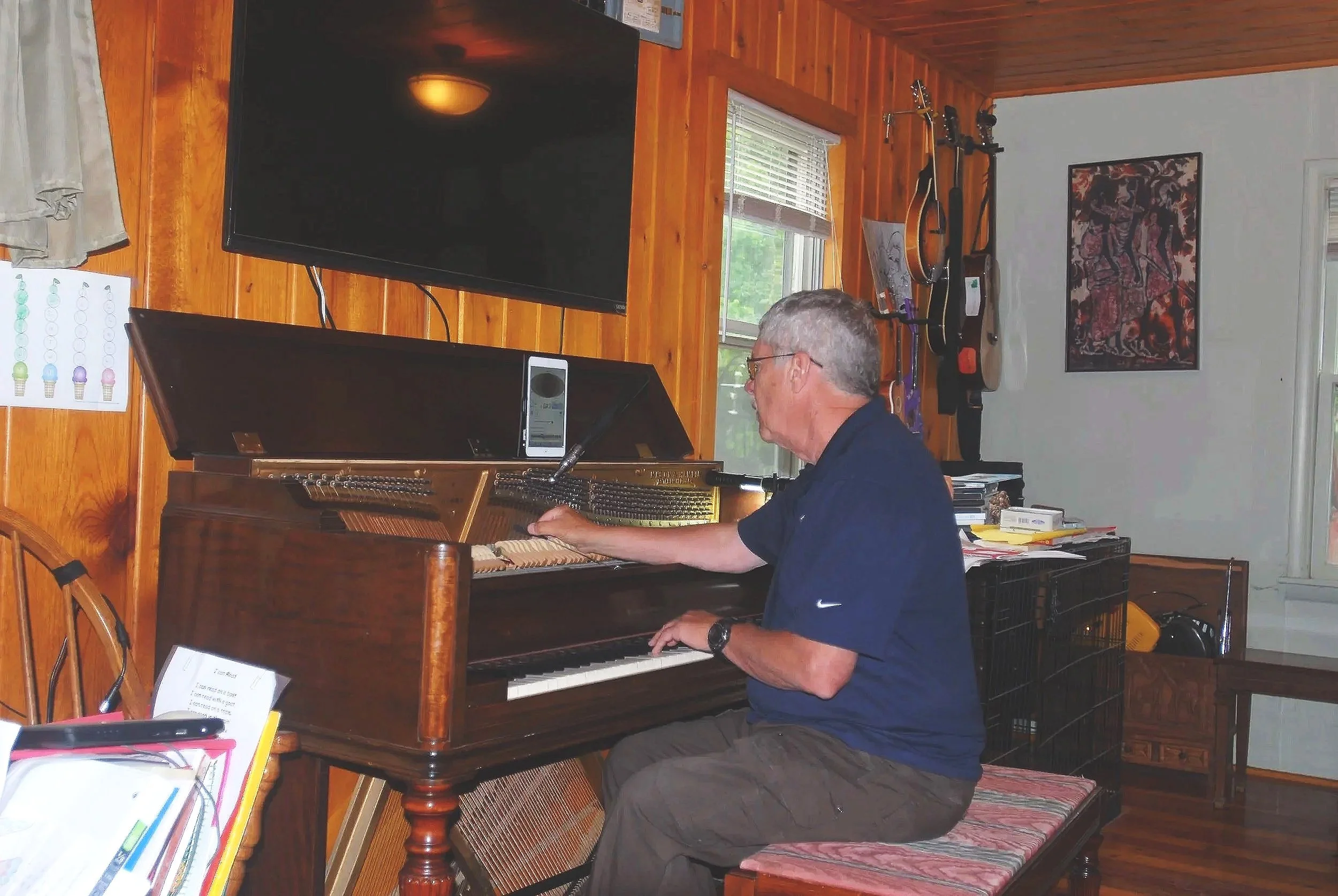
The Mason Hamlin
My father bought the Mason Hamlin in 1951. Made of solid mahogany stained a deep burgundy and mated to a matching bench, the serial number stamped on the steel frame behind the face cover revealed it had been built in 1949. Andrew Senior was an Air Force pilot and, following World War II, how he afforded the expensive upright on a captain’s salary is a mystery. Perhaps when his fingers first touched the ivory keys at E.E. Forbes Piano in Montgomery, Alabama he remembered sitting next to his mother while she played and sang. Perhaps as he played George Gershwin, Cole Porter, or Richard Rogers on the Mason Hamlin the emotions welled up and he had no choice but to withdraw the sale price from his savings.
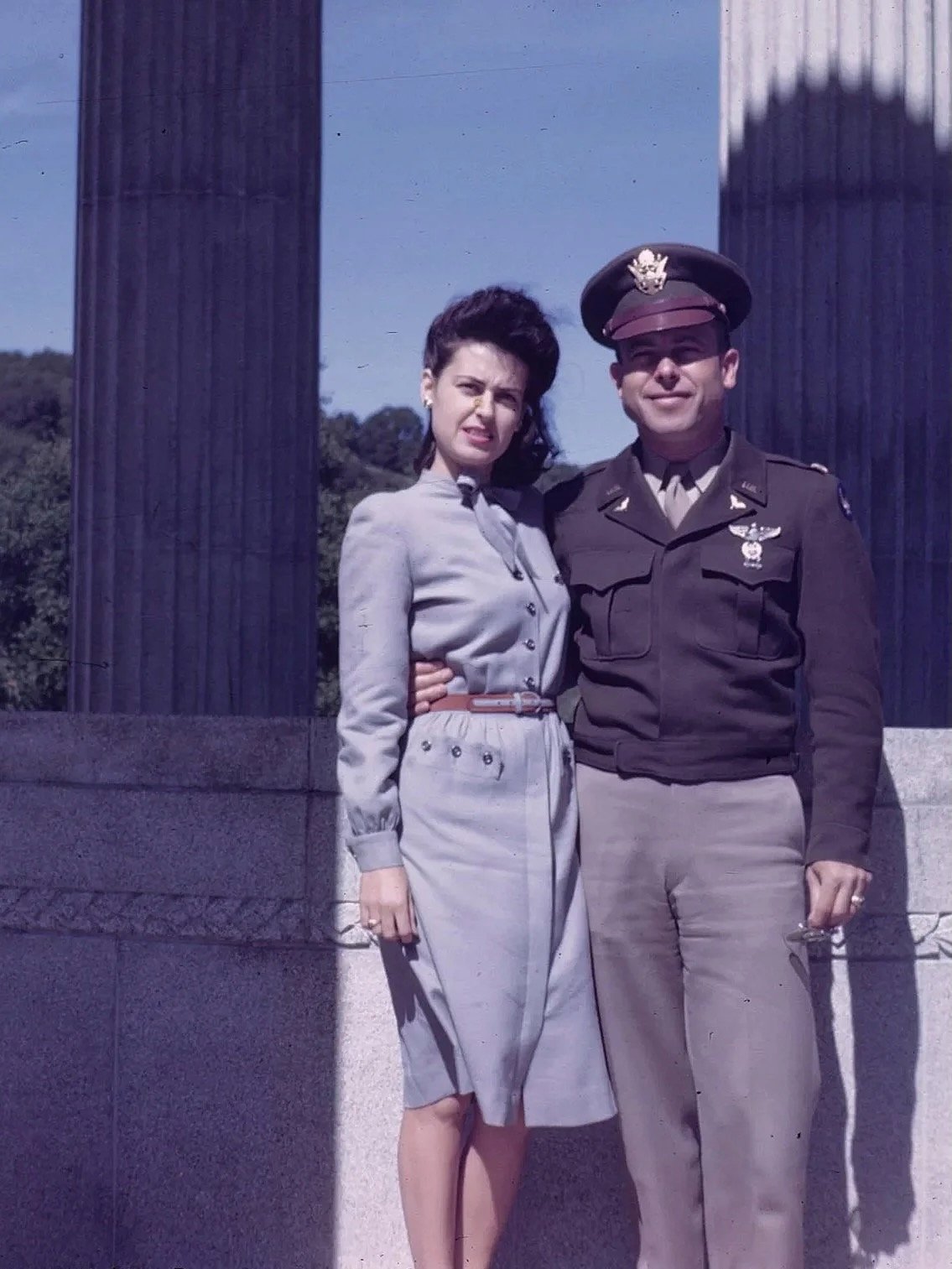
My mother, Mary Catherine Scott was a black haired, green-eyed beauty who once dated Jimmy Stewart. She graduated from Sunnyvale High in 1938, attended Heald Business College in San Francisco, then found work as a secretary for an Air Force Colonel at Moffett Naval Air Station. In 1941 my father was a flight instructor in the Army Air Corps assigned to Moffett. He met Mary Catherine in the Colonel’s office and asked her out to dinner. She replied that she had plans. From that moment he pursued her with such passion that she agreed to marry him a month after the attack on Pearl Harbor.
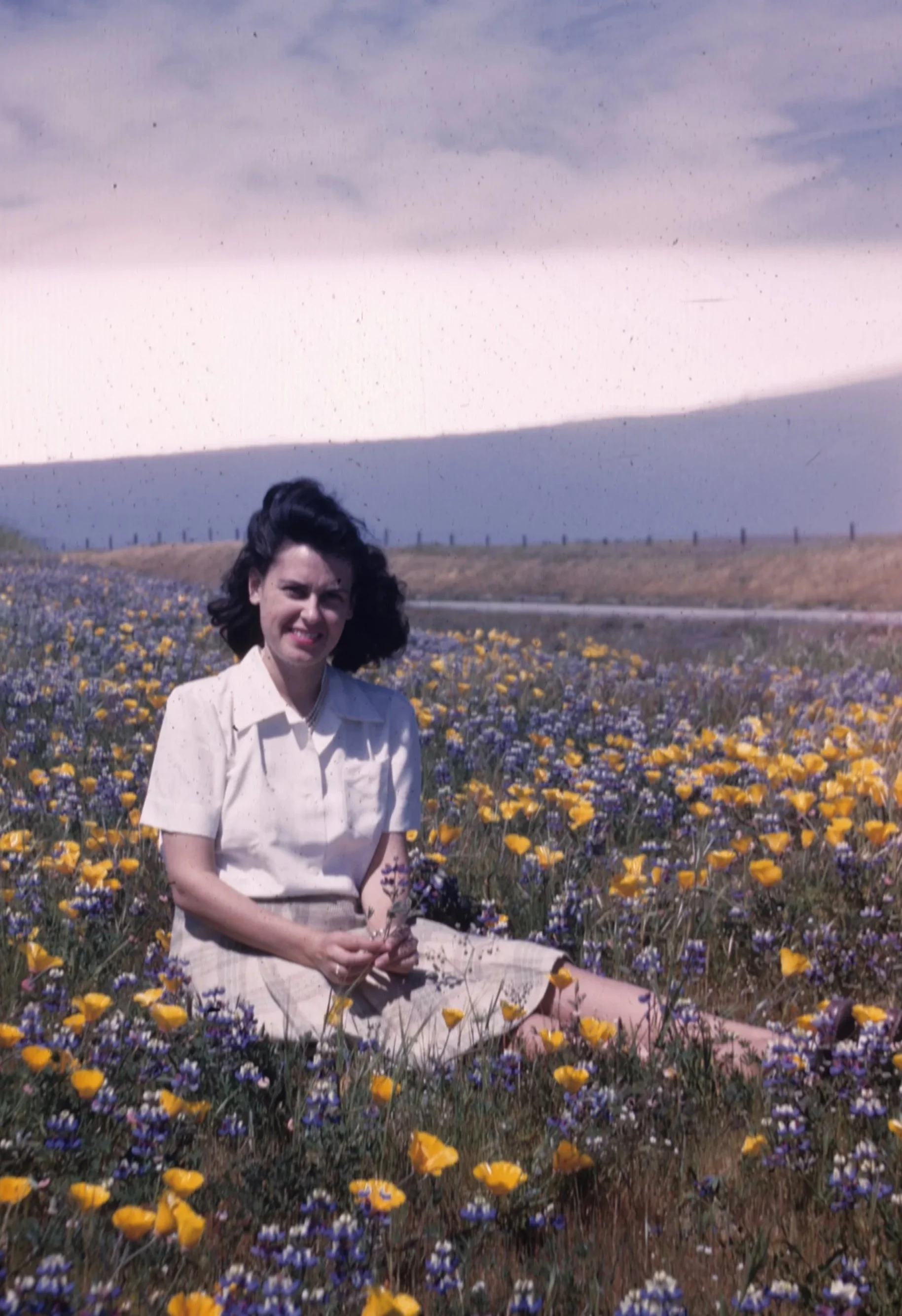
My older sister was born ten months after they married. The second of five, I followed four years later in November of 1947 when my father was working as a flight instructor near Aurora, Colorado. The Mason Hamlin appeared in 1950 between Janice and Lenore and, during the next decade, followed our family from Alabama to California, Ohio and New York.
My father truly loved the Mason Hamlin. Not with the passion he spared for my mother or my brother and sisters. It was clear, however, the piano offered him a refuge from the pressures of command and on most evenings he would change from his pressed uniform into khaki slacks, a Hawaiian shirt and leather huarache sandals, settle on the bench, dust the ivory keys with a white handkerchief and lose himself in his music.
We were living on Mitchel Air Force base on Long Island on June 29 of 1960 when my father was felled by a coronary thrombosis while he sat alone in the back yard. Of all the music he played and sang, my last and strongest memory is of Mary Catherine’s hysterical screams when she found him slumped on the lawn swing.
He was forty-six, I was twelve.
My father’s funeral was held in the base chapel that was filled to overflowing with the officers he served with and enlisted men who respected him. I couldn’t look into my father’s open casket, but my ten-year-old sister Jannie did and had to be carried out of the base chapel. Two days later, while six silent movers packed the house, Uncle Carl, my father’s younger brother belted me into the passenger seat of my father’s 1958 Corvette, dragged our wild beagle Scoshi onto my lap and drove almost without sleep for four days across the U.S. to Palo Alto California.
During the past century, rumors have hardened to facts in my family. Snippets of poorly remembered conversations, brittle black and white photographs, births, abbreviated lives and vague references to early deaths fill our oral history. Shadows haunt my Grandfather Louis Scott’s death on the train tracks east of the Sunnyvale home he designed and built on Taffe Street. I idolized my Uncle Bill who said his father was killed by the mob who laid him across the tracks to destroy the evidence. My Aunt Marge, who had the sight, said my Grandfather Louis appeared in a burning fireplace shortly after he died. “I'm sorry, I’m so sorry,” he repeated to her. She took the vision to mean Louis had committed suicide.
We were too young to ask about my father’s parents, or the truth about Louis’s final minutes. Following the death of my father, Mary Catherine rarely spoke of Andrew Senior, or her father Louis, or claimed to know much about my father’s mother Edith. I now understand why she avoided any mention of my father’s family. Dad’s death deeply scarred our family and any questions to Mary Catherine about Edith or my father’s younger sister Clare resurrected memories better left buried in old kodachrome slides, onion skin copies of orders and duplicate autopsy reports.
The movers appeared at the Palo Alto home my father built on Bryant Street in 1947. It was August of 1960 when the Bekins crew set the piano against our dining room wall where it waited silently until my grandmother Edith and my father Andrew’s love of music blossomed in Lenore. Poor by Palo Alto standards, my mother managed to pay for my youngest sister’s weekly lessons from Ms. Pfeiffer. If Ester vaguely resembled Ichabod Crane, the elderly spinster adored Lenore and did her best to nurture the talent my beautiful dark haired sister so clearly possessed.
Notes and scales began to flow from the Mason Hamlin until, shortly before I left home for the University of California,
I stood and listened in wonder. During the next decade Lenore would earn a full music scholarship to Mills College and, following graduation, sing and act in San Francisco stage plays. She married, had three children, taught music in half a dozen high schools and colleges and organized and conducted choirs that appeared in Carnegie Hall and toured Europe.
By then, however, my mother had moved to Seacliff on the California coast where the Mason Hamlin was forgotten against an empty, silent wall in a downstairs den.
I was in my mid-forties and unprepared for my mother’s call. “Andrew and Robert are old enough to take piano lessons.” she paused. “As the oldest son, your father’s piano belongs to you.” She never asked if I wanted it. My answer was preordained.
It was early winter of 1992 when I started my 1984 F-150 and turned southwest into Nevada. The old truck took seventeen hours to labor through Donner Summit’s blowing snow to Sacramento and eventually my mother’s home above the stranded concrete ship.
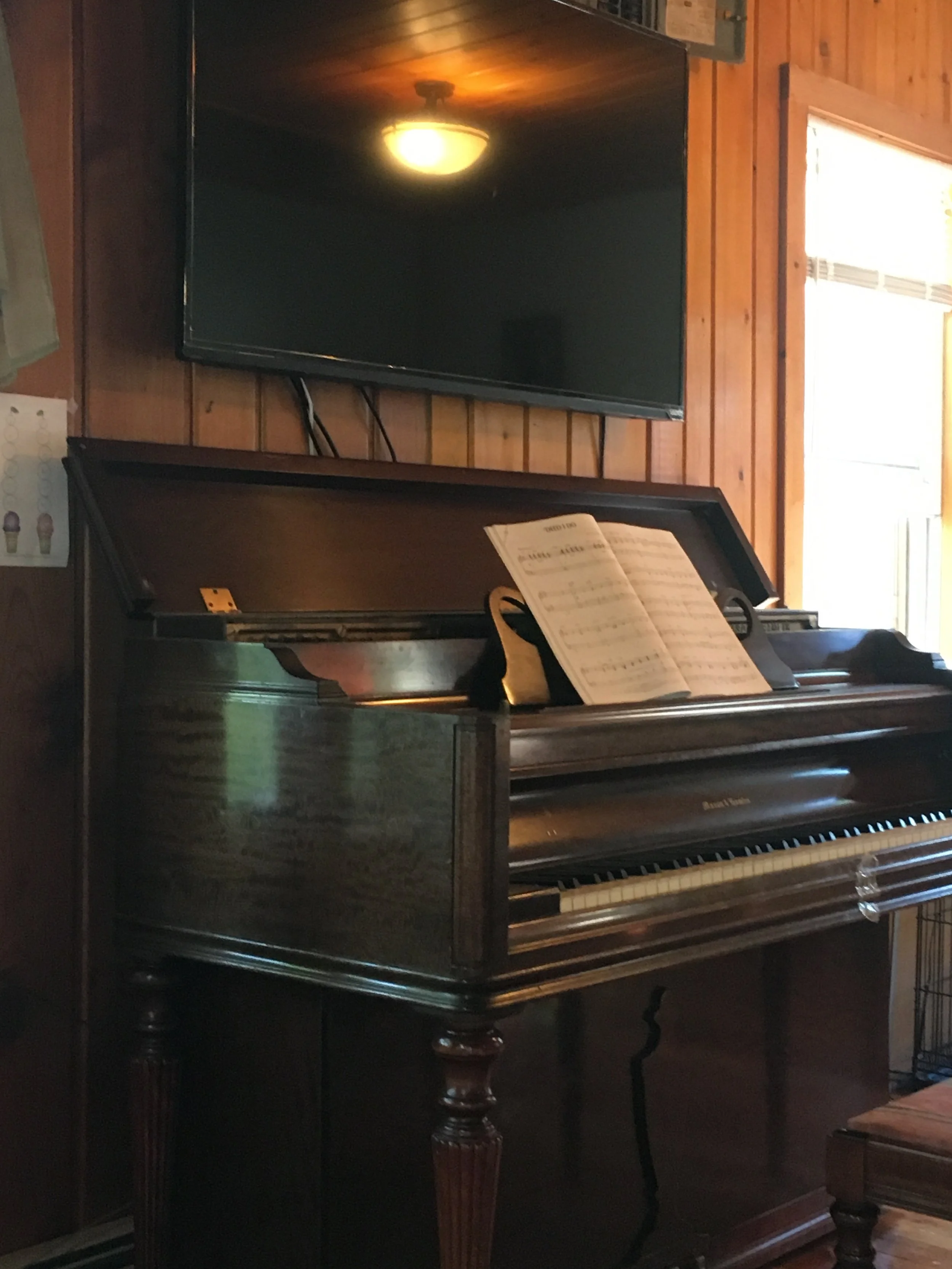
Dad’s Mason Hamlin Upright Piano
I hired three Samoans to help me lift the Mason Hamlin into the pickup bed, covered it with shipping blankets then secured it with a web of tie downs and returned across California’s Central Valley and Nevada’s Great Basin to East Fork where, calling four friends, I set the piano in the living room.
My sons took lessons for a year until their teacher returned to teaching music at Hailey Idaho’s middle school. When neither expressed an interest in learning to play Mozart, Beethoven or Chopin, the Mason Hamlin fell silent for twenty-seven years.
Deep winter snows melted into long summer days. The boys left for college in Australia, Brazil, Costa Rica and the Caribbean. As part of a divorce settlement, a local court ordered me to sell the house or sit in jail until I did. The Mason Hamlin was consigned to a climactically controlled storage unit in Hailey, Idaho. Three more years passed while the piano silently gathered dust in the dark.
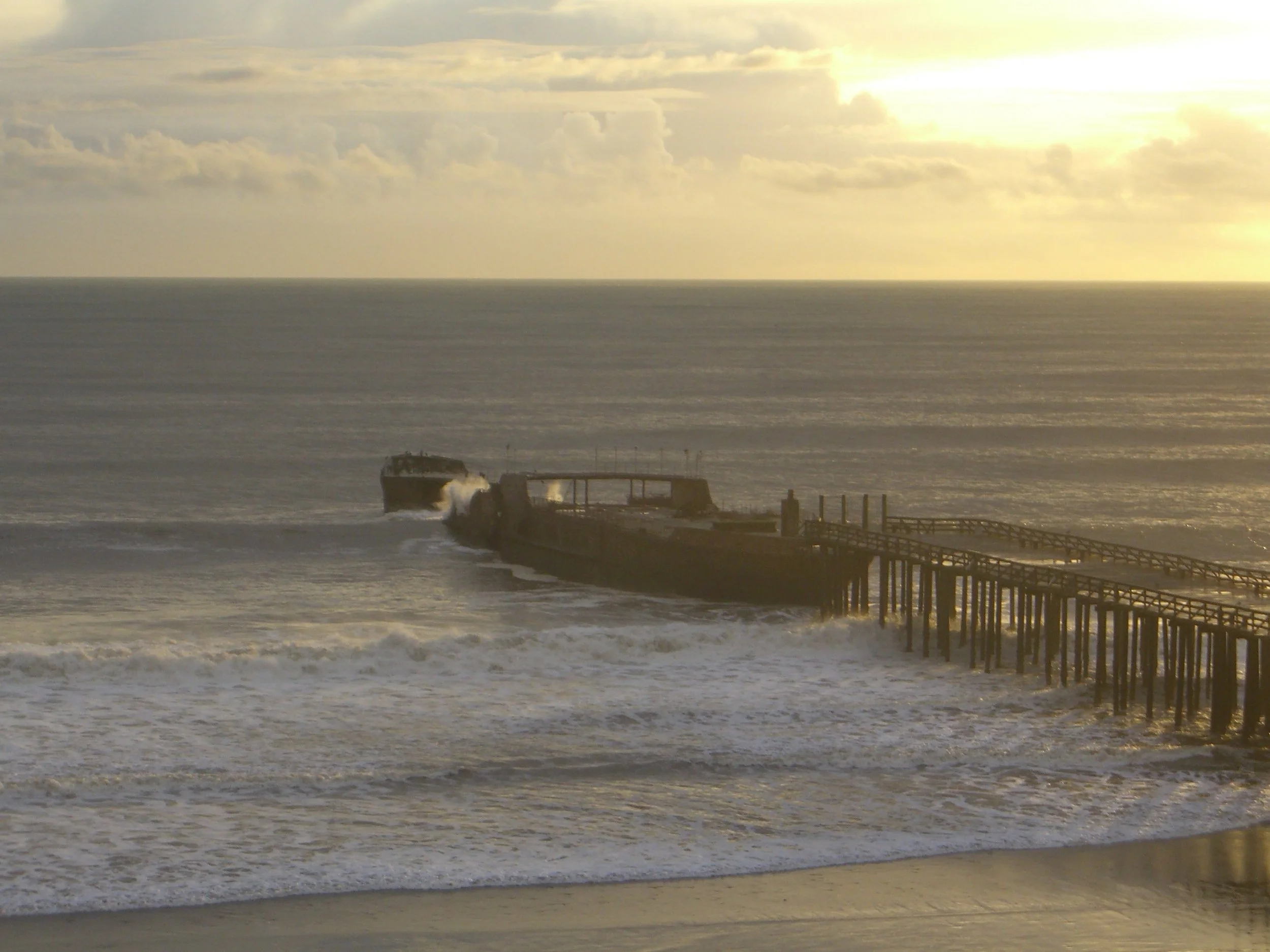
Concrete Ship, Sea cliff, California
Second among my father’s beloved treasures was an eight-foot, three piece, Granger rod. Ferrules wrapped in red silk, two tips in case one broke, the cork handle was scarred by a thousand barbed hooks my father had set as he moved from deep pool to riffle. It was far too big for trout but when I cast the Granger, I saw my father laying an elegant floating line to bass in Ohio, salmon in Alaska, steelhead in Oregon, rainbow trout in California and browns and brooks in Yellowstone National Park.
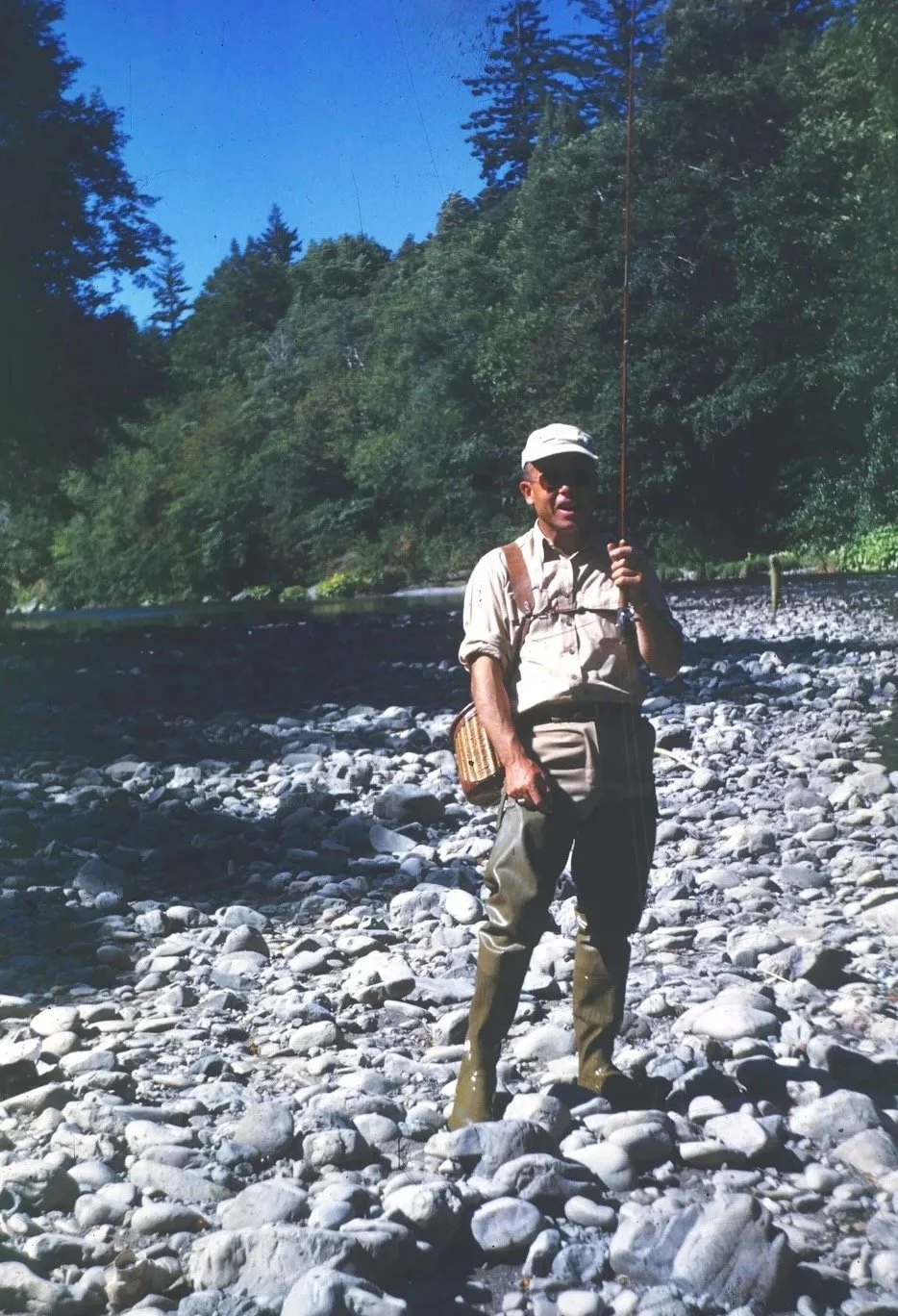
Andrew SlouGh with Granger Cane Fly Rod
Of all the songs my father played, I remember Debussy’s “Clare de Lune,” best. Since my French lessons amounted to an introductory class in college, and later, a three-month motorcycle trip across France, I mistakenly translated “Clare de Lune,” to “Song of the Loon.” Once, listening to Debussy’s haunting melody, I wondered if during a late ‘40’s fishing trip to Yellowstone National Park Dad might have heard loons call on the Firehole or Yellowstone River or Yellowstone Lake. I would later learn that a night on a Wyoming lake wasn’t the reason he was drawn to Debussy’s sad, haunting melody.
When I asked Lenore why Dad would repeatedly play a piece about loons, she replied in a voice that summoned the memory of my mother seated across the dining room table in Seacliff. “Debussy wasn’t writing about a loon, but of the moon.”
I was building a circular redwood bench in Woodside, listening to a scratchy classic station when the static suddenly cleared and “Claire de Lune” lifted into the silent redwood glade. Drawn from his grave in Los Altos by Debussy’s anthem, my father’s voice asked me why the Mason Hamlin now sat abandoned in a warehouse.
In my youth, I was allowed three permissible responses. “Yes sir, no sir, no excuse sir.” I waited a week then offered the piano to my grown sons. Named after my father, Andrew the third was living in the Netherlands. “I don’t know when I’ll have a place to keep it.” He texted.
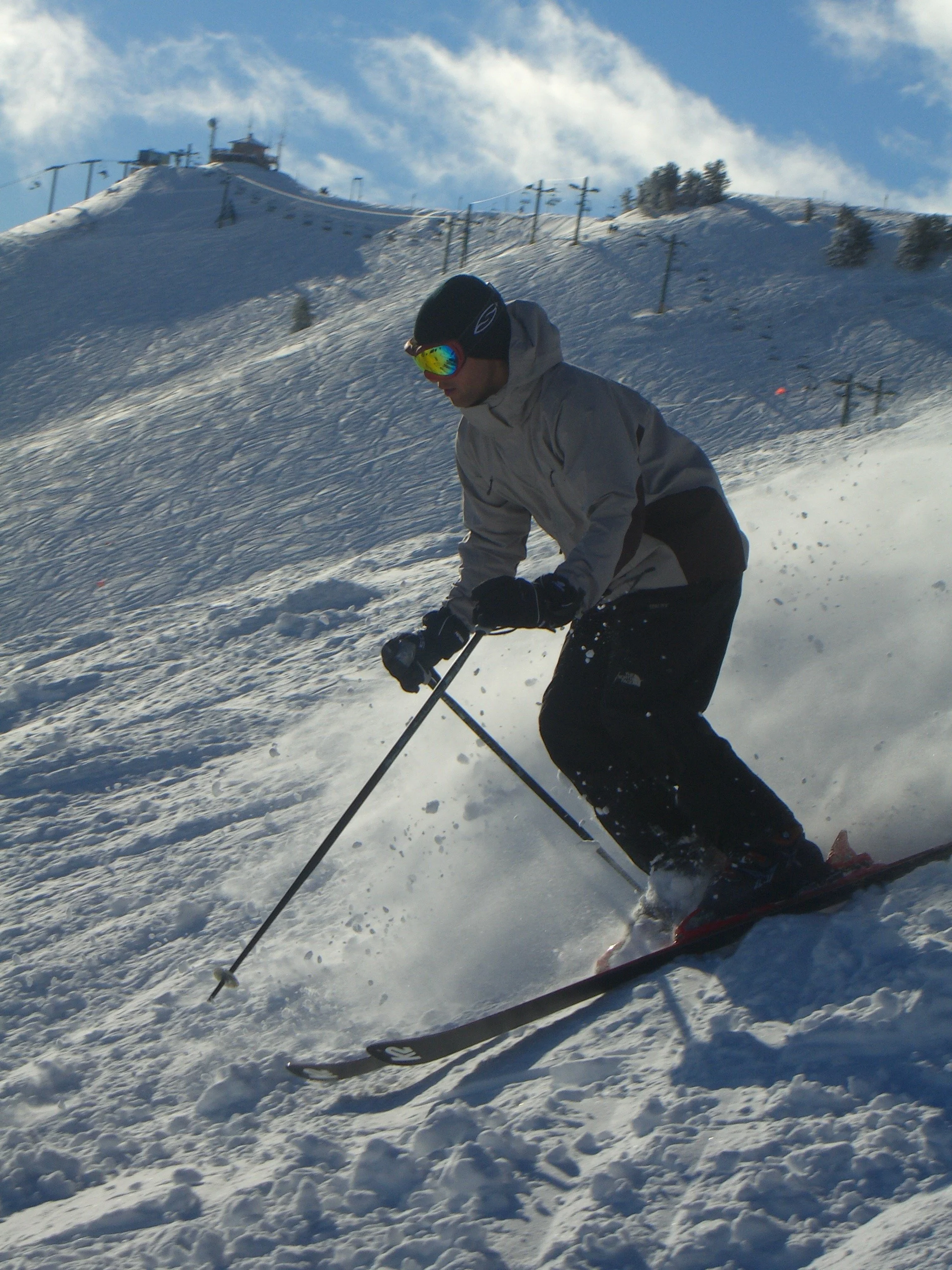
Robert Skiing Sun Valley
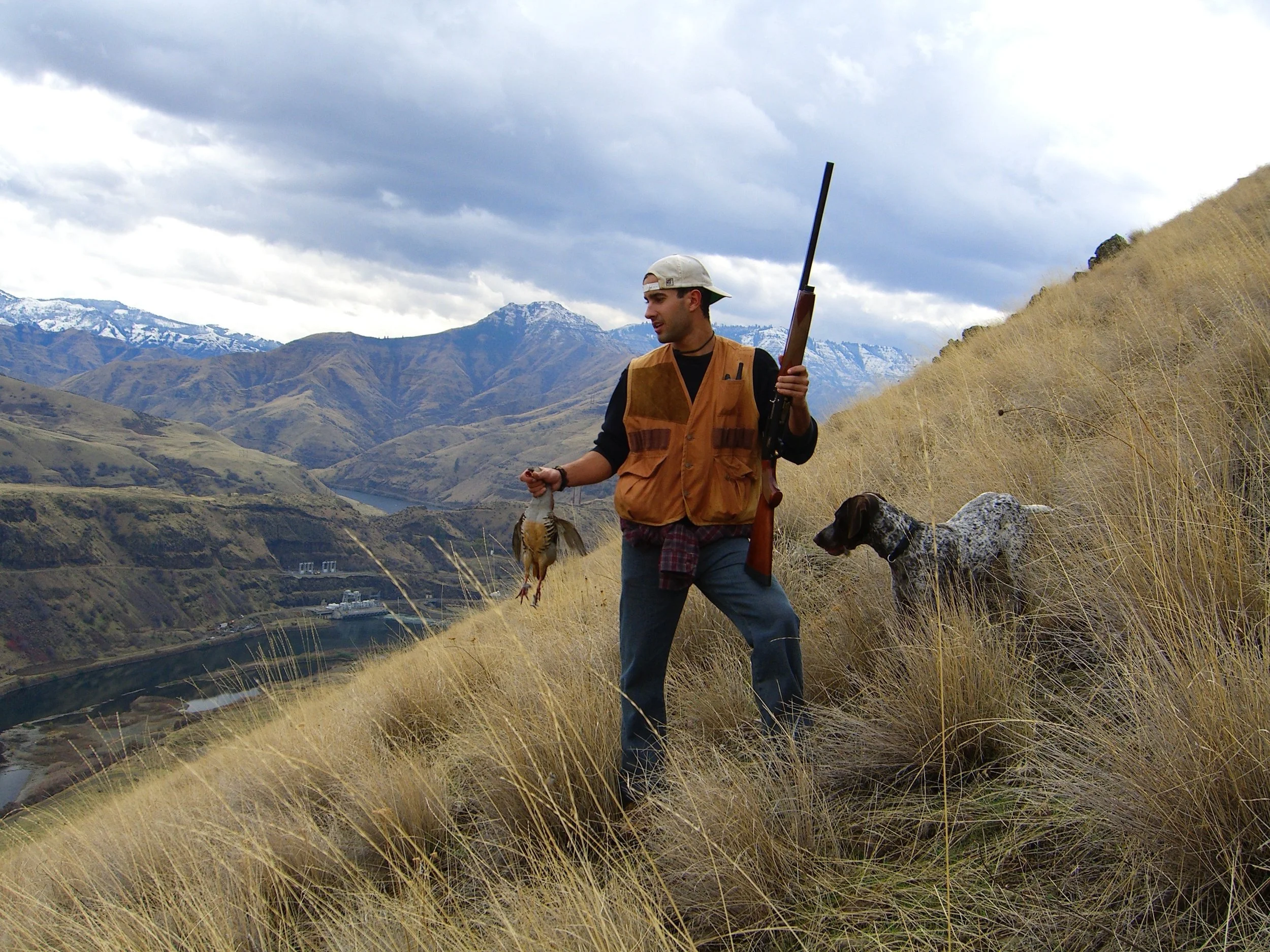
Andrew and Birdy hunting Chukars
Named after his maternal grandfather, Robert, the youngest, was working as an emergency room physician in Los Angles. Overwhelmed with Covid’s sick and dying he never replied.
Thirty-five years had passed since I last saw or spoke with my cousins Steve and Linda Slough. In that time, Linda had retired from nursing. Steve rose to Lieutenant Colonel in the USAF then retired to teach high school biology in Rapid City, South Dakota. When he wasn’t teaching science classes, Steve sold western roping saddles, farmed a hundred and sixty acres in Success Missouri and rode a bicycle with his daughter Mithril from Wyoming to Banff Alberta.
Two faded airline tickets were pinned to a corkboard above my office desk. With a week left before they expired, Michigan’s Upper Peninsula seemed as good a destination as any and a week later my wife Linda and I boarded a flight from SFO to Marquette. During the following three days at Steve and Linda’s home on Little Manistique Lake, family bonds were strengthened and during breakfast I asked my cousins what I should do with my father’s piano.
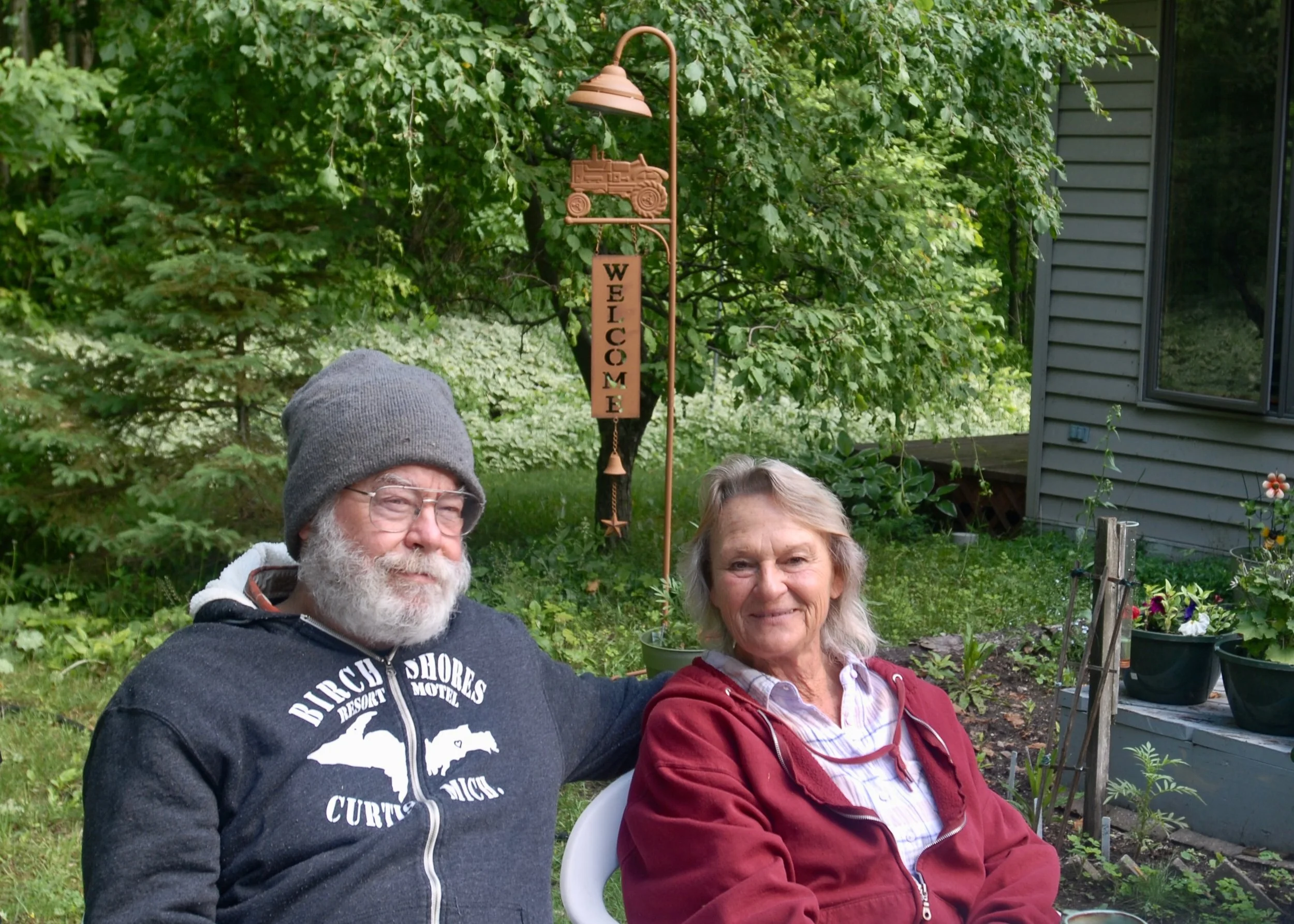
Steve and Linda Slough
Other than keeping it in the family, neither dared say.
Linda and I were on our way to the airport, when we stopped by Birch Shores–– Steve and Linda’s daughter Mithril and her husband Jay Bitely’s fishing resort on Big Manistique Lake. Mithril waited until we were leaving to hand Linda a bottle of maple syrup that Jay and the children had tapped and distilled. “Dad said your father’s piano needs a home?” she ventured
I nodded.
“Where is it now,” she asked.
“In a warehouse in Hailey.” I said.
Mithril and Jay met in Africa while serving in the Peace Corps. Mithril had played the piano since she was a young girl and their two children, eleven year old son Birch and eight year old daughter Ripple were now taking lessons. “And, how long has it been since it was last played?” Mithril inquired.
“Thirty years, longer.”
“It needs to played.” She said. “What if I drive my truck to Idaho and bring it back here?”
“Do you have any idea how far it is from Michigan to Idaho and back?”
“I’ve driven cross country more than once.” She advised me.
If I let the Mason Hamlin go, would the fading images of my father playing in the evening simply disappear? “Let me think about it.” I postponed the decision.
In the months that followed, I returned to the moment when my father’s ghost appeared in the redwood glade. If Andrew senior was moved to speak from beyond the grave, perhaps in the same way that he felt compelled to buy the Mason Hamlin, I had no choice but transport it to Michigan’s Upper Peninsula.
My wife Linda has devoted her much of her adult life to exploring the planet’s sacred and magical places––Macho Pico, Egypt’s Pyramids, Crop Circles, Turkey’s ruins, UFOs, Psychics, Astrologers, Tarot Readers, Fortune Tellers, Mysticism, nothing is off the table in her search for enlightenment. She didn’t blink when I told her my father wanted me to deliver his piano twenty-five hundred miles to a Northern Michigan fishing lodge.
My family’s greatest, most lasting mystery concerns my grandmother, Edith Leigh Slough. Mary Catherine once told me that Edith was a concert pianist who played for rapturous audiences on both coasts. My mother also believed that Edith drove a Tin Lizzy across the country in 1922 but pressing her for further details elicited a blink, a shrug and a gentle shake of her head.
Along with the phone numbers, addresses, children, birth dates and ten thousand other irreplaceable mental records, my mother took our family history with her when she died in 2006. Fourteen years passed before I started to search early 20th century newspapers for any mention of my Grandfather Elmer, Edith or my father and his siblings.
Edith was, surprisingly, not difficult to find. A graduate of the Monmouth College Conservatory of Music and Chicago Conservatory Music, Edith Lenore Leigh was the stepdaughter of Robert McCarthy—an heir to Central Illinois’ wealthy McCarthy family. While still in her late teens Edith exhibited both a classically trained voice and a virtuoso’s touch on the piano.
A story in Clarksburg, West Virginia’s “The Daily Telegraph” records that “A large audience was edified and inspired by vocal solos of Miss Edith L. Leigh at the First Baptist church.” The article continued “Miss Leigh sang sweetly and expressively, My Heart at the Sweet Voice, by Saens; Sunlight by H. Ware: Nevin’s My Rosary and Unexprest by C. Jacobs-Bond. Her numbers were enthusiastically received.”
On July 20, 1905 the Walla Walla Evening Statesman wrote, “Miss Edith Lenore Leigh pupil of Sherwood in piano and Holmes Cowper of Chicago in voice, will render vocal and piano selections afternoons and evenings at Ellers Piano House during their big sale. Everybody invited to attend.”
Further research from 1906 to 1923 uncovered a series of Edith’s travel stories that were published by the Hearst Syndicate. Front-page articles in the San Francisco Examiner and Los Angeles Times chronicled Edith’s 1922 camping trip from Peoria, Illinois across the Canadian border through Alberta and British Columbia to Washington State in a 1913 Ford Model T. In 1923, a second trip from Peoria to Seattle through the America’s national parks and down the West Coast yielded an additional twenty-six stories. The final front-page piece in an L.A. Times Sunday travel section chronicled a desperately hot passage on Route 66 through California’s Mojave Desert. Called the Mother Road by John Steinbeck in “Grapes of Wrath” the rough gravel track across the Mojave offered only clouds of alkali dust and deep washouts.
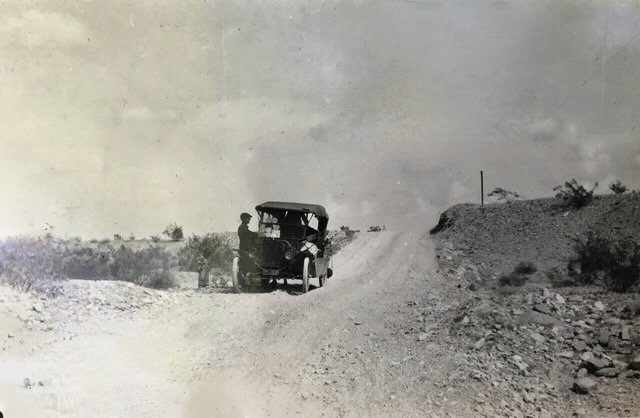
Edith Slough, Tin Lizzy, Mojave Desert
I found my grandfather, Elmer Slough in Peoria, Illinois’ court records. Raised on a prosperous farm in central Illinois, my grandfather was eighteen when he was hired by a local lawyer to “read the law.” Successful, handsome and scintillatingly bright Elmer passed the Illinois bar and was practicing law in Peoria and living at home with his elderly mother when he met Edith.
Where is another mystery. Possibly while he was going door to door for the census or while she played and sang at a Sunday church service, or simply passing on a downtown Peoria sidewalk.
Elmer was twenty-one years older than Edith and must have been well aware of the danger that divides a late thirties attorney and a sixteen year old schoolgirl. Despite, or perhaps, because of the difference in their ages, Elmer, the successful lawyer was captivated by the talented, teen-aged beauty.
Letters that detail their courtship might still be stored in a dusty Peoria attic, or forgotten Medford basement, or in an abandoned wood cabin above the Rogue River. Or, perhaps those first, courtly letters ultimately survived one generation, or two, and were then used to start a fire, or buried in an Illinois landfill.
The timeline, however, suggests that Edith had reservations about Elmer. A decade passed before she finally accepted his proposal and they were married on April 27, 1909.
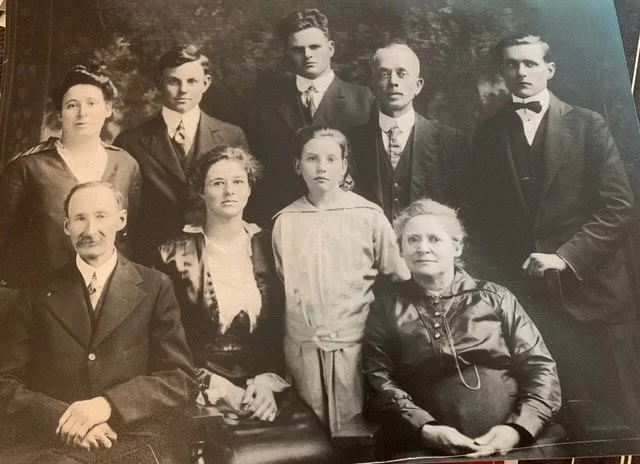
A single photo survives of Edith, her mother, Clare Wood McCartney, her stepfather James McCarthy, her half sisters Isla McCartney and Calla Belle McCartney and half brothers Lee McCartney and George E McCartney. Separated by Lee and George from Edith, Elmer Slough is standing behind Isla and Clara his mother-in-law. Shorter than Lee and George, his white thinning hair speaks to the twenty plus year difference in his marriage. Somber, staring intensely into the camera, he might well be looking across the century and a quarter that separate him from the grandson who struggled with Elmer as a middle name. My father, my Uncle Carl, my cousin Steve, my sons and in some ways, I too mirror Elmer’s light eyes and intelligent face.
Perhaps I’m reading more into the photo than the photographer who arranged the family intended but the black and white print betrays an emotional distance between Edith and Elmer.
No matter how my grandmother felt about my grandfather in the early years of their marriage, Elmer adored Edith and the four children who followed over the next nine years. My Aunt Ann was born in 1910, my father in 1913, my Uncle Carl in 1915 and the youngest, my Aunt Clara in 1918.
Eighty years before cell phones, computers and the Internet appeared to dominate our lives and two years after the first commercial radio station crackled on air, the newspapers and the news, ads and travel stories they published offered the world’s predominant form of entertainment. In 1923 Edith had begun to free-lance travel articles to the Seattle Star and San Francisco Examiner and in part to support his wife’s talent, Elmer loaded Edith, Ann, Clara and Mrs. Wood his mother-in-law, a canvass tent, five cots, kerosene stove, plates and silverware into their ten year old Model T and turned west from Peoria toward Seattle.
Who clipped Edith’s articles from the Seattle Star, San Francisco Examiner and Los Angeles Times and who glued them to black felt paper that eventually found their way into my sister Janice’s closet provides yet another mystery. It might have been Edith, or Elmer, or perhaps my father when he later discovered the newspapers among his mother’s effects. The stories now allow my long dead grandmother to speak across the intervening century.
“We started from Peoria, Wednesday, June 30,” She wrote. “Over the Logan and Lee Trail to Davenport, thence over the Red Star, to nine miles north of Tipton, Iowa where it joins the Lincoln Highway.”
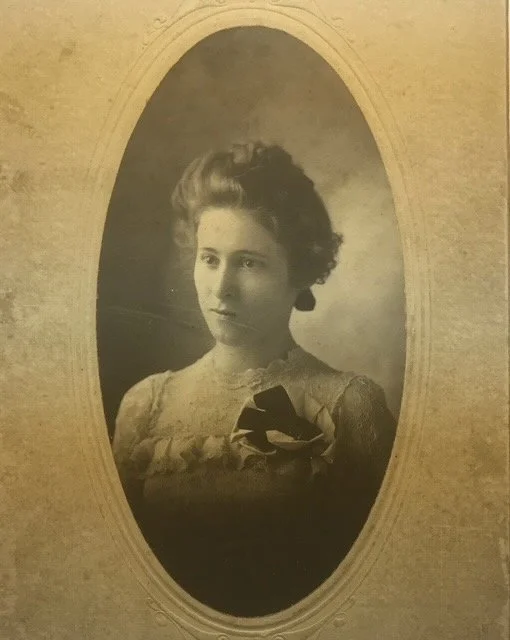
Edith Leigh, Writer, Musician, Wife, Mother,
In the course of twenty-five hundred words, she described roads and trails that were little better than rutted tracks from farms to town and then west, through vast cornfields. “Over the Lincoln to Cedar Rapids…” she wrote. “We turned north on the Red Ball, a through trail to Saint Paul and Minneapolis. All of these trails were in good condition, especially the Red Ball.”
Later, in the same piece she described their journey across North Dakota, “We crossed great plains of yellow and brown alternating rugged purple buttes and red lava rock formations, over which the trail climbed, making “rough going,” only to come down again into other vast cactus-strewn plains––far away on the dim horizon––more of the purple chains of mountain foothills.”
In successive articles written during their journey across North Dakota, Montana, Wyoming and Idaho into Washington she described the beauty of the prairies, forests, lakes, rivers and the people who appeared and faded along the passing miles.
Crossing the Oregon border into California, Edith watched Mount Shasta grow in the Model T’s windshield. “We had caught frequent glimpses of Mt. Shasta, all the afternoon but as we traveled down the valley from Grenada to Weed she was only about fifteen miles away––to the east. Nearing the forests around her, we found a small tourist camp among the pines and with several other cars––drove into camp for the night. Staking our tent we prepared our campfire and supper and then gave our evening to enjoyment of the beautiful mountain above us.
“On first beholding her she had seemed as a nun––chaste and cold as the snow crown that covered her twin peaks. Her shoulders rugged and grey above, the timberline and about her feet, dense forests of green and black pines
“But as the sun went down behind the western range, its last rays awakened her to life and garbed her in tints so glowing and exquisite––her beauty and majesty.
“The forests became a garment of royal purple––about her shoulders the deepest softest rose––shot here and there with flecks of gold and above it all a diadem of sparkling gleaming snow.”
During the next month, Edith described, in equally lyric columns––Sacramento, Fresno, Los Angeles and Santa Monica until Elmer, fearing the three months away would bankrupt his law practice, turned east through Arizona, New Mexico, Oklahoma and finally home to Peoria.
I do not know why Edith and Elmer divorced. My Uncle Carl believed that, toward the end, they had begun to fight. A second clue was, in her final articles, she had begun to refer to my grandfather as Mr. S. and the “lord.” Whatever the cause, shortly after their return to Peoria, Edith loaded the four children in the Model T and drove back across the country to Medford Oregon. The loss of Edith and the children devastated Elmer and in 1926 the brilliant jurist, loving husband and father retreated into dementia and was committed to the Limestone Hospital for the criminally insane.
Edith next appeared in the 1930 census that recorded she was living in Medford with her four children. By then the Great Depression had driven the country to financial ruin and feeding and housing four children must have pushed my grandmother to her physical and emotional limits. Under marital status, though Elmer was still housed in the asylum, she stated, “Widow.” Under “Occupation,” Edith replied “Housekeeper.” Following her divorce my grandmother, the classically trained pianist, singer and syndicated travel writer, was reduced to cleaning houses.
How Edith found the time to teach my father to sing and play is yet another mystery. She didn’t own a piano and I wonder if she might have given him lessons in one of the houses where she cleaned or cooked. My father would have been thirteen in 1926 and I can picture them sitting together on a piano bench, my Grandmother’s fingers touching the keys with a confidence born from her years in the music colleges and public recitals. My father would have struggled with chords until he mastered simple pieces and, years later, classic songwriters. The result was, in his forties, my father could listen to a song then settle at the Mason Hamlin and perfectly reproduce the notes, tone and phrasing.
No correspondence remains from 1926 to 1930. While my sister Janice and I have tried to locate a letter from our Aunt Ann, or Aunt Isla, my father, Uncle Carl or less likely, my Grandmother Edith, what remains are contained in newspaper accounts.
Great GrandMother, Uncle Carl, Dad, Edith
My Aunt Clara was twelve when she died from a .22 gunshot. The Medford Mail Tribune recorded, “Apparently brooding over Zane Grey fiction, Clara Eleanor Slough, 12 years old Yreka school girl, shot and critically injured herself with a .22 caliber rifle at her mother’s apartment home here Wednesday night. The girl is hovering between life and death at the hospital and it is feared that if she lives she will be partially paralyzed.”
“When the girl’s mother, Mrs. Mary Slough, (another mystery is why, or how had the reporter gotten her name wrong) advertising manager for a local newspaper left the apartment about 5 o’clock to the newspaper office she left the girl reading Zane Grey’s “Border Legion.” Upon the mother’s return about two hours later she found the girl lying on the floor. A few feet away the mother picked up the rifle that showed signs of having just been fired.
“Mamma, I’ve shot myself,” the girl said amid sobs.
Edith rushed Clara to the Yreka hospital where doctors discovered the bullet had entered her right breast, pierced her liver and grazed her spinal cord. Edith speculated that her daughter had been trying to load the rifle when it accidentally discharged.
Described as unusually bright, Clara was in an advanced seventh grade class and was fond of reading, particularly the work of Zane Grey. Edith found the novel “Border Legion” open on the bed. Clara lingered for three days then died.
Clara’s death haunted Edith, Elmer, my dad, Uncle Carl and Aunt Anne. My father and mother never spoke of her death but I was ten when my older sister told me, “Dad and Uncle Carl were playing with the rifle and it went off. The bullet hit Clara.” Who confided in her remains a mystery but it wasn’t beyond my sister to pass fiction off as fact.
I was in my late thirties when I asked my mother, how Clara died.
“It was an accident,” was all she would say.
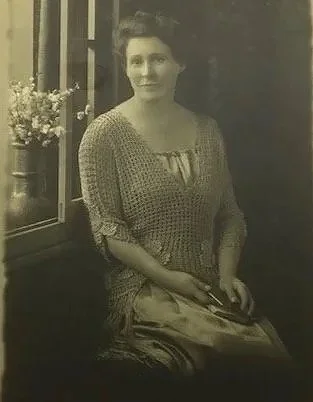
Edith outlived Clara by three years before she was hospitalized in June of 1933. Lacking imaging tools, blood tests or drugs to treat a partial blockage of a main artery, the doctors held my grandmother for a week, and then released her. She survived until October of that year when at forty-nine she succumbed to a second heart attack. Twenty-first century cardiologists might have monitored her high cholesterol and stinted her clogged blood vessels, but I believe my grandmother never got over Clara’s death and died of a broken heart.
My grandmother’s early death should have served as a warning to my father and uncle who would both die of heart attacks. When Elmer died in 1934, Dad and Uncle Carl joined the Army Air Corps because, simply, during the Great Depression, they had no other place to go.
Compared to the absence of letters between Edith and Elmer, the history of my father Andrew, Uncle Carl and Aunt Ann was written in Kodachrome slides, newspaper clippings, rumors and talks with my mother as we faced each other across a picnic table at Sea Cliff State Beach. I would trade a latte that, in her final years, she had begun to prefer over black coffee for what little she would reveal about my father’s, or her own family.
Surrounded by her children in her home at the beach, Mary Catherine died quietly in June of 2006. While we were all shattered by my mother’s death, my oldest sister and younger brother behaved in unexpected, self-destructive ways. Janice, Lenore and I remained close, but weeks turned to months until a decade and a half silence separated us from our oldest sister and youngest brother.
While cleaning out my mother’s home my sister Janice discovered my father and mother’s love letters in a camphor chest that had sat for five decades at the end of her bed. Filled with expensive bolts of Hong Kong silver cloth, silk scarves, linen table cloths, the flag that draped my father’s coffin, his medals and Air Force uniform hat, she kept their letters in the left bottom corner of the hand carved Chinese chest where none of her children, or later the housekeeper, and later still the Hospice volunteers would accidently come across the airmail envelopes—one written in dad’s uneven masculine script, the next in my Mother’s beautiful, feminine hand.
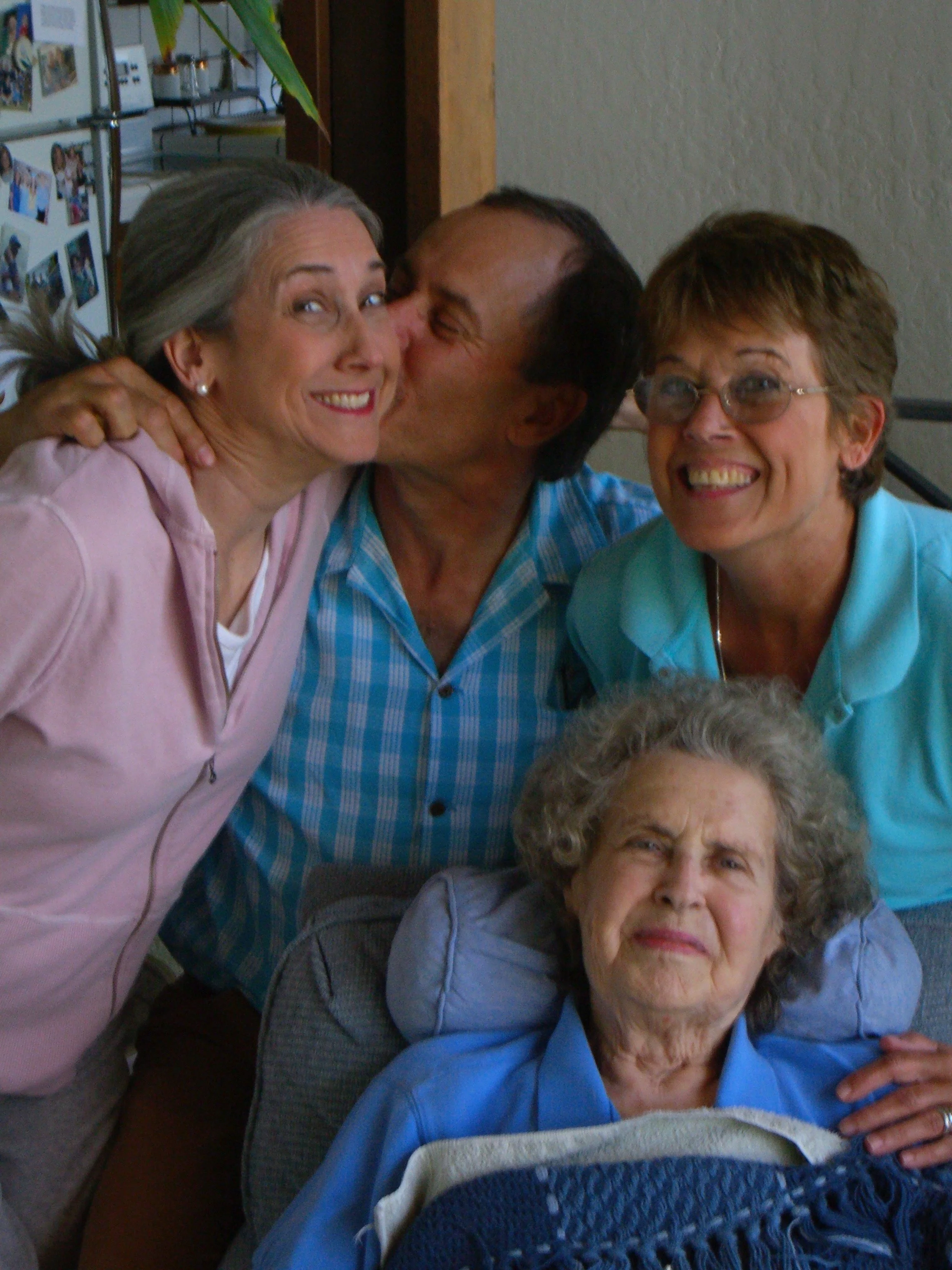
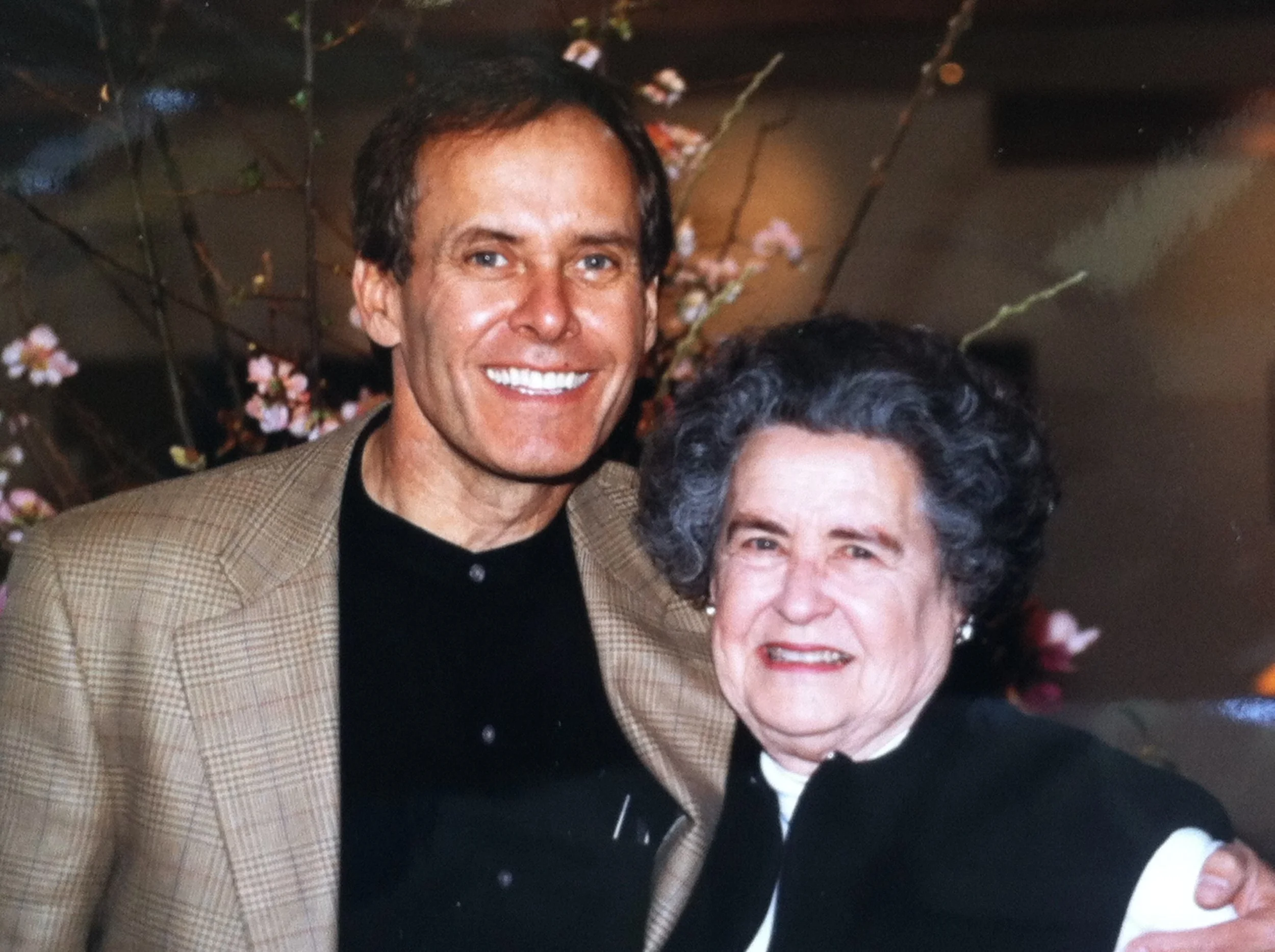
Lenore, Andy, Jannie and Mary Catherine
Camphor repels borers and bound with a pink silk ribbon, four dozen letters written during night training flights to Spokane, Boise, Missoula and Los Angeles described how my father missed and loved my mother. In reply my mother’s beautiful script described her work, a trip to San Francisco, her family and at the end, a chaste . . . Love, Scotty. Framed in these letters their courtship was marked by a respect, innocence and deep love for one and other.
My father was stationed at Kadena Air Force Base in Okinawa when he leased a point of land in the Awasee District that offered views of Buckner Bay and five small Okinawan villages. Bounded by the distant mountains and a dark blue ocean, verdant rice paddies stretched around thatched huts that looked as if they were lifted from a Satsuma vase. Dad contracted with local Okinawans to build the house that sat above a cliff filled with century old tombs that were excavated into the sand stone. The house was surrounded with flowers from my mother’s gardens and banana trees bent beneath heavy hands of ripe fruit. During the fall when typhoons roared off the Philippine Sea and threatened to rip the house off its foundation, we clustered around kerosene lanterns and listened to Dad’s battery operated short wave radio for any news about when the screaming winds and torrential rains would end.
Dad was nearing the end of his tour when he added a shopping trip to an Air Force exercise in Hong Kong. He was flying back to Okinawa when two of the four engines on his B-29 exploded. With the bomber losing altitude, Dad was forced to dump a teak dining table, eight chairs and everything else that wasn’t bolted down into the East China Sea. He wave hopped the bomber back to Kadena on two feathered engines, one critically over heated, with the last screaming at full throttle. My father, the crew and the camphor chest just managed to clear the cliffs and touch down on the runway.
Half a century passed before the chest and the letters passed from my father, to my mother to me. Faced with the wreckage in my immediate family, I hoped something good would come of freeing my father’s Mason Hamlin from the Hailey Idaho warehouse. During a call to Mithril I asked if she was still interested. “Of course. How much do you want for it?” she hesitantly asked.
“Only that you play it . . . .”
“I should at least pay for your gas and the U-Haul.”
“No, Dad would want it to be a gift…”
That is how Linda and I left Fremont in the mid-morning on June 2 on Highway 580 west to Stockton where we merged onto Highway 99 north to Sacramento.
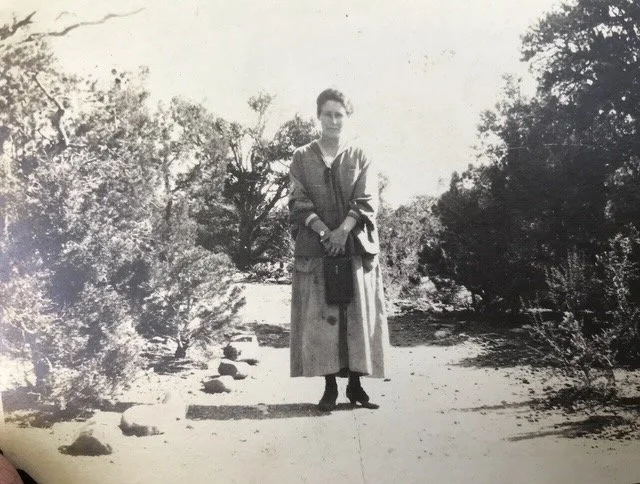
Edith Slough in the Central Valley
Edith had described the Central Valley in one of the columns she’d written for the L.A. Times. “On each ranch and always near its center were mansions of mission and Spanish architecture, snow white and surrounded by palms. To the north and south was a sea of grapes, stretching in endless rows as far as the eye could reach up and down the beautiful valley. To the east towering against the sky, was a long range of blue peaks, the Sierra Nevadas’. As we approached the Mattei ranch we found it was the largest in that portion of the valley…
“The residence and ranch buildings are nearly in the center and we reached them by an avenue of palms and oleanders. We were given a very nice camping spot in an orchard of fig trees near the house, and told to help ourselves to all the fruit we cared to eat, as the ripened figs were falling about our tent in all directions; and not a stone’s throw from its door was a large prune orchard ladened with ripened fruit, and adjoining and surrounding us were miles of luscious grapes, white red, blue and green, of every variety we’d ever heard of, and many we had not. I felt just like I’d been turned loose in million dollar bank and told to help myself to any amount at any time.”
Ninety-seven years after Edith penned that piece, she would not recognize the Central Valley. Now crowded with new subdivisions and interlocking freeways, the mission ranches she once admired have long since fallen to developer’s bulldozers.
Hoping to dodge the traffic, we left in the mid morning but missed a turnoff in Stockton and struggled for an hour before we broke free north of Sacramento where we joined Highway 99 to Chico and Highway 32 across the Northern Sierras to Susanville. We intended to camp that night in the Eastern Sierras but the Covid-19 had closed all Forest Service campgrounds and with forecasts predicting torrential rain followed by an inch of snow in the mountains, we retreated to a motel in Susanville and a shared calzone in an empty Italian restaurant.
The following morning we pressed through alternating hard sleet and heavy rain to Vale, Oregon where we found a campsite above Bully Creek Reservoir. A cold rain shook the tent that night and, when I woke, I’d lost all hearing in my right ear. Warm saline had no effect and we stopped briefly in Boise for equally useless eardrops, then continued east on Highway 20 to Hailey where the Mason Hamlin had been pulled from storage. Anthropomorphism describes giving life to inanimate objects, but when the summer sun touched the piano’s clear mahogany, it seemed to smile in recognition.
We turned south out of Hailey in the early afternoon toward Picabo, Gannet and Carey then east through the Crater’s of The Moon national monument, toward Arco and the Idaho National Engineering Laboratory where a plume of radioactive ground water now flows inexorably toward the Snake River. To the south of Highway 33, in the distance, Big Southern Butte lifted out of the rolling desert. Now disfigured with 5G towers that ensure that travelers can text, email, or play games on their phones without ever looking out at the passing landscape, the Butte gave way to Mud Lake and Terreton where deeply financed green John Deer Tractors and red Massey Ferguson Harvesters, allowed weathered farmers to scratch a living from the surrounding fields of alfalfa, barley and potatoes. Beyond Sage Junction where Interstate 15 continued north toward Butte, Montana, the land faded back to dusty broken hummocks of black lava and fragrant, blue green sage.
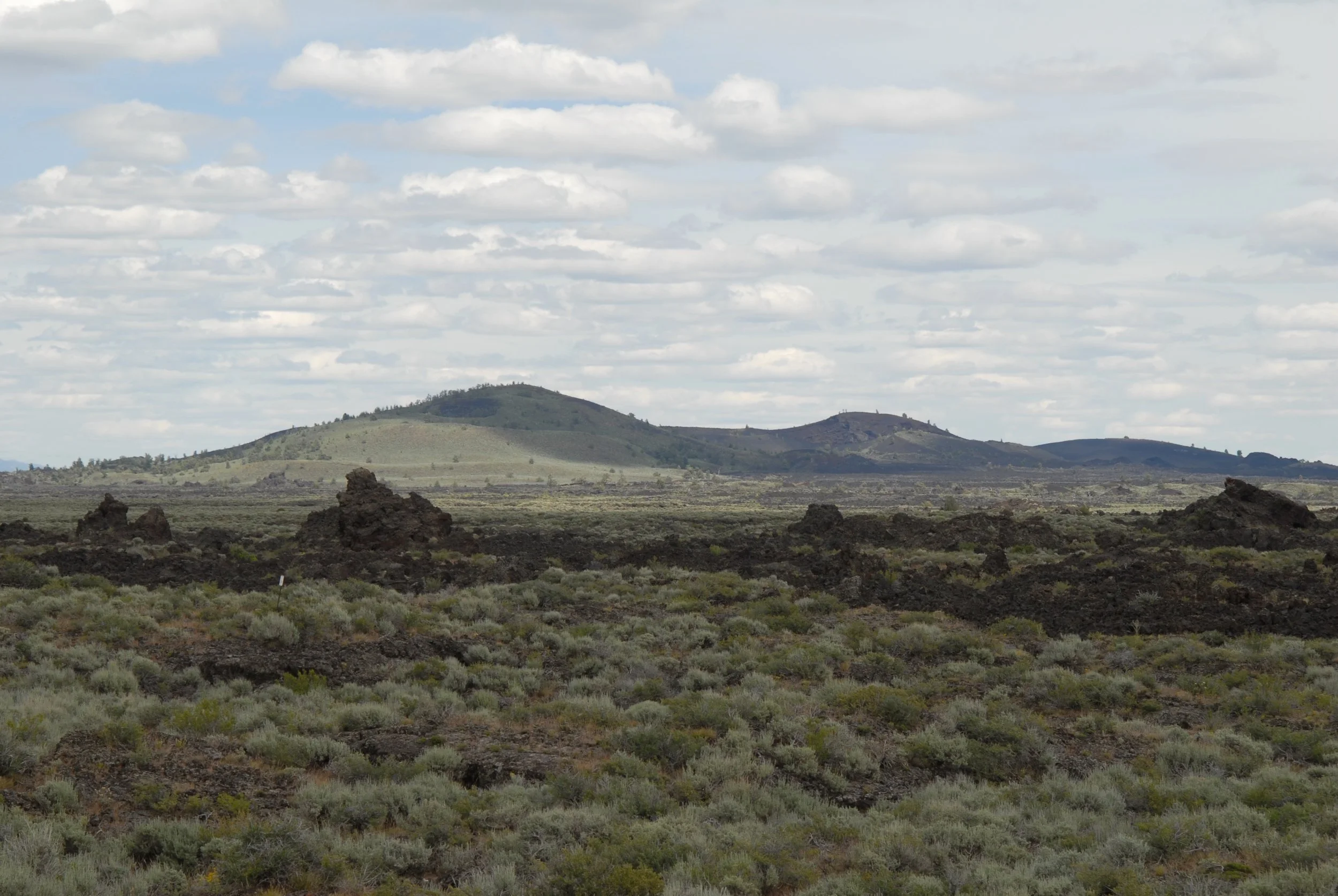
Craters of The Moon, Snake River plain
Linda had never visited Yellowstone and we joined Highway 20 to Rexburg. With the Covid pandemic filling emergency rooms, Yellowstone was closed to all camping and when we pulled into Island Park, a cold rain thundered down on the Henry’s Fork of the Snake River.
Mack’s Inn was already ancient in 1989 when I stayed there with my sons. That evening, the Henry’s Fork was shadowed with undulating sheets of rising caddis, and anticipating the morning hatch, we slept without complaint. Thirty years later and pressed for a room, Mack’s Inn’s Internet ad now claimed, Mack’s “maintained its “bit of nostalgia” with old time flavor.” In the cold rain of early June, it was clear that half a century of hot summers, a million guests and heavy winter snows had further diminished the old hotel. A hundred and fifty dollars for the tiny room, sagging bed and converted closet for a bathroom seemed high, but it was early June and heavy rains and inch deep hail filled Highway 20 north into the park.
In September of 1980, I rode a bicycle from Yellowstone’s National Park’s Mammoth Hot Springs down Highway 191 to Jackson, Wyoming. Sleeping in campsites and bathing in a bucket, I photographed geysers and thermal pools, the Firehole River and Yellowstone Falls against a backdrop of yellow and red aspens, yellow cottonwoods and willows. Chilled by the fall winds, I listened to elk bugle in the early morning and watched Bison battle over attentive cows. Two decades would pass before my youngest son and I backpacked up the Yellowstone River where dinner plate sized grizzly bear prints filled the muddy islands and west slope cutthroat trout rose without fear to caddis patterns.
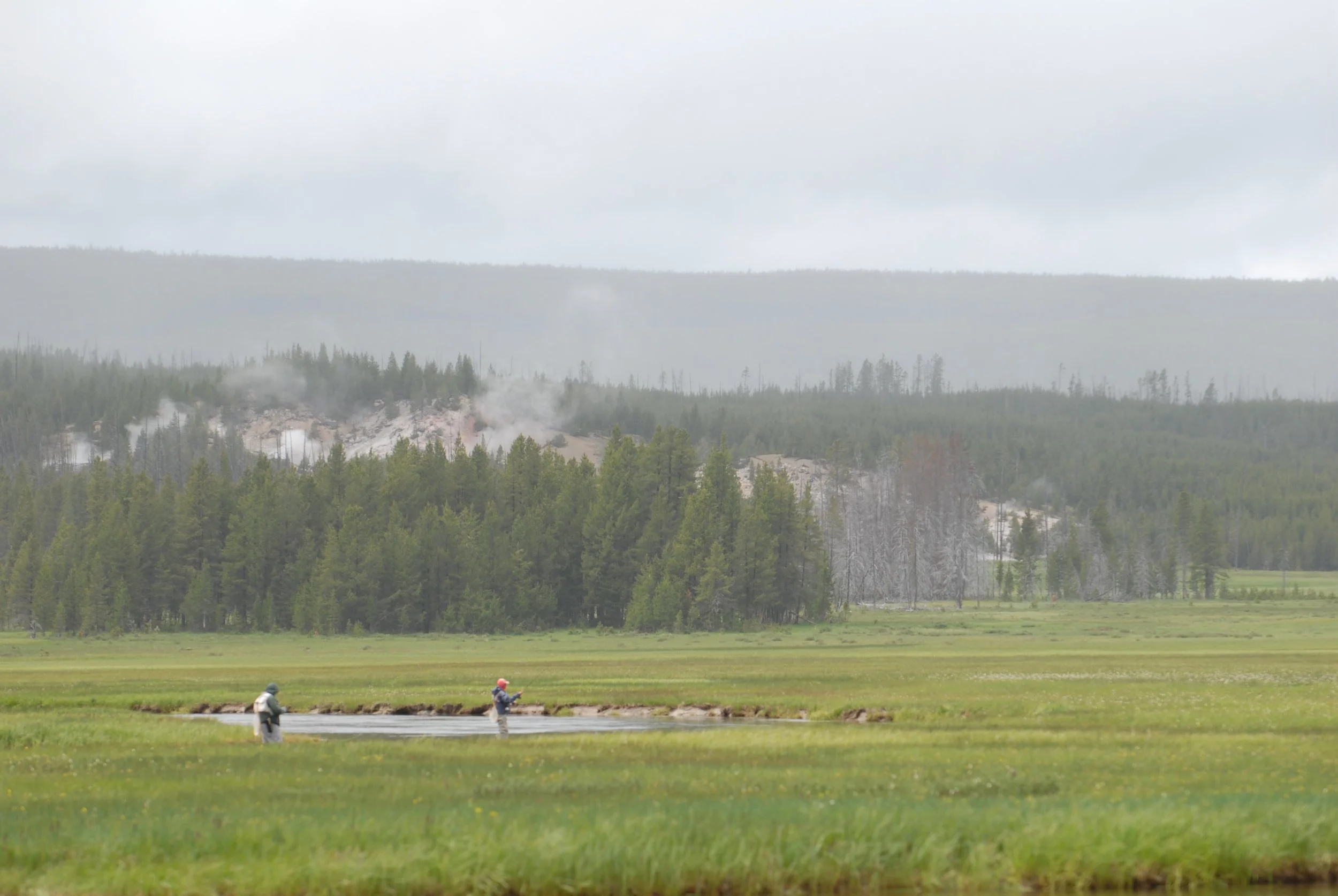
Snow continued to fall that night on the Yellowstone caldera’s high mountains and as sun lifted above the eastern ridges, the Firehole River glowed with spring aspens, wild flower filled meadows and clear streams as lumbering buffalo stopped traffics on the major roads. Old Faithful erupted into the gray sky and we turned north to Mammoth Hot Springs then east to the Lamar Valley. Black bears appeared next to the road sending frantic families in mini vans into the barrow pit for a cell phone cover shot, buffalo grazed next to road, wolf packs chased elk calves, Bald Eagles soared…and the sun parted the cumulous in the afternoon to light the west face of the Bear Tooth Pass.
Edith visited Yellowstone in 1923 when the entry fee was $7.50, and the Park Rangers insisted she check her rifle at the park’s north gate. Framed in her elegant script, her letters to the L.A. Times described the rutted dirt roads to Old Faithful, Fountain Paint Pot and the Norris Geyser Basin. Her letters were printed in a front-page travel section and on March 18, 1923, she described Mammoth Hot Springs.
“As we rounded a turn, we came fully upon it––a majestic mountain of snow-white terraces, descending far down the valley––one below another.
“The active terraces are brilliant with color due to a velvet-like covering of algous growth––a low form of plant life––which cleaves to the surface of the limestone rock and requires hot or tepid water in which to live. The multitude of tiny streams which trickle down the face of the snowy mountain add a mosaic of color, until the whole is like nothing so much as a magnificent fountain, carved from marble by a master’s hand.”
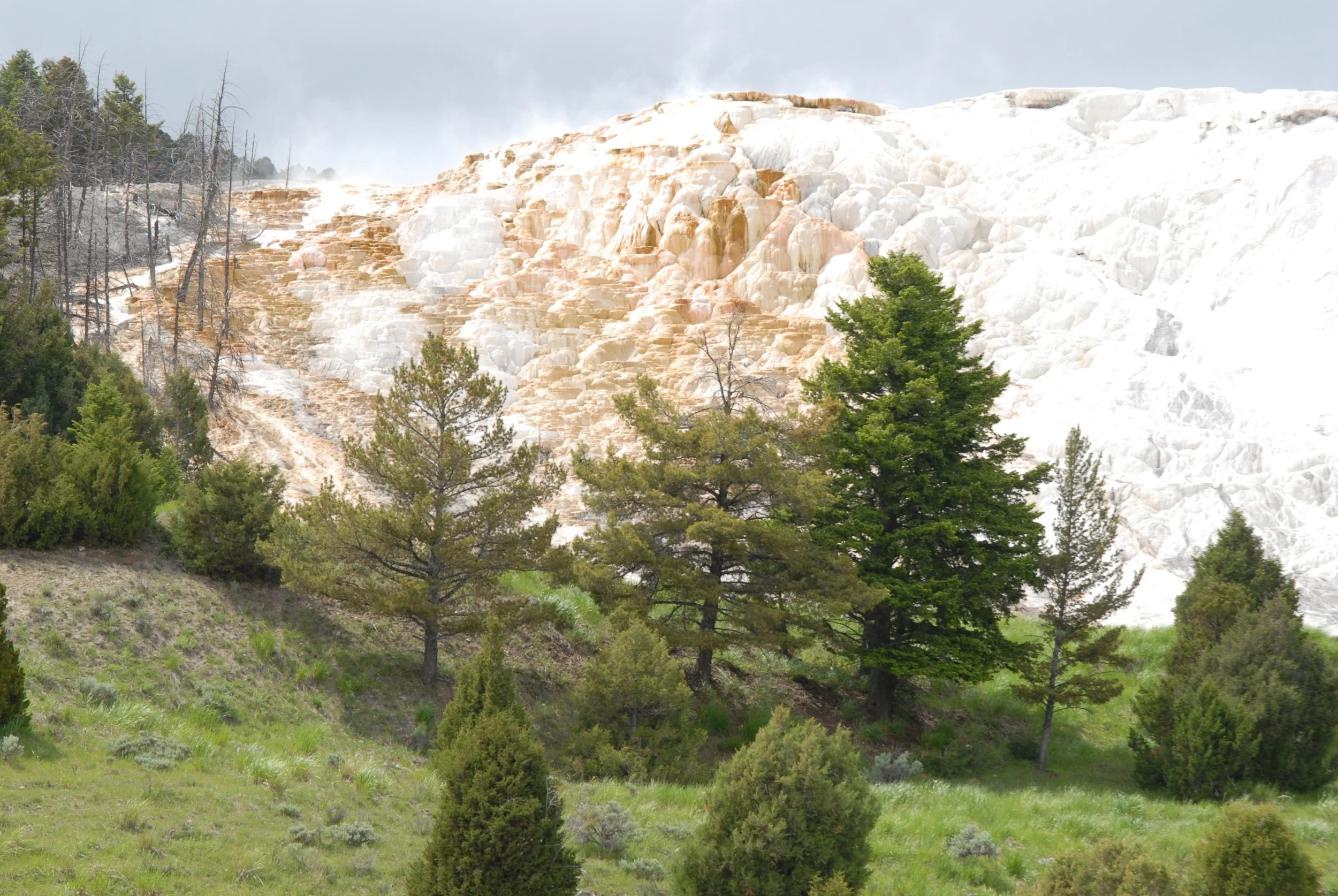
Yellowstone Park’s Mammoth Hot Springs
Nearly a century later, while Covid raged through the nation’s cities, crowds filled Mammoth’s boardwalks, ice cream stores and curio shops.
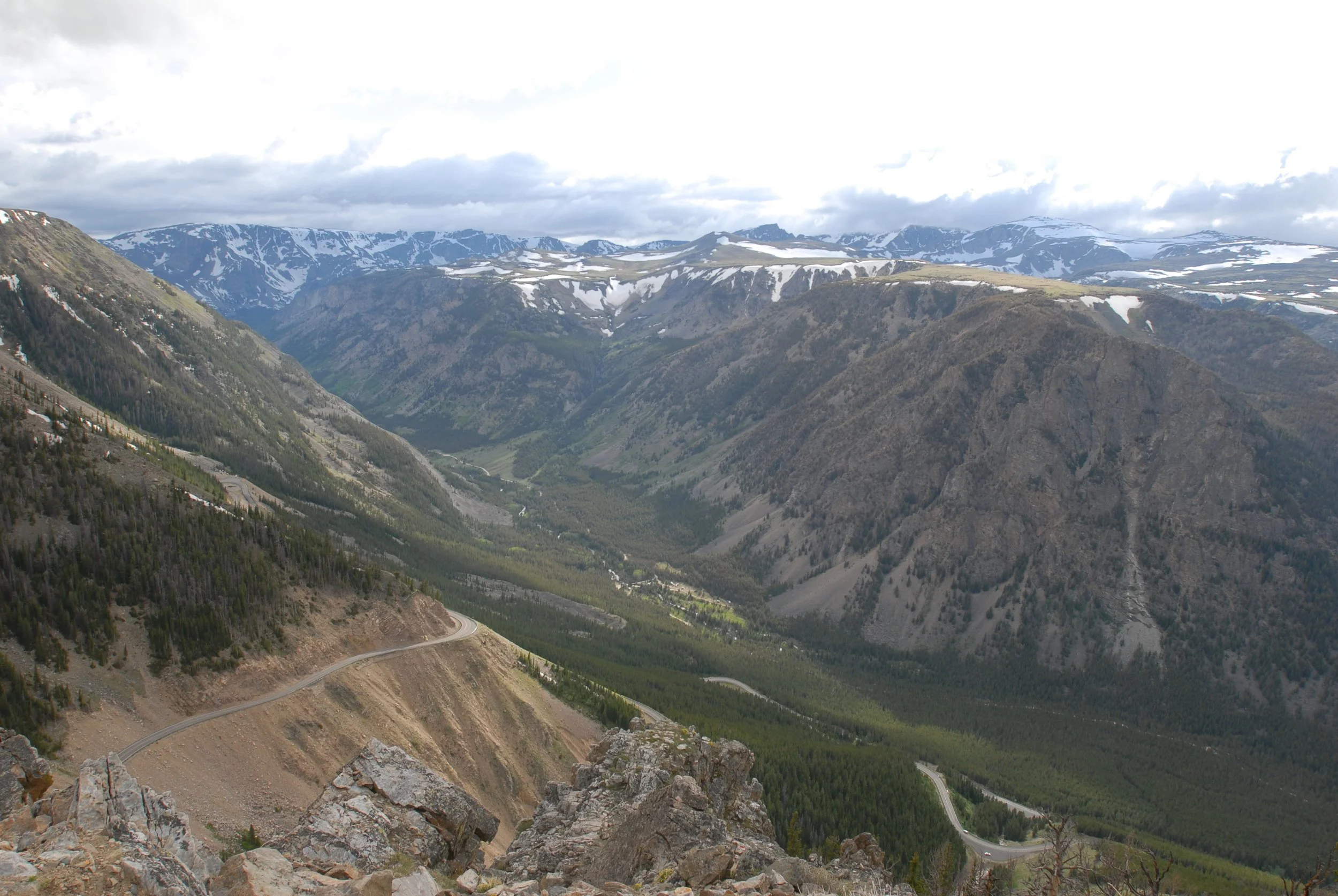
Montana’s Bear Tooth PASS
I didn’t intentionally drag the Mason Hamlin up U.S. Route 212 to the Bear Tooth’s 5747-foot summit. I would have made a U-turn with the U-Haul if I’d known about the hairpin turns, chuckholes, thousand foot cliffs or could have predicted the steep grades that prompted prayers the scarred guard rails would resist one more grinding collision.
At some point during the sixty-seven miles of snowfields and blinding vistas, I sensed a presence in the back seat. The feeling was equally as strong as in the redwood grove when “Clare de Lune,” broke my father’s sixty-year silence.
For once my mother’s screams did not frame the image of my father lying on his right side in the lawn swing. Instead who, or what, occupied the back seat seemed at home among the jagged mountains, deep valleys, high snowfields and ancient glacial moraines. Had dad’s spirit stowed away while we towed the Mason Hamlin east to Michigan, just as he and Uncle Carl hopped freights from Oregon to Illinois to visit their father in the asylum?
“Go away, you’re not my sons,” Elmer told dad and Carl. “They’re still little boys.
Three decades had passed since Marek Rosin traded Sun Valley, Idaho for Red Lodge, Montana––the northwest portal to Yellowstone. In that time, Marek had built Adventure Whitewater, a white water company that runs rivers which spring from the park. When I called Marek’s business number, his familiar voice stepped across the intervening decades.
Though Marek and I had worked together on a variety of magazine assignments, I had not seen or spoken to him in thirty years. In those few minutes, the decades evaporated and we were once again in our early thirties, skiing a hundred days a season, fishing isolated stretches of the Boise River, Silver Creek, the Big and Little Wood and the Richfield canal below Magic during the summer––working when the rent, electricity and car payment came due. We agreed to meet the following morning for breakfast at the Pollard Hotel.
When Marek entered the historic dining room, friends rose from their breakfasts to shake hands, the waitress embraced him and asked after his wife and children.

Marek Rosin Living La Vida Loca
He was still handsome––a little grayer, a faint crow’s feet from years of staring into bright river glare––wise in the way of a man who devoted decades to powerful rapids, racing his bright red 996 Ducati road bike across Bear Tooth Pass and nurturing his twenty-five year old marriage and son and daughter. He spoke of how Adventure Whitewater keeps him busy from spring through fall and the difficulty he faces flying to Melbourne to join his wife and children during Australia’s Covid 19 lockdown.
The years when we lived in Sun Valley burned brightly and too soon Linda and I needed to take our leave from Marek and Red Lodge. The windshield wipers were struggling to keep up with a torrential downpour on Highway 212 north toward Boyd when my phone rang.
“Are you feeling single?” Mac Dean, the owner of the Yodeler Motel asked me.
I glanced across the cab.
“Well, you left your wedding ring on the sink. We can send it to you, or, if you haven’t put too much windshield time between us…you can turn around.”
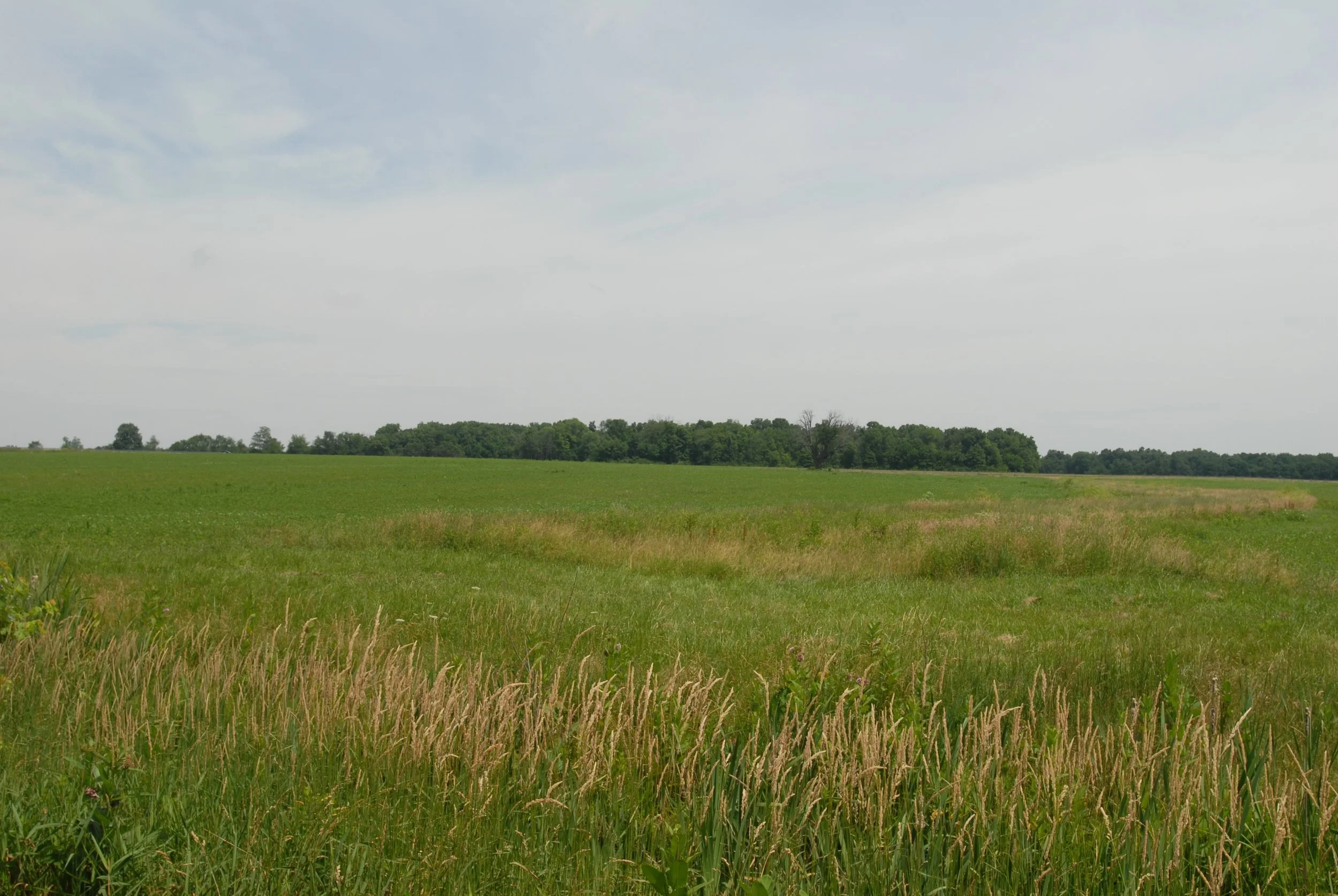
Montana’s Rolling Grasslands
It took most of the day to return to Red Lodge then invest the windshield time crossing Montana. My grandmother took three days and of those miles wrote, “We crossed the Fort Peck Indian Reservation and along our trail for miles were the Indian tepees, alternating with modern bungalows on the more prosperous ranches.
“We saw the Indian young men herding great flocks of sheep that must have contained between two and three thousand head. Large herds of cattle and horses seemed to be their chief source of wealth for no grain farming was in evidence anywhere near the trail.
“The Indian people always spoke pleasantly and seemed intelligent and well mannered whenever we talked with them. They belong to the Sioux we were told.”
It was dusk when we reached Theodore Roosevelt National Park. If we hoped to camp Covid had rewritten the park rules closing the campgrounds until further notice. While the South Entrance was open, the South Unit Scenic Loop Road and the Information Centers were also closed.
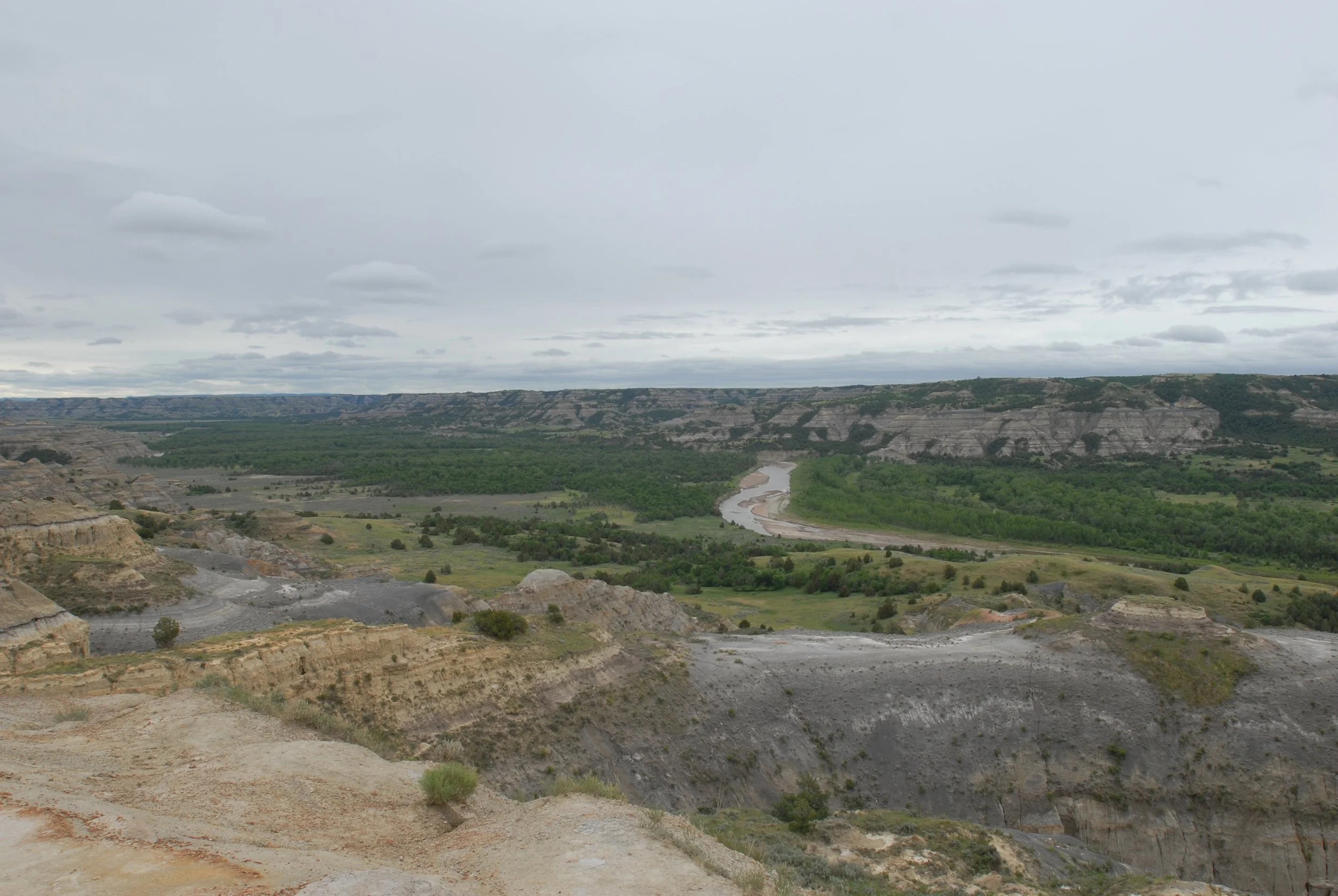
Teddy Roosevelt National Park
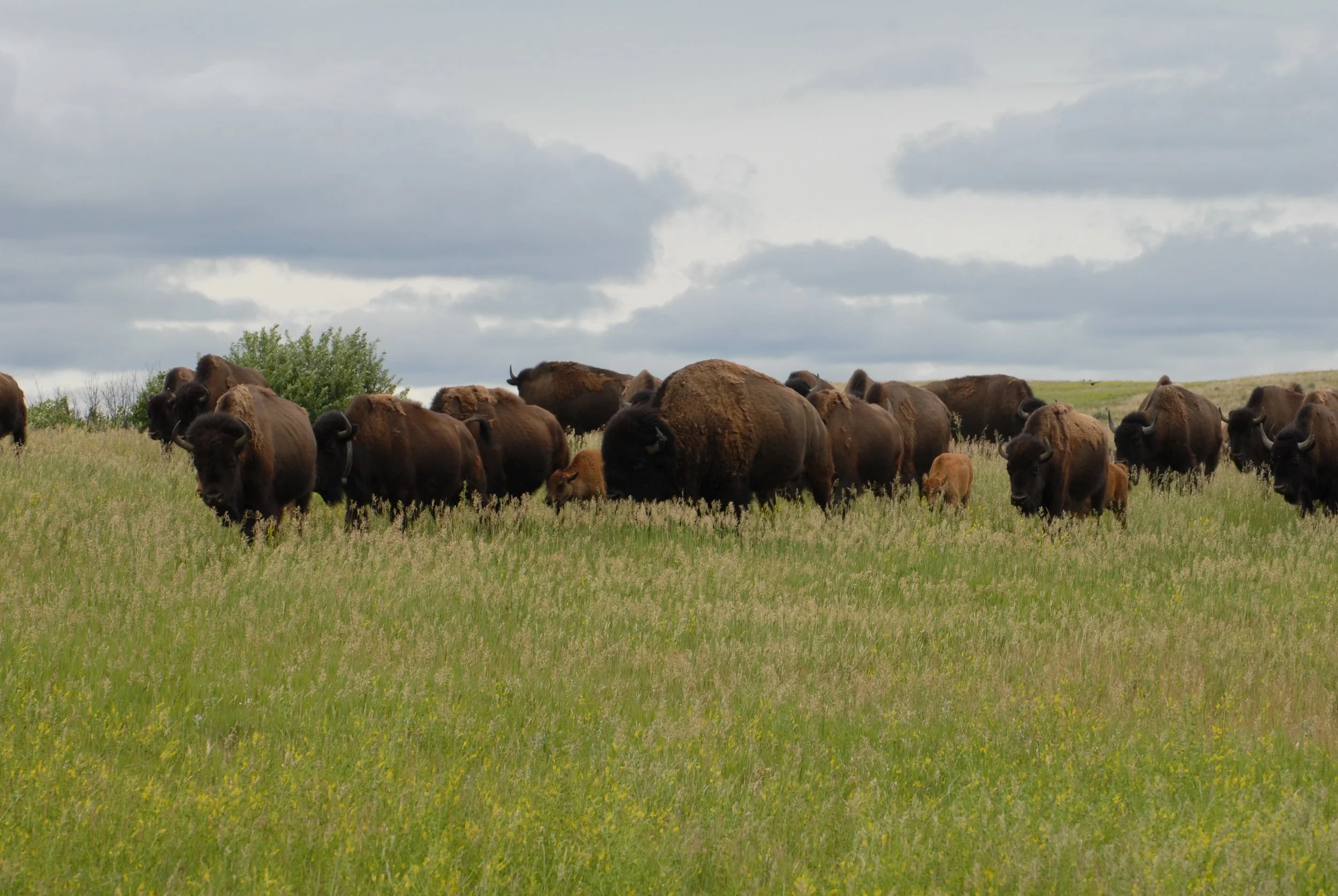
We hit a low point that evening and were ready to throw in the camping towel but my conscience wouldn’t allow us to skip the park and we continued the few miles to Belfield where the concierge at the Cowboy Motel, after quoting an eye watering price for a room said, “Camping? With a tent? Not that I know of! If you had a trailer, that might be different, but a tent?” She shook her head.
With no other choice, we pushed ahead to Dickinson, North Dakota where we again traded our tent for a hotel room. While checking in Linda asked the desk clerk if she thought it would be worth returning to Roosevelt National Park. “Hun’,” She said. “You've come all this way…of course it’s worth returning a few extra miles.”
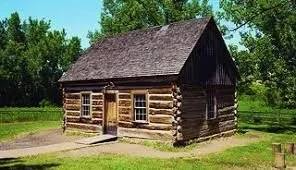
Roosevelt’s Maltese Cabin
Rain was threatening when we stood in front of Theodore Roosevelt’s Maltese Cabin near the Visitor Center. I did not know it then, but the grass hills, eroded canyons and single room cabin also spoke to Edith in 1923 during her journey west from Illinois. The log cabin had been moved first to Bismarck then back to the park and in a story published on February 18, 1923 in the Los Angeles Times, my grandmother wrote.
“President Roosevelt’s log cabin was brought to the capital city and is preserved on the State-house grounds as a memorial to one of our dearly beloved Presidents and the greatest and most fearless Americans of modern times….
“The log house formerly stood on the Roosevelt “Pleasant Valley” ranch at Medora in the heart of the North Dakota Bad Lands and was occupied by Mr. Roosevelt for several years when he was in the West for his health. Its logs are soft gray in color and carved with countless initials of those who have been its visitors.”
“The weather-beaten little cabin faces the east and the sunrise, as though its face were lifted to the realms of the morning, whence has journeyed the spirit of it’s departed master; and as I turned to go, I sent up a silent petition that God would grant to America in this her time of testing the wisdom and courage to “carry on” the great principles of righteous living and right government on which our nation was founded and for which Theodore Roosevelt devoted his life….”
Because access was limited in the South Unit we followed Highway 85, to the North Unit where a rough, serpentine road threatened to dislodge the Mason Hamlin as we passed herds of buffalo, antelope, deer and a lone eagle riding the thermals above the Little Missouri River.
We had not plotted a specific route back to Michigan. Instead, we planned to stick to backcountry roads in a search for what remained of the America I witnessed from the back seat of my father’s 1951 Buick Woody station wagon.
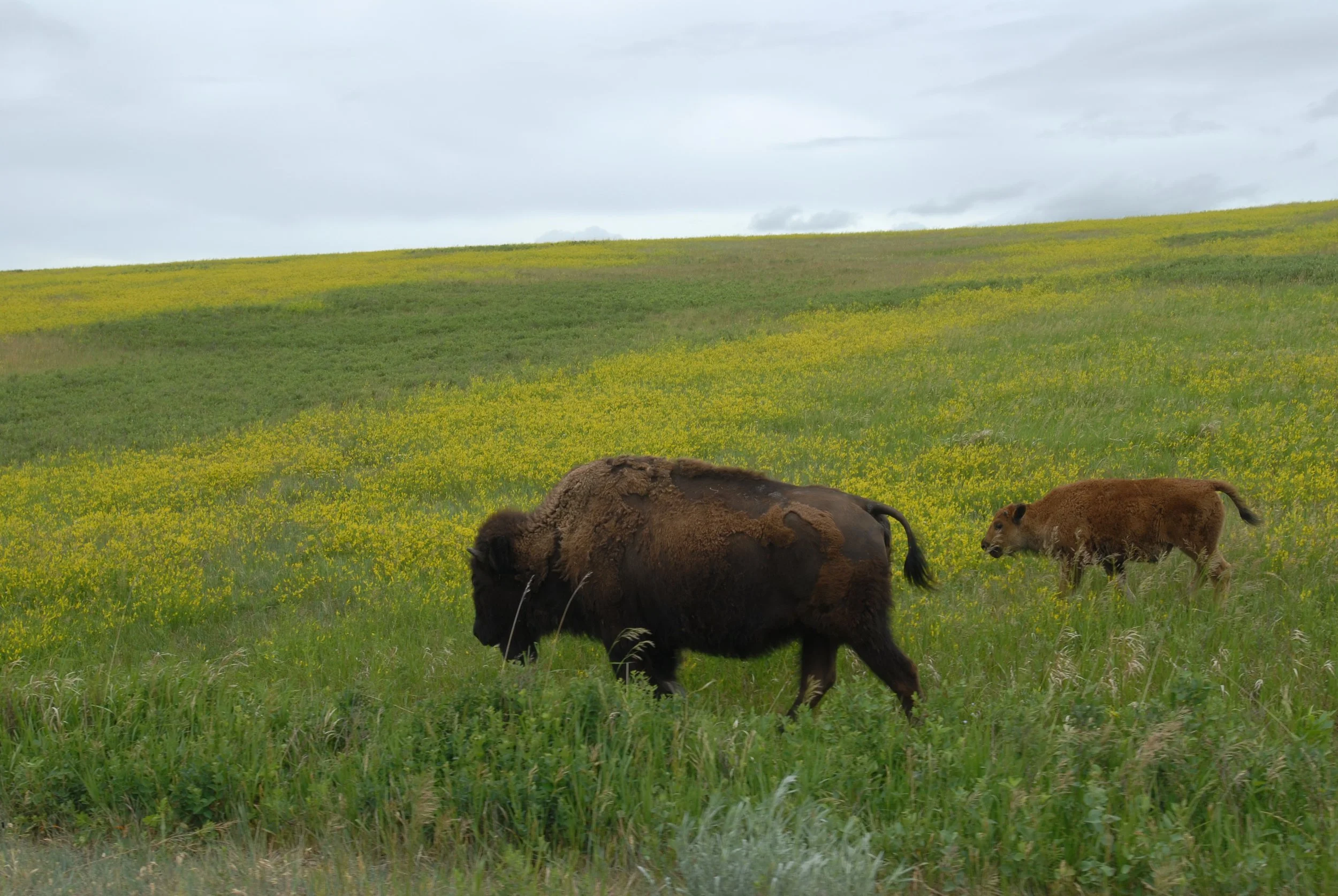
It was past noon when we turned east on North Dakota’s Highway 200 through rolling grasslands toward Killdeer, Werner, Dodge and McClusky. The clerk at McClusky’s two pump station advised us, “Lucky you filled here, there’s no gas for another seventy miles.”
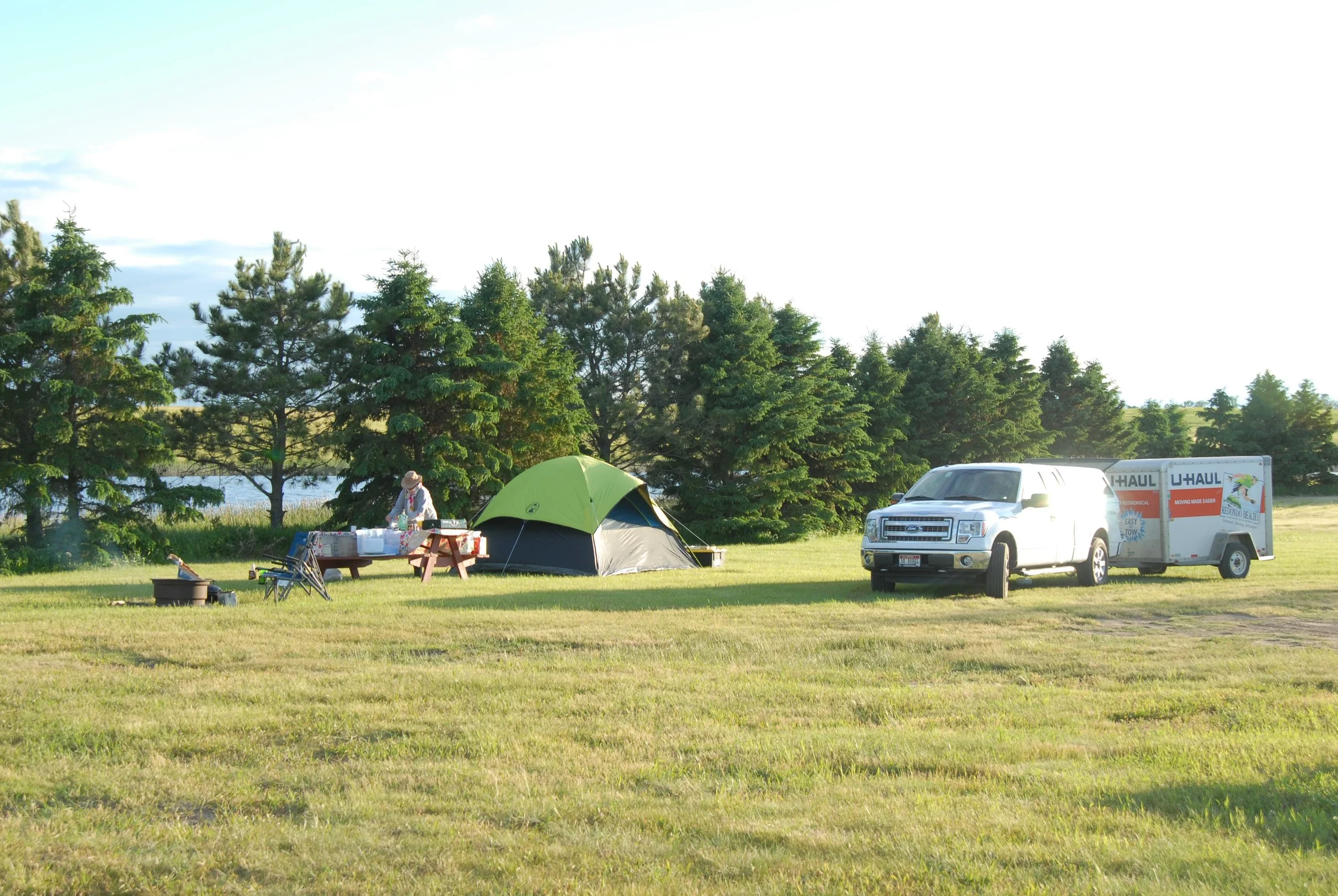
Camp Ground in McCluskey North Dakota
Storms had chased us from California, through Idaho and Wyoming and Montana to North Dakota. Now, under clear skies we were anxious to set up the tent and cook over an open fire. I asked the McClusky clerk if she knew of any camping along 200 east. “None that I’ve heard of but we’ve got some wonderful camping north of town.” Wonderful camping proved to be a hundred acre lake that charged $10.00 for a site on a peninsula surrounded by cattails. We erected the tent at the edge of a cedar windbreak where, after the last tent stake was driven home and the sleeping bag was spread across the blow up mattress, a shower of ticks spotted both the rain fly and Linda’s shoulders. Following a quick tick check and a liberal application of Cutters, the tent was moved.
That evening, ten minutes before dinner was ready, a bleak north wind drove us into the truck where we dined on barbecued steak, potatoes baked in the fire coals, a tossed green salad and chilled glass of cabernet. That night we were wakened at 2:00 a.m. by pickup headlights from lovers seeking solitude. Half an hour later, the county sheriff’s headlights swept our tent as he appeared to send the lovers on their way.
Dawn rose over the flat plains in a spectrum of royal purple, violet and a deep rose that in turn gave way to the faint yellow of the rising sun. Night mists clung to the tent’s rain fly and I spread it on the truck’s hood and waited for it to dry as I brewed coffee on our two-burner Coleman gas stove.
Edith described how storms chased Elmer, her mother Clare Wood, daughter Clara and her across the country. When it rained, as it did on most nights, Edith would drape the canvass tent across the Model T, where the morning sun would dry it sufficiently that it could be packed and stored for the day’s journey. And on those days when the rains continued unabated through breakfast, she would pack the wet tent behind the front seat and for the next day she would pray for a break in the clouds as Elmer fought the muddy ruts and axle deep puddles on their way west.
In an article for the San Francisco Examiner, she wrote, “When we reached Medora we found that owing to the recent heavy rains, the trail to “Pleasant Valley” ranch was under water as the Little Missouri was out of it’s banks . . .
“We followed the highway west from Medora and we encountered some of the worst mud holes I have ever gotten into and out of.”
I packed our tent into the pickup and continued that day east across central North Dakota through rolling hills where herds of Black Angus, Herefords and Charolaise cattle stood belly deep in high plain grasses. Highway 200 skirted pothole ponds where a north wind ruffled the surface and mallard, sprig and teal nested in shoreline cattails.
We continued east on Highway 200 through rolling farmland, and meandering streams traced by green ribbons of willow, cottonwood, ash, and oak. Carrington, Cooperstown, Marysville and Halstad appeared and receded as the endless Great Plains reached to distant green hills that in turn rose to North Dakota’s indigo sky. Scattered copses turned to forests as Highway 200 passed through Mahnomen on the White Earth Reservation until the oak, maple and birch closed over the road and we crossed the border into Minnesota.
My grandmother also crossed the state 1922 during a trip to Canada and the Pacific Northwest. In a story for the San Francisco Examiner she wrote,
“We followed the Jefferson Highway to Warren that joins the old Pembina Indian trail of early settlers’ time from St. Paul to Winnipeg, Canada and in places, as unbelievable as it seems, traces are still to be seen of the old ruts left by the oxen carts of bygone days.”
It had been a wet spring and the western prairies were filled with wildflowers that crowded out of the ditch banks next to the road.
My grandmother wrote, “One of the loveliest features of the Indian Trail were the flaming masses of red tiger lilies that grow wild on Minnesota’s prairies. The children gather their arms full of them repeatedly.”
I imagined how my father, uncle Carl, Clara and Anne stood waist deep in the prairie flowers until their father called them back to the Tin Lizzy where the children’s flowers were scattered across the back seat until they wilted and were cast out the Model T’s open side and along the rough road as the old, underpowered car labored west.
By that point we had towed the Mason Hamlin more than a thousand miles. My father’s presence in the back seat had not faded and I wondered where Edith had played and sang during her journey from Peoria to Seattle. The music lived in her, as it would later live in my father and my sister Lenore and I imagined she would ask Elmer to stop at a hotel where she hoped a piano would grace the lobby. It was not because she sought the approval of an audience that she would square herself to the keyboard, position her feet on the pedals and start to play. Even so, a crowd would gather, as they did for my father who as a boy stood to one side and watched his mother’s hands glide across the keys as her soprano voice filled the lobby. And when she finished, the crowd would applaud, she would nod her thanks and return to the Model T.
I had known Bob and Judy Harrington since my early days in Ketchum. Bob, nicknamed “Harry” had left Bemidji for college in Bozeman Montana. Following graduation he returned to manage the family shoe store. Judy worked in a women’s clothing store across the street from Harrington’s Shoes and while Harry wasn’t overly interested in women’s fashion, after watching the red haired Judy arrive for work, he crossed the street and introduced himself.
While invitations were extended to fish and canoe the Minnesota’s lakes, we were two hundred miles west of Bemidji when I dialed Harry’s cell. We intended only to take Harry and Judy out to dinner then press on to Michigan but they invited us to spend the night in their lakeside home.
That night I thought of Edith while Harry described how he loved to hunt the Northern Mallards that spiraled onto ponds around his hunting lodge. In 1922 my grandmother wrote, “The town of Bemidji, near the park, is the center of the hunting region and is headquarters for deer and bear hunters. Plenty of good Indian guides are to be had from the nearby reservations and splendid fishing as well from Bemidji, Class and Leech lakes.”
The sun was setting when Harry led us out onto their dock where he dropped a leech pattern in front of a large mouth bass that lived in a weed bed above a drop off. Harry stripped in line and the leech fluttered across the still surface. A second passed before a drain opened beneath the dark fly. The heavy bass fought well, surging toward deep water then struggling to tangle the line in a sunken branch. Harry knew this bass, and turned it toward the dock until, in time, it rose from the depths, dark back, golden sides, an ancient fish that he held for a photo then released.
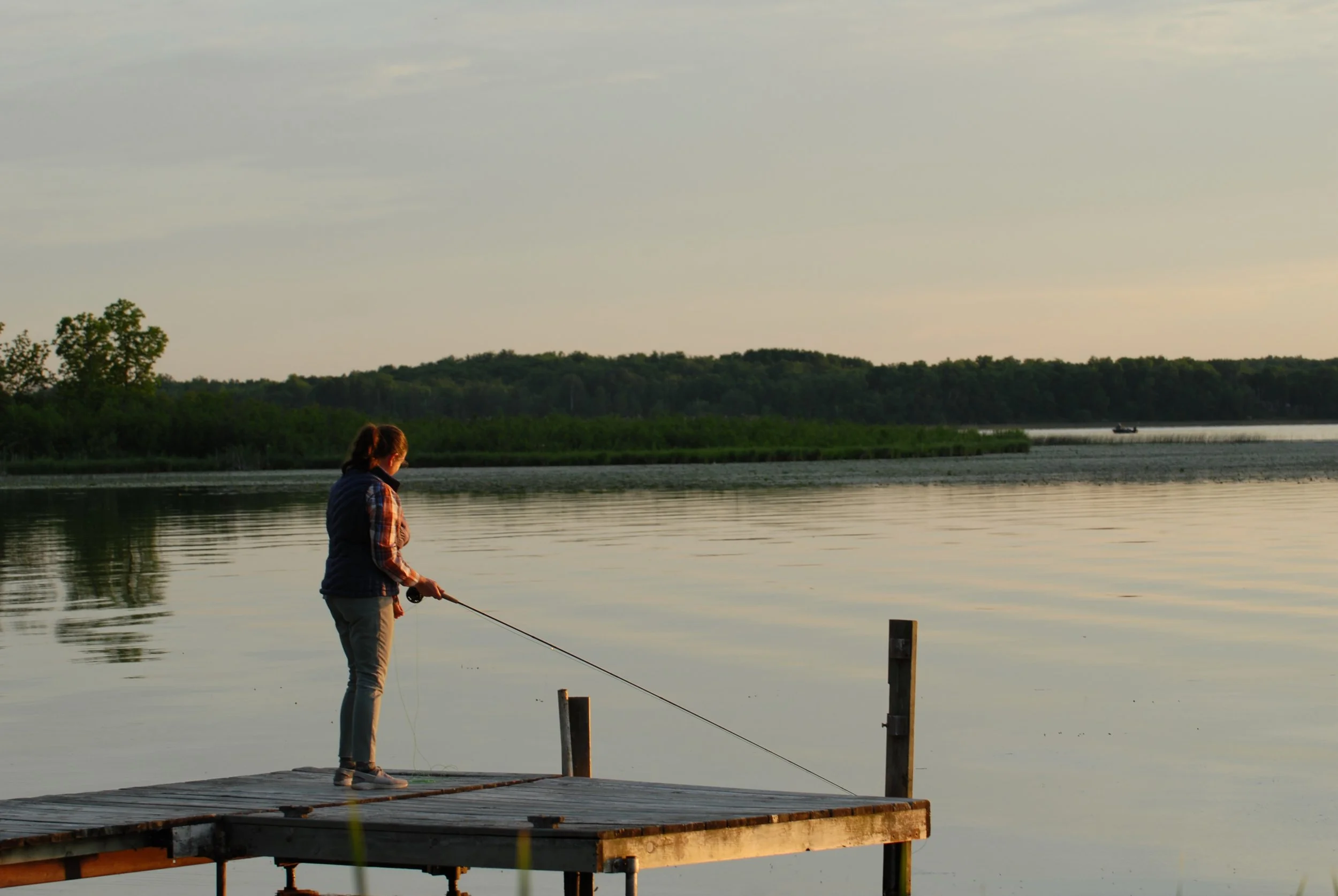
Linda Fishing Off Harry Harrington’s Dock
Morning on the lake grew in shades of purple and a nesting loon calling from the reeds. Too many years had passed since I shared more than a cup of coffee in Sun Valley’s Lookout restaurant with Harry and Judy but with regrets over having to leave and promises to stay in closer touch, we turned southeast on Highway 2 toward Grand Rapids, Duluth and further along to Ashland on the shores of Lake Superior.
Storms had chased us from California, through Idaho and Wyoming and Montana to Minnesota and now, two hundred miles west of Marquette, Michigan in Iron River Wisconsin, southern storm clouds pushed above Highway 2.
The approaching low pressure deepened my hearing loss. All sounds––music, Linda’s voice, and road noise–– were stripped of the high notes and I listened to myself repeat, “excuse me…what did you say?” Linda was more concerned than annoyed and the miles passed in a series of thumps and rumbles. The windshield was filled with a tapestry of green forests, ruffled ponds and dark clouds before the rain pounded down in a gray wall that changed the road to a shimmering mirror. Approaching headlights turned to prisms in the struggling wipers. Depressions flooded and the F-150’s front wheels threw waves off the road into oncoming traffic.
A gray, sullen dawn rose over Marquette’s rusting ore docks as we followed Highway 41 south through the Upper Peninsula’s marshes to Yalmar and Trenary that backed into the deep forest, to Rapid River where we rejoined Highway 2 west. Miles passed as Highway 2 traced Lake Michigan’s north shore. Echoes of French Voyagers, the Chippewa Tribe who thrived on the wild lake and among the deep forests, birch bark canoes filled with furs and the trade that would eventually open the Upper Peninsula, haunted the road. I cannot judge whether that early contact, or the first roads and the farms and towns that followed were a blessing, or curse. What is clear, the Northern Shore of Lake Michigan has been tamed by the resorts, second homes, marinas and pastie and fudge road side attractions that thrive on tourism.
In time we turned on H-33 the Manistique Lake Road that led north to Curtis, and further on Birch Shores. Jay, Mithril, Birch and Ripple were excited to see us and led us to a cabin that sat on the lakeshore. After eight days and twenty-five hundred miles, I backed the U-Haul to Jay and Mithril’s front porch, freed the straps, removed the shipping blankets and carefully rolled the Mason Hamlin across the front porch and into the living room. It found a home against the north wall that faced the garden, sugar shack and weathered cabins.
I remembered how my father loved to fish, camp and hunt and how he dreamed of starting a bush pilot charter service once he retired to Alaska. And while I was at best a failure as a Boy Scout, Mary Catherine told me Dad earned the highest number of merit badges in Oregon.
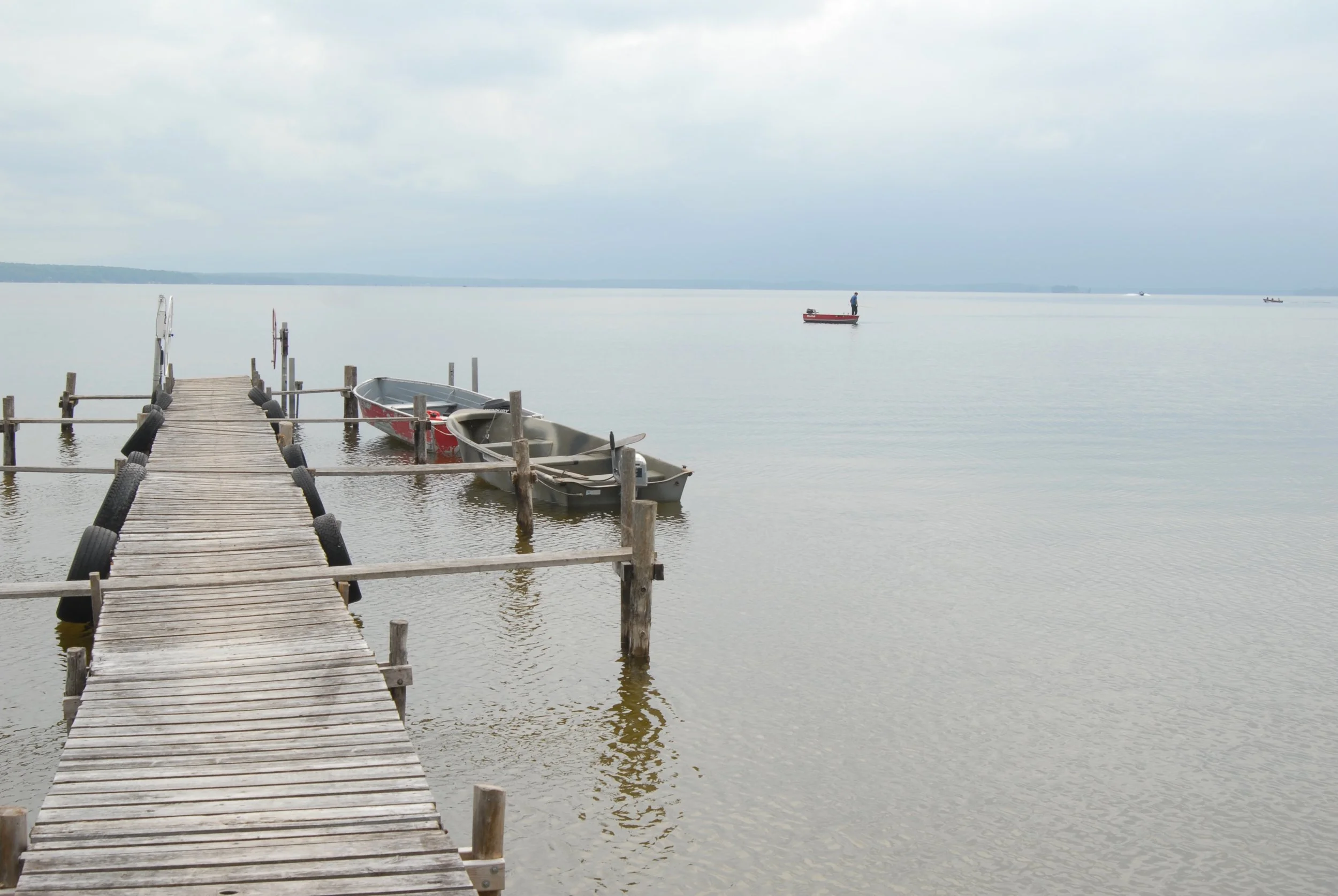
Birch Shores Dock
Now, I imagined how he would untie one of the Birch Lodge skiffs in the early morning when the loons were calling, start the outboard and turn toward the deep water where the schools of walleye waited for a flashing imitation. I watched him cast a lure across the mirrored surface and, when it sank, start to reel. Though my father loved to catch fish, he no longer reeled and cast, reeled and cast, reeled and cast simply to put fish on a stringer but to reclaim the years when he was young, married to Mary Catherine and father to three daughters and two sons. I watched him stare at the distant shore as he cast and reeled, cast and reeled until the empty lure shimmered out of the dark depths.
I was grateful to Mithril for calling Bill Van Effen, the Upper Peninsula’s resident piano tuner. Mr. Van Effen had tuned pianos for thirty-five years and, equipped with a bag filled with tuning wrenches, proved to be a man of many talents––piano tuner, band member, pilot, politician–– he now settled on the bench, opened the Mason Hamlin’s mahogany face panel and touched an ivory key.
“Beautiful piano,” he said as he listened to the resulting note and turned the wrench. An hour and twenty minutes later, he tuned the final key, closed the cover and began to play. Not ‘Claire de Lune,” I would surely have taken it as a final message from my father, but “Danny Boy” the 1913 song by Frederick E. Weatherly that speaks of a mother’s, or lover’s love and fears for a son leaving for the war.
Oh, Danny boy, the pipes, the pipes are calling
From glen to glen, and down the mountain side.
The summer's gone, and all the roses falling,
It's you, It's you must go and I must bide.
But come ye back when summer's in the meadow,
Or when the valley's hushed and white with snow,
It's I'll be here in sunshine or in shadow,—
Oh, Danny boy, O Danny boy, I love you so!
But when ye come, and all the flowers are dying,
If I am dead, as dead I well may be,
Ye'll come and find the place where I am lying,
And kneel and say an Avè there for me.
And I shall hear, though soft you tread above me,
And all my grave will warmer, sweeter be,
For you will bend and tell me that you love me,
And I shall sleep in peace until you come to me!
Mr. Van Effen filled the living room with the familiar, but somber song. When he finished and the music faded he turned on the bench and confessed, “I’ve tuned pianos for most of my life and this is the best I’ve ever encountered.”
The Mason Hamlin had belonged to my family for seventy years. In that time it had played during times of great joy and deep grief. The record of our family’s history lived in its mahogany case, ivory keys, steel and brass frame. After moving it halfway across the country, could I now give it away?
A moment passed, Mr. Van Effen stood, gathered his tools and said goodbye.
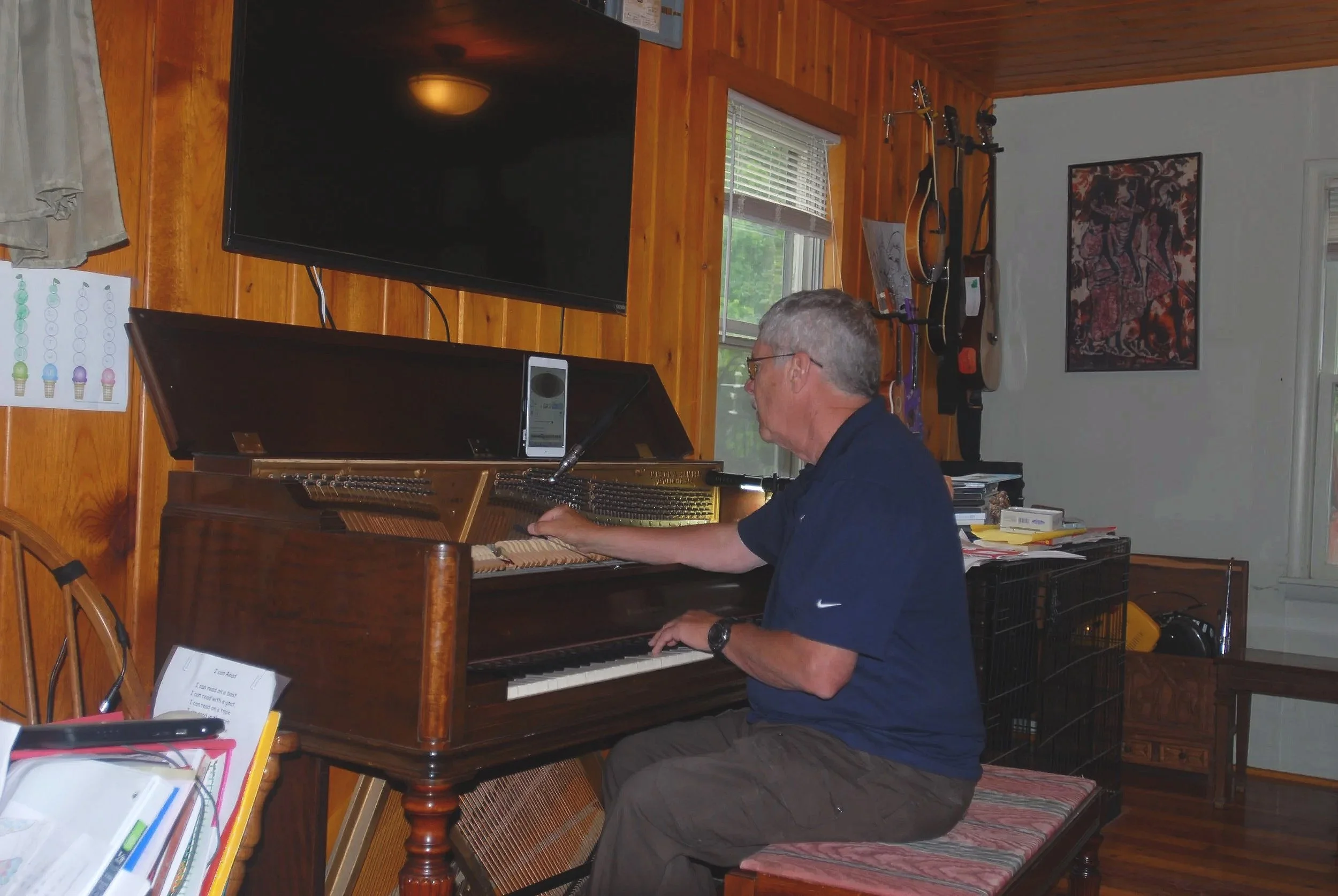
Bob Van Effen Tuning Dad’s Mason Hamlin
Mithril watched Mr. Van Effen go then quietly said, “The piano still belongs to your family. Let me know if you ever want it back.”
She then retrieved a page of sheet music from a file and settling on the bench, began to play “Clare d’lune.”
The silence in my right ear that had haunted me since Idaho faded and I listened as the familiar notes filled the old cabin.