
Diary of a Deer Hunter
July 15
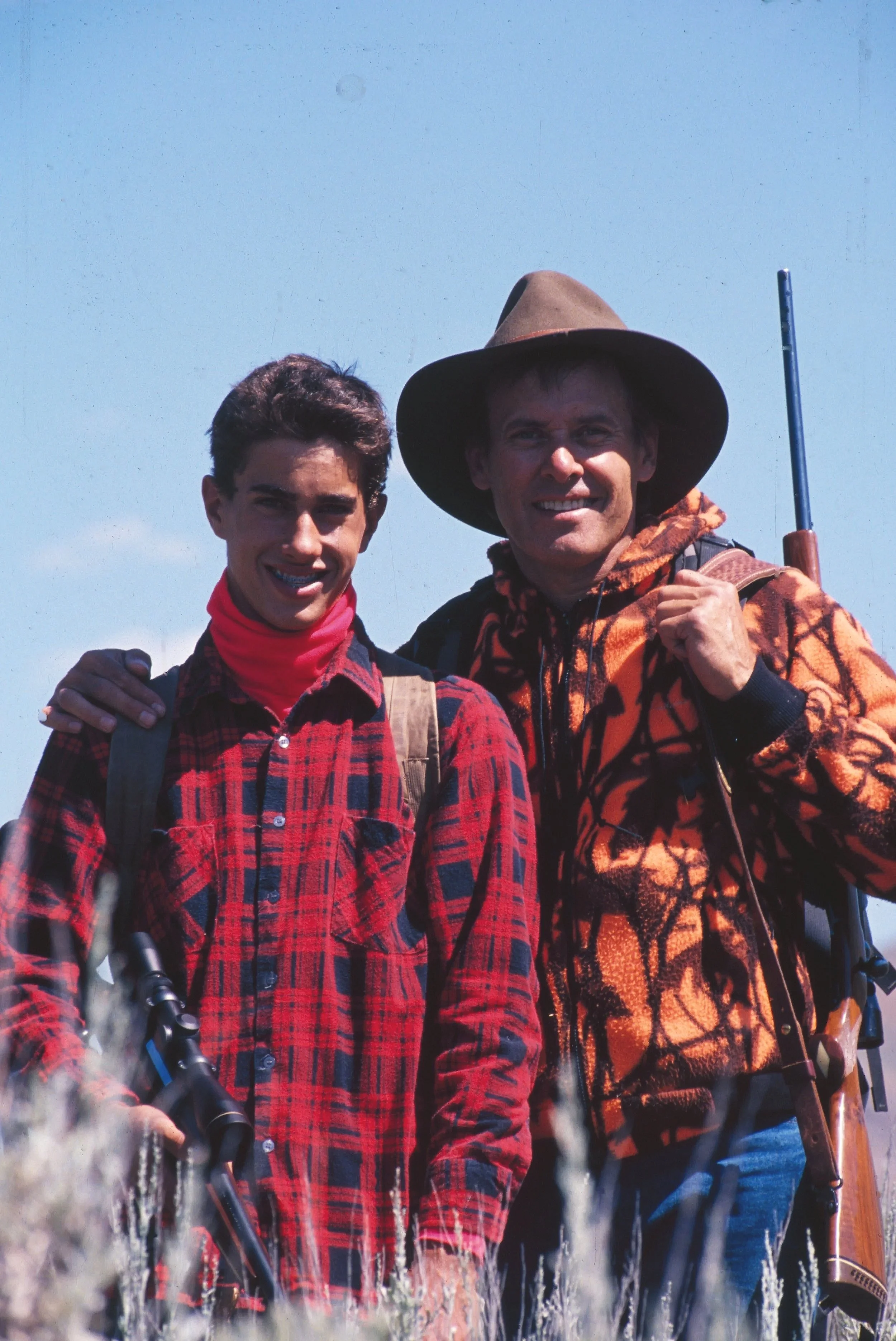
I wouldn't normally be thinking about deer season in mid July's ninety degree heat. July in Ketchum, Idaho is devoted to fly fishing on the Wood River, hikes into high mountain lakes and single track mountain bike rides past abandoned silver mines. But this July is different. My son Andrew turned twelve on the Ides of March which means if he passes Idaho's Hunter Safety, he can carry a rifle this coming October.
Andrew should be writing this diary not me. He is too young, however, to assign much importance to a chronicle of his first hunt. A day lasts forever when you are twelve and thoughts that now seem very ordinary, will become incredibly valuable in 2030 when he too turns forty-seven. If I am alive, I will eighty-two, roughly the same age as Andrew's grandfather Rob Seely. Rob hasn't deer hunted in a decade and when I last tried to drag him out into the flat desert south of Carey, he laughed, shook his head and admitted," No, my deer hunting days are behind me."
On this July 15th, Andrew is five feet one inch tall, weighs ninety pounds, has dark thick hair and my rangy build. He is also drawn to baseball, soccer, alpine skiing and cross country--sports that place a premium on endurance and foot speed.
I could have predicted my son's love of deer hunting. He has watched me stalk, kill and clean deer since he was old enough to place his boots quietly in my tracks. He has helped me butcher heavy hindquarters on our kitchen counter and knows meat doesn't grow in cellophane packages, but in Idaho's heavy timber and on sage covered hillsides.
Now he appears in my office and asks, "Dad can you give me a ride to Hunter's Safety?"
"What time?" I inquire, without looking away from my computer.
"I have to be there by a quarter to six. That means we should leave here by 5:30." he tells me, revealing his mania for promptness. By the time I thought about hunter's safety, he had scraped together the fifteen dollars, written away for the application and was registered.
When Andrew was an infant, I could not wait to teach him how to cast a fly rod, train a wire hair pointer or handle a shotgun. I believed that I had much to pass on to my first son about tying flies, calling ducks and hunting deer. During the first of five Hunter Safety classes, however, I watched other fathers coach their sons and wondered if, by serving as a buffer between Andrew and his instructors, I'd rob him of the ability to make the right decisions. Intuitively, I felt I should step back and let him make his own mistakes. Not with a gun, of course, but mistakes in a controlled situation, which is exactly what occurred. Sun Valley's Hunter Safety included two hours at High Desert Sport's indoor laser range. In this darkened basement deer, elk and bear walked, stood and turned on the wall twenty five feet away. Graded on safety and bullet placement, after hitting an elk in the heart with the pistol's red beam, Andrew turned excitedly toward his friend Robert Fundy. The muzzle came around and all hell broke loose.
"What's the first rule of safety?" his instructor demanded.
Deeply embarrassed, Andrew still managed. "Know where your muzzle is pointed,"
"And where was it pointed?"
"At Robert," Andrew admitted.
His instructor shook his head. "That mistake just cost you a turn." he said. "In the field it could cost you a great deal more."
It was Andrew's only major error and he listened attentively, took notes and passed.
September 2
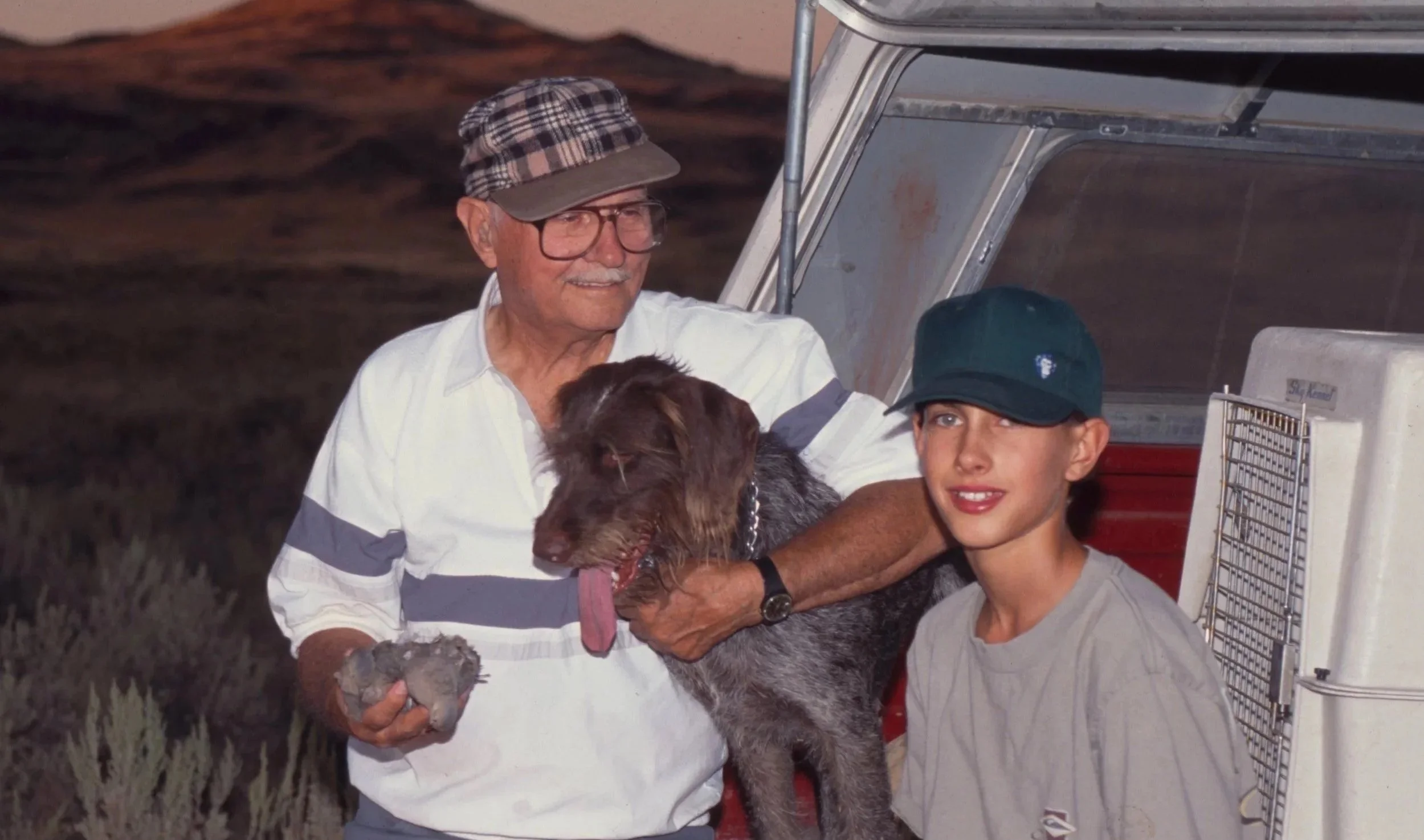
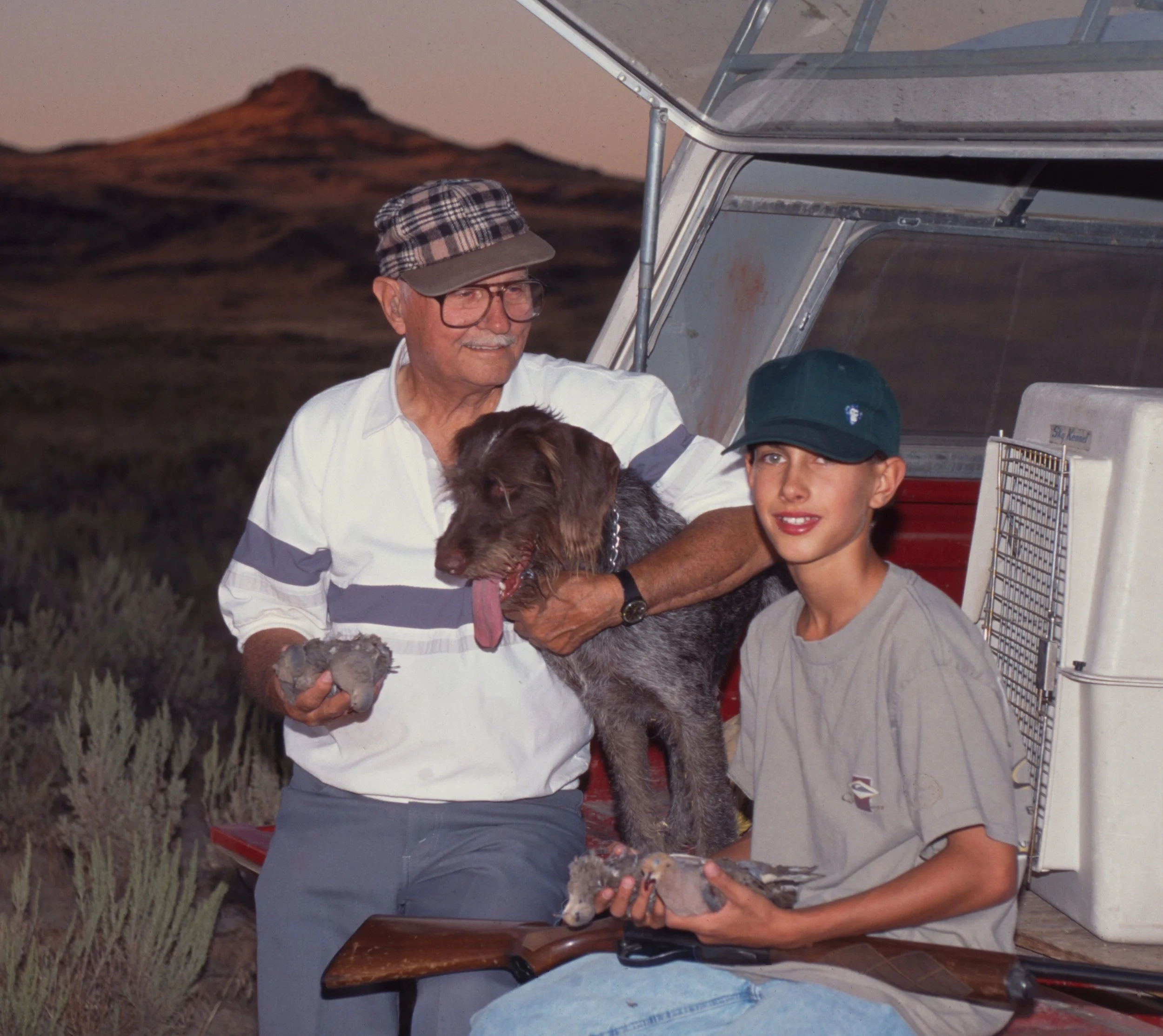
Opening day of doves in Idaho. Dependent equally on a bountiful crop of wild sunflowers, warm nights and desert springs, doves is an iffy season. I was early afternoon when I loaded the truck with Star our Drahthaar, a twenty gauge and a lawn chair for Andrew’s visiting grandfather Rob Seely to sit in while he bore witness to this rite of passage.
I don't expect to find many doves. Cold nights had pushed the birds out of the Wood River's tributary canyons but a dozen miles out a dusty desert road we spotted a field of sunflowers surrounded by red willows and a gray line of cottonwood snags. Six doves were sitting in the snag but scattered when we approach. Handing Andrew one low base eight, I watched a single return across the sage. Andrew waited too long and the bird flared out of range. The next was neither as wary nor as lucky as the first and tumbled into the sunflowers. Star found the bird but when she tried to give it to me, Andrew stepped between us.
"Star, it's mine, give it to me," he said, coaxing her to heel.
September 10
Andrew has been watching the want ads for deer rifles. He wants to raid his college savings to pay for the gun--an idea that is summarily rejected.
Fathers have strange ways of testing and rewarding their sons. I tell Andrew that my friend John Cole has a Winchester Model 94 , 30-30 brush gun an old Nevada line rider once owned. There are deep scratches on the stock and some rust on the barrel but Cole will sell it for fifty bucks.
“It's got iron sights and fifty yards is about its maximum range." I say, waiting for Andrew to complain about the 30.30's age, scars or lack of a scope. Instead he replies, "Any rifle will be fine," then asks me when we can pick it up. "I'll need to shoot it before opening day." he reminds me.
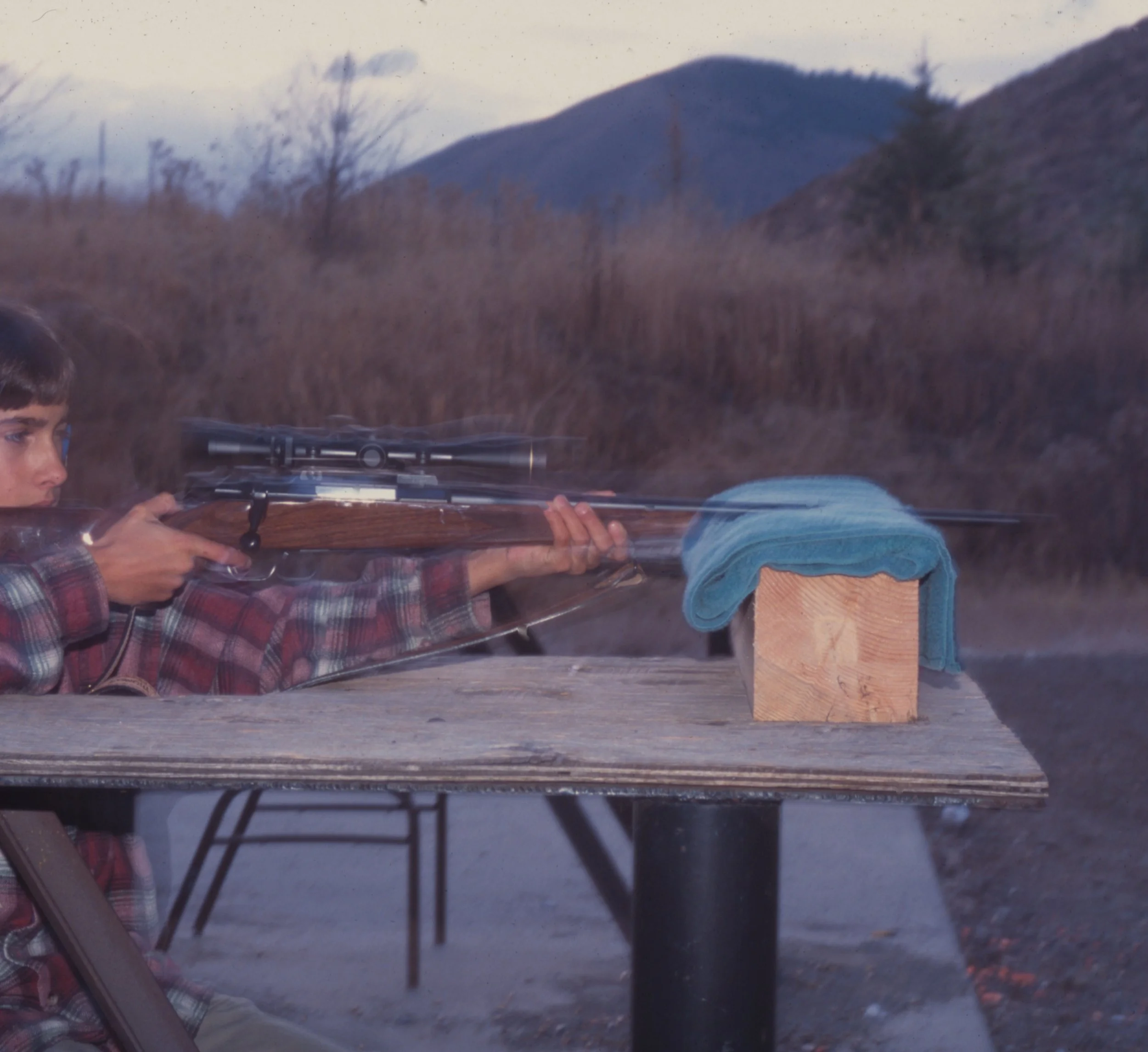
Cole is part of the deception and when Andrew calls to buy the 30.30, he admits, "I didn't know you wanted that gun! Your dad never got back to me and I sold it yesterday for fifty bucks! Andrew, I'm sorry!"
Disappointment and resignation flickered across his face, but there was no anger and after he hung up, he shrugged and said, "I guess we'll just have to keep looking."
The obvious choice for a twelve year old was a .243. Light, flat shooting with a manageable recoil, the downside of the .243 was the lack of bullet weights and cost. As expensive as a 30.06, in the hands of an inexperienced hunter, a .243 was too light for a big mule deer and out of the question for elk.
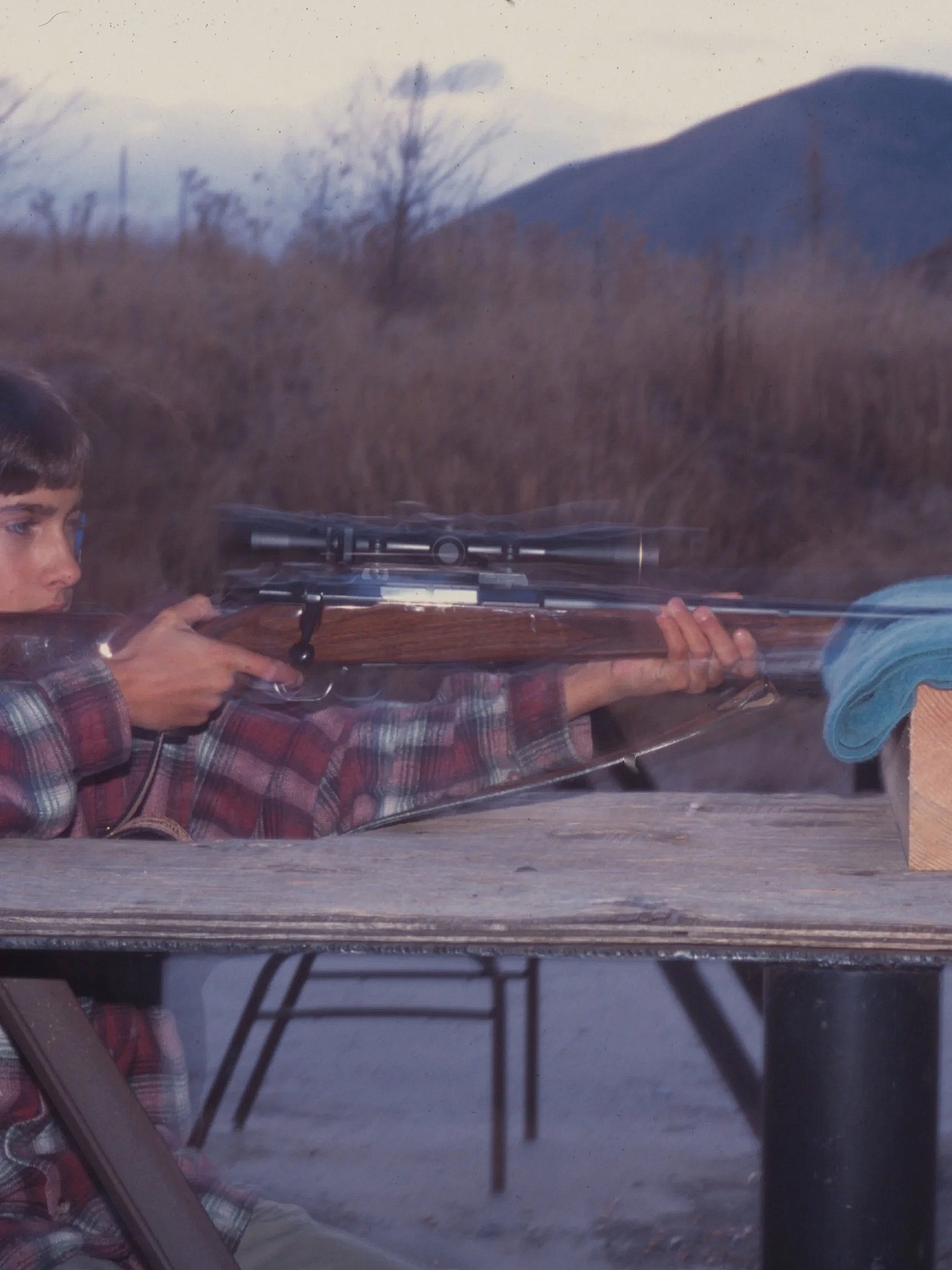
A 30.06 has excellent knockdown power and a range of inexpensive bullet weights. If I worried about recoil Andrew was able to hold a six inch pattern at a hundred yards with a borrowed rifle. Then too, he was growing fast and in two years, recoil would cease to be a factor. After much thought, I tapped his grandfather and my savings, to buy him a Browning Hunter with a Leopold 3x9 Gold Ring scope. Camouflaging the shining Browning in a stained old case I sent him on a twenty clue treasure hunt that stopped at the wood pile, Star's kennel, the garbage cans, the kitchen and his room. When he finally found the Browning he was ecstatic. "My own thirty odd six! My own deer rifle," he repeatedly exclaimed.
October 5
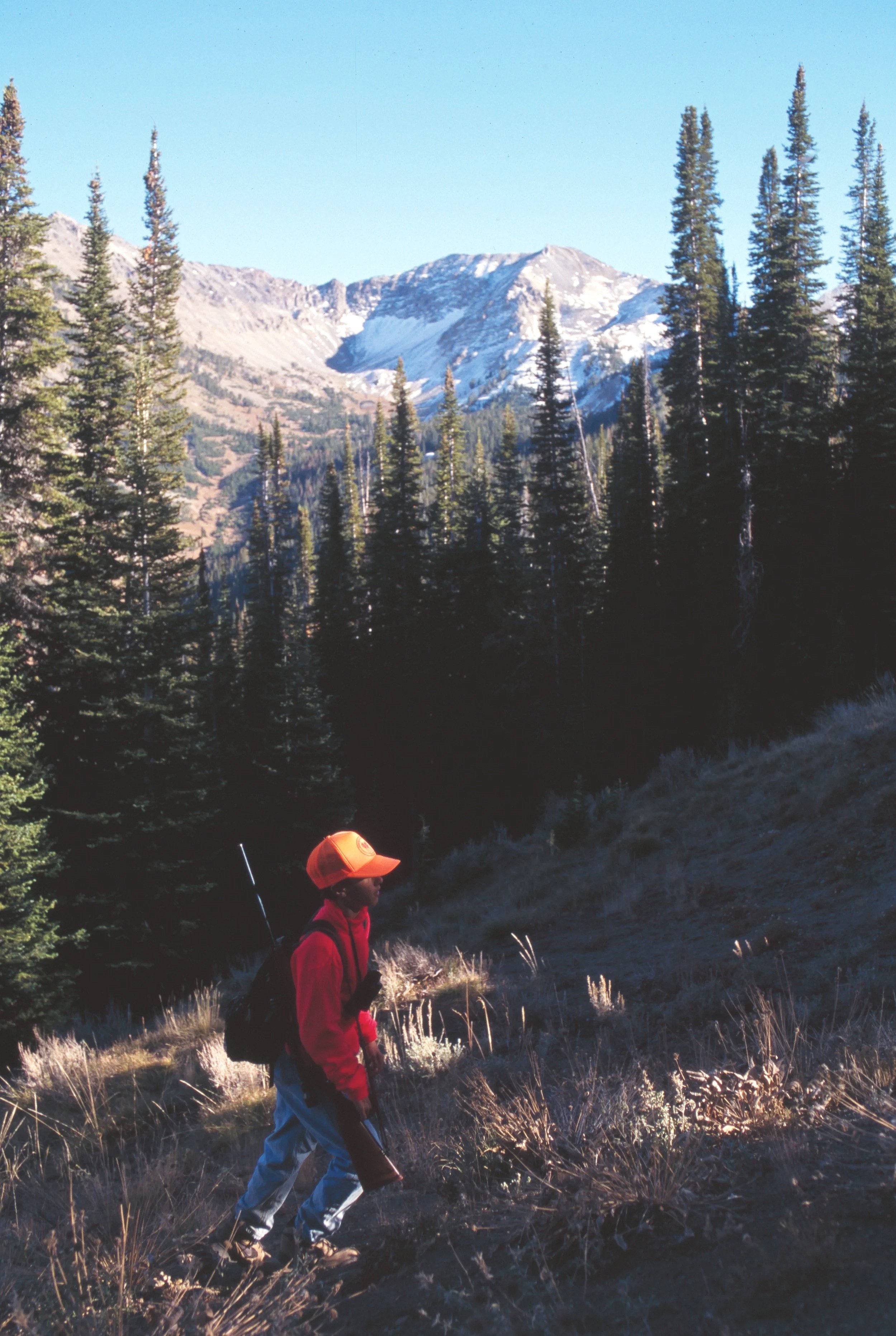
Dawn of Idaho’s first day of deer season, found Andrew and I on a sheer sage covered face. The combination of thick buck brush, high springs and heavy north facing forests offered excellent habitat and because the temperate morning air promised an unseasonably hot day, I hoped we'd see a buck. We were following a ridge line’s forested north side when a three point stepped into a sunlit glade. Turning toward us, he hesitated for a second then wheeled and bounded back into the thick lodgepole. As he raced through the trees, we just caught a glimpse of his rack.
An hour later, we watched a doe settle onto a sage covered hillside. Glassing the blue green brush around her, I counted a dozen deer including a small spike. On opening day, I suspected a dominant buck would also be bedded unseen in the sage. It took us half an hour to crawl on hands and knees and, when I felt we were close enough, I threw a small rock downhill. The spike stood up and turned toward the spot where the rock landed. Less than thirty yards from the small deer, Andrew had an easy shot, but I told him to wait.
"Why?" he whispered.
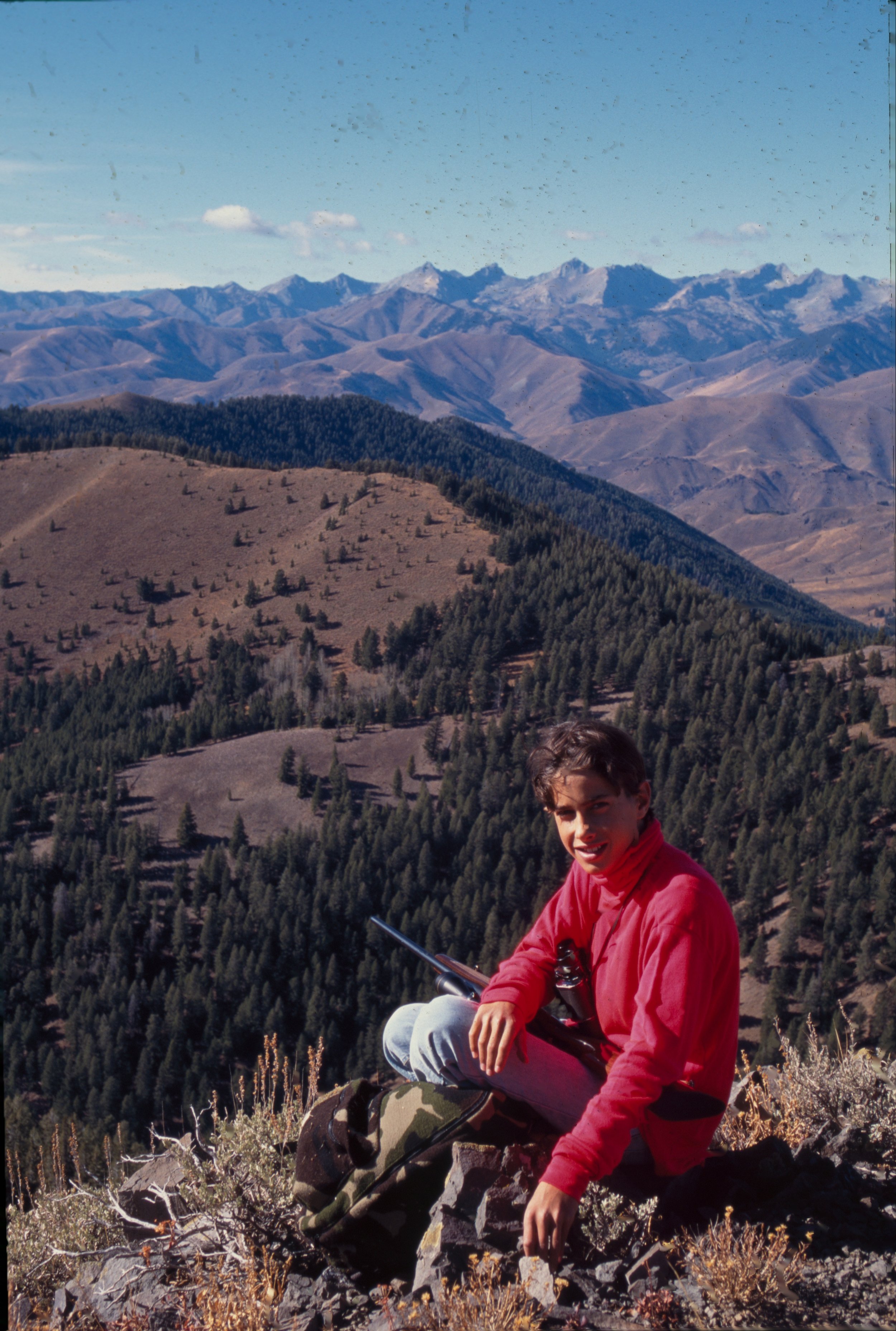
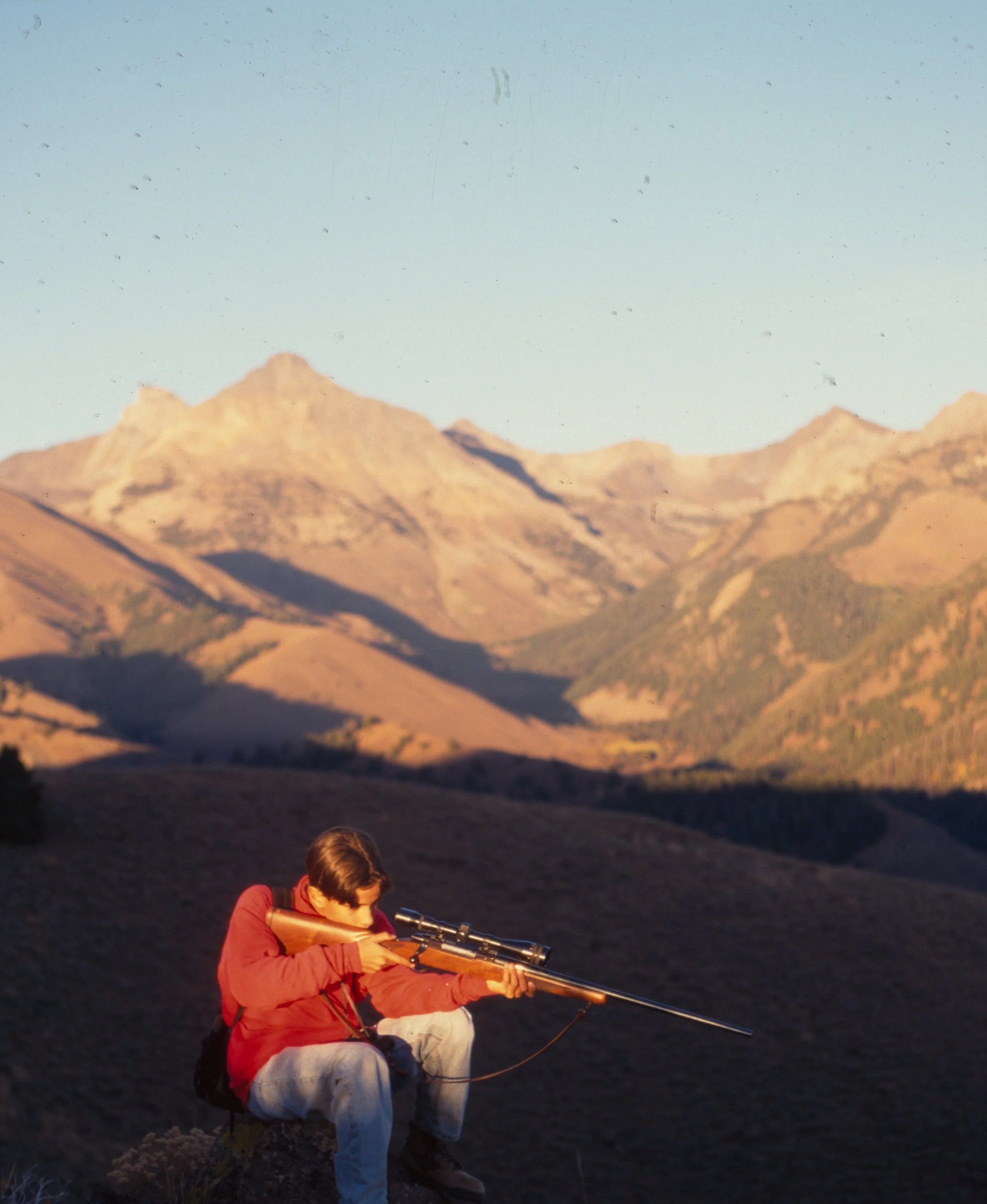
Keeping my voice down, I told him that if he shot the spike a bigger buck would stand up. I threw a larger rock down hill. Six does and five fawns rise out of the sage. There was no dominant buck and with a snort of alarm the spike bounced away.
October 7
It was late afternoon when we spotted a heavy bodied three point brousing three hundred yards away on the edge of a forest. Keeping an intersecting ridge between us, we narrowed the distance to sixty yards. Andrew was setting up for a shot, when I heard a door slam and turned to see an Sport Utility Vehicle parked on the sheep road behind us. A hunter was standing in the open, glassing the surrounding hills. When I turned back, the buck had slipped back into the forest.
October 8
We saw a decent buck just before dusk and managed to close to within a hundred yards before the gathering dark ruined our chance. That evening we hiked out in headlamps
October 15
It is nine a.m. on a wooded ridge east of Ketchum Idaho. For the past hour Andrew and I have been climbing a shale and quartz spine toward a huge buck that is brousing slowly across a high, sage filled bowl. To reach his sanctuary in the deep, north facing fir, the buck will have to cross a shallow depression just below us. We have barely reached a rocky outcrop when the heavy horned muley stepped into the open. From a distance of a hundred and twenty-five yards the buck carries the heavy shoulders and muscled hips of a yearling steer. But it is the muley's massive rack that causes me to pause in wonder. The beams travel out a foot before branching up into four major points. From these various minor spikes turn out and down creating an impression of size, power and an undeniable majesty.
On this, the second weekend of the season, I wish I hadn't promised this deer to my son. I wish I hadn't made him pass on the spike. This buck is simply too big, too much of a once in a lifetime trophy to serve as Andrew's first deer. In my thirty years of hunting big game, I have only seen one other buck that came close to this animal.
I want Andrew to get a buck, but not this buck. It's not that I am greedy or selfish or want it for myself, but I want to give him something to dream of, to work toward and to remember for the rest of his life. Any deer Andrew will shoot in the future would pale beside this buck.
The moment has a momentum behind it and I watch him sink to a sitting position, watch him bring his rifle to his shoulder and hear myself whisper, "Hold just behind his shoulder son."
I want his first shot to anchor the deer. I did not want to see it stagger and run, or drop and struggle to rise. For the sake of future deer hunts, I want the kill to be clean and wait for the buck to fall. It takes two steps up hill then hesitates, "Shoot again." I whisper. Again the 30.06 breaks the morning silence, but the buck simply stares at us then trots into the forest.
Andrew had missed it. Blame it on his high heart rate from the forced climb to the ridge or a deserved case of buck fever, he could not forgive himself.
All the try drained out of him as he leaned against an ancient doug fir. "Dad, why didn't you shoot it?" he finally asked me.
I told him it was his deer to kill or miss. I could not ruin the memory of those two shots by killing the buck. Nor, in hindsight, do I now want him to be able to measure that spectacular head. Over the years the buck will grow to mythic proportions and in time, Andrew will value the pain of that miss more than the joy of a killing shot.
October 29
Andrew and I were glassing a high open bowl when deer season ended. There was nothing special to fix the moment in time. The shadows simply deepened on the hillside until we could no longer make out details. Between other hunters driving into our stalk, or dusk coming on, or a rock carelessly kicked onto a shale slide, luck had stayed a half step ahead of us. The best I could do was to guide him, to find a buck and to position him for a shot. And failing that, to remind him there is always next fall
In hindsight, I wish Andrew had shot a deer, because I cannot tell him how he will feel for fear that my description will then become his experience and in a way ruin his chance for something personal, valuable and lasting. I also do not tell him that some of my best lessons resulted from failures. I do tell him that there are no guarantees. When you hunt big game you can rise early, move quietly and if you are lucky enough to see a deer on an open hillside, avoid impulsive shots--take a steady rest and when the scope holds steady on the neck or chest, pull the trigger, or not. But there are no guarantees.
We didn't kill a deer but I learned more about my son in those three weeks than I had in the past two years. Between the tough hikes and morning cold, the stalks and how he dealt with the disappointment of missing a huge buck, I developed a profound respect for him. I learned he is tough, dedicated and funny. He's also the best hunting companion I could ask for. "So, are you sorry you didn't shoot that spike on opening day?" I asked as we climbed down from the ridge.
"Since we didn't get a deer, sure," he confessed. "But then if I'd killed that spike, I'd have never seen that four point."
Epilogue
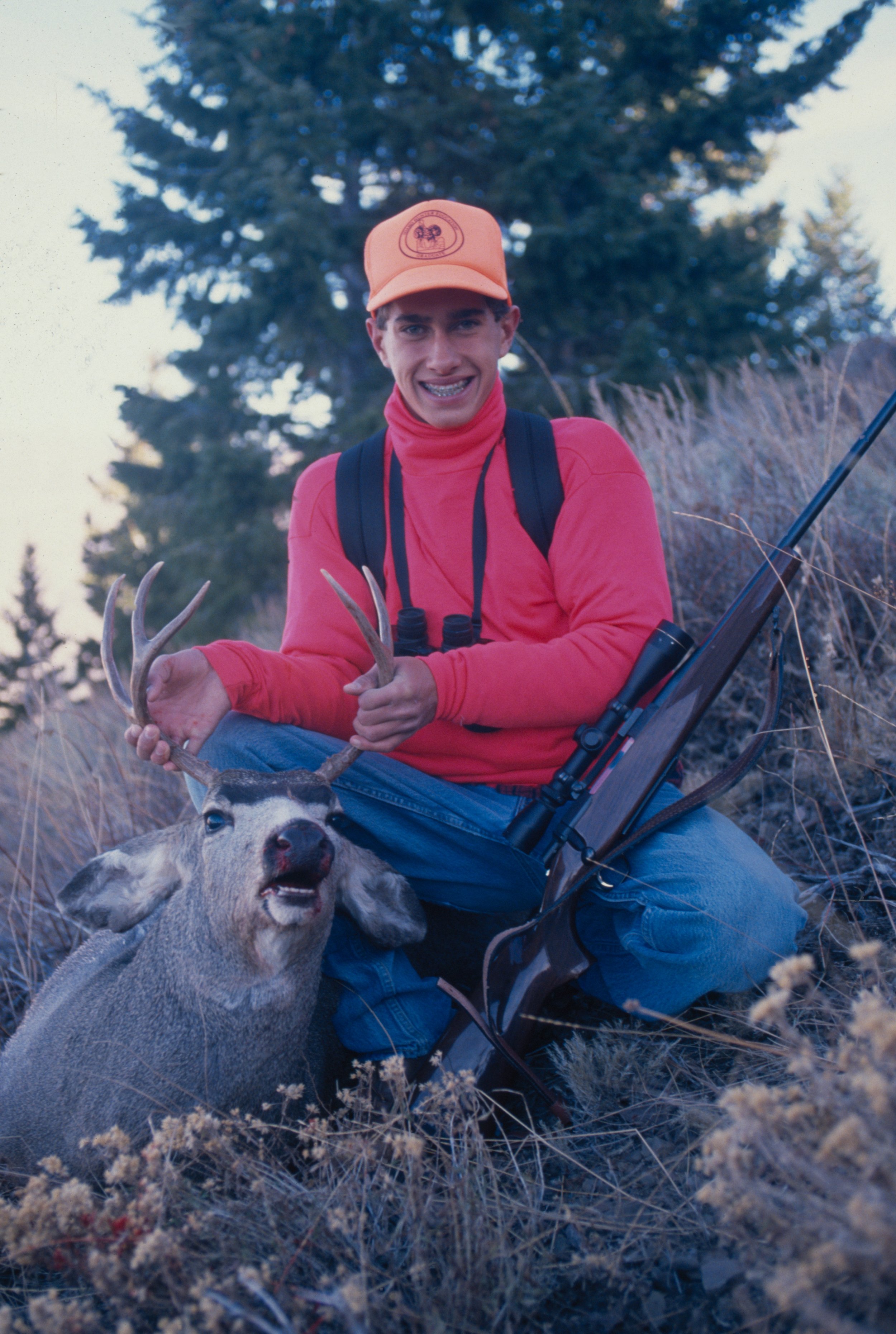
Andrew killed his first buck a year later. It was late afternoon on the opening day of deer season when we spotted a three point brousing across a sage filled meadow. After a fast uphill climb, he rested his rifle on his pack and squeezed off a shot. The bullet hit behind behind the buck’s right shoulder dropping it in the blue sage. As soon as Andrew calmed down enough to keep from cutting himself, I coached him through the field dressing. Then, while helping him drag it down to a road, I wondered aloud if he was sorry he took the first deer we saw.
In reply, he looked at me as if I was crazy.