
Hike Through Hell
The road to Hell's Canyon is a serpentine ribbon of potholed asphalt blasted through the native basalt. Constructed by dam builders in the mid-'50s, the road now hangs above Brownlee, Oxbow, and Hell's Canyon reservoirs. Above the road, black cliffs periodically dislodge cantalope sized boulders that fall and fragment, forcing the the driver of the River Rat Express, to pick a careful way through the debris. Loaded with twelve clients, five guides and all our gear, the old school bus shudders as the ex-highway patrolman downshifts and applies the brakes which shriek in the morning silence, then quiet.
Seated next to me on the green vinyl seat, my nine year old son Andrew wonders why the brakes are shrieking. He's at an age when he takes such things seriously and I lay my arm across his shoulders and ask if he's looking forward to hiking through Hell's Canyon.
“Sure,” he agrees then returns to listening to the brakes
Andrew is also rightly confused about the H word. A week ago he could say “Hell” only at the risk of early to bed and loss of privledges. This morning he can say it fifty times in a row, as long as he adds "Canyon. "
I had boated Hell's Canyon twice before and knew that from Hell's Canyon Dam downstream to Pittsburg landing, the Snake River bisects a vast, remote wilderness. Here on the border of Oregon and Idaho it explodes over class four rapids, drifts past Nez Pierce pictographs and pushes against towering cliffs as it rushes to deepen the deepest canyon in the U.S--7500 vertical feet from the top of Seven Devils Wilderness Area to the black basalt banks. Now, contemplating the forecast hundred degree heat, I wondered if this five day, thirty-four mile trek would prove to be too far, too hot and too much elevation for my nine year old son.
J. Beal, River Oddessy West's lead guide, confessed that an unnamed collegue believed it was a bad idea to test Andrew against Hells Canyon.
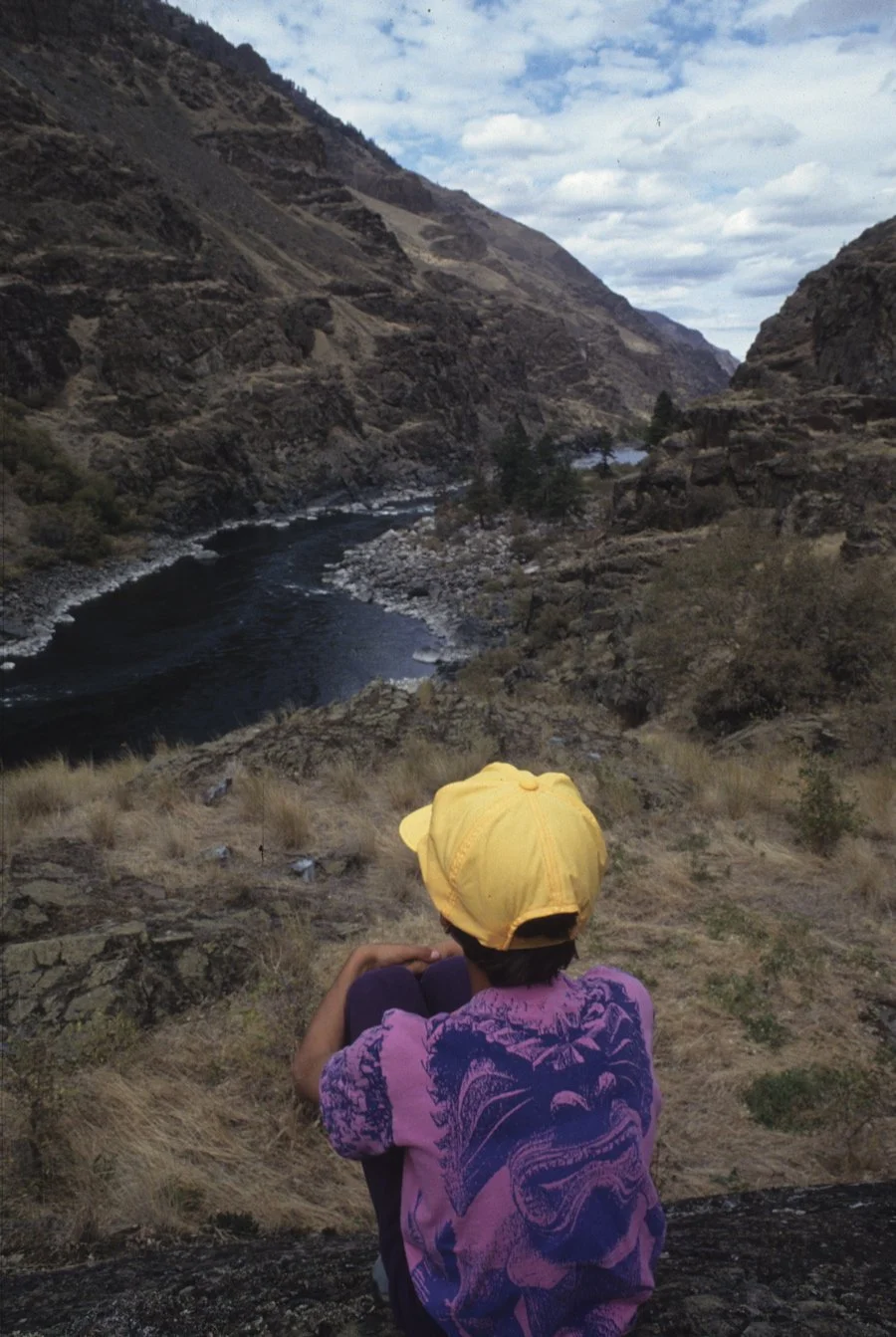
Andrew Contemplates the Coming Hike
The truth was, I included Andrew at the last moment. Born in Sun Valley, and educated on the ski runs and back country trails above it, he could hike for miles without complaint. Then too, there was the obvious appeal of sharing not only the adventure but the hardships of the trail. For ROW, the operative word may have been “walk” but by rafting the food, tents and personal gear between camps, guides J. Beal, Mike Ardnt, Nancy Mertz and Michelle LeClaire eliminated the hard work of backpacking. By any standard this would be a spectacular adventure and while fantasizing about how the two of us would hike into the setting sun, I convinced myself that this would serve as quality father-son time, persuaded his teacher to excuse him for a week, bought him a new pair of hiking boots and followed Highway 95 to Cambridge.
I was unprepared for the group that gathered on the dock below Hell's Canyon Dam. Scrubbed, shaved, and pallid from too much time behind office desks, of the fourteen hikers the youngest was forty-eight, the oldest was in her sixties and only one or two had trained for this hike. Professions varied as widely as the ages. Edith Eggenberger manufactured snowboard accessories, Richard Flynn was a butcher, Gary Barker was a controller while Jeanne Aiken was a retired violinist for the Los Angeles Symphony. Experience ran from James and Mel Barron who had passed decades in the outdoors, to Tressa Sargent who had never slept on the ground and not surprisingly, foot gear ran the spectrum from full assault leather hiking boots, to high tech blends of gore-tex and vibram, to Tressa's cute white and pink Rebok mall crawlers.
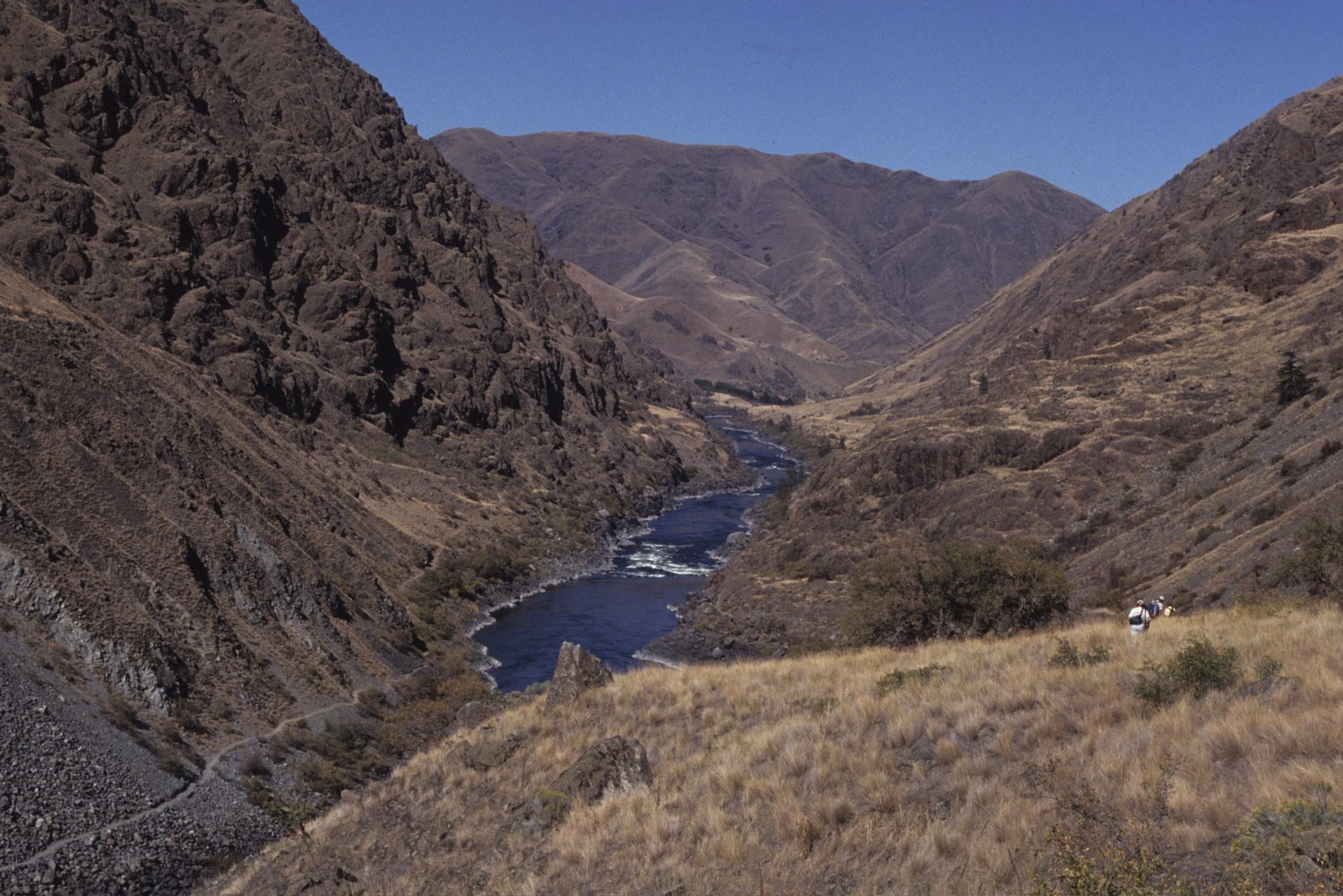
From the Dam, the Idaho trail climbs vertically two thousand feet to the Hells Canyon rim. A jet boat ferried us six miles downstream to where the trail rejoined the river at Butler Bar. From there it turned uphill again through fifteen million year old Columbia lava flows, cheat grass, hackberry bushes and the sound of Chukar partridge.
The difference between the placid reservoirs and wild rivers is both striking and disheartening. The Army Corps Of Engineer’s goal was to supply cheap power to the Pacific Northwest but, in hindsight, the power proved to more expensive than anyone could possibly have predicted. Rising behind the concrete monoliths, the reservoirs silenced miles of white water, isolated century old White Sturgeons, and obliterated the fall Chinook salmon runs.
I assumed Andrew would stick close to my side—if only to satisfy his curiousity about things that slithered, flew and padded silently on clawed feet but he had other ideas. Deciding that lead guide J. Beal knew as much, or more than I did, Andrew claimed second in line, a place he refused to relinguish in the coming days.
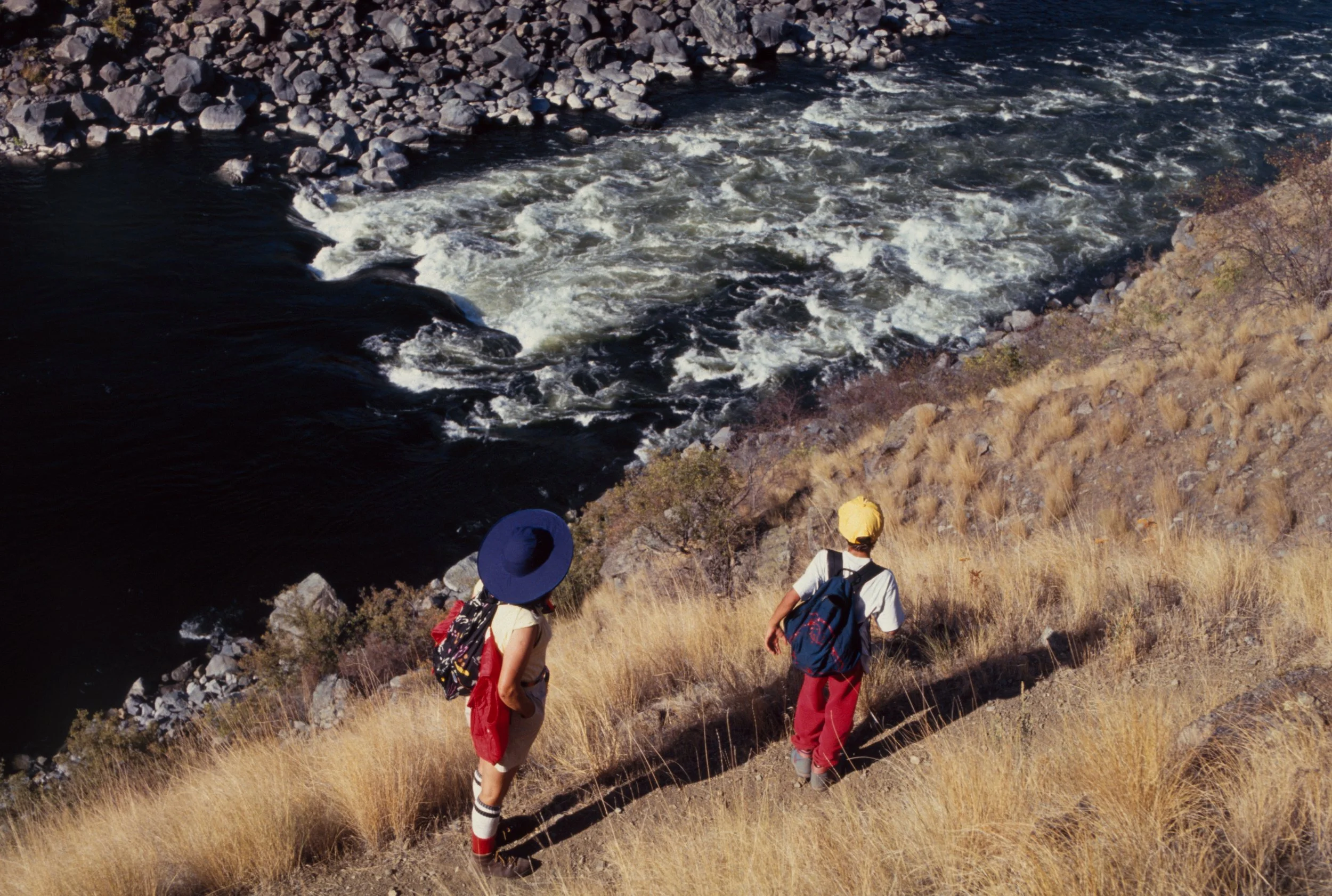
In half an hour the Snake had receded to a blue ribbon winding between black rock and yellow grass. That morning the sun lit the east facing canyon wall. Bathed in golden fall light, the views were spectacular and the pace stopped and started as the group tried to photograph vistas that defied the best lenses and finest grained film.
The four miles to Granite Creek were not difficult, but the vertical relief took the wind out of the group. With guide Mike Arndt riding herd on the stragglers, the trail skirted sheer cliffs where a single mis-step would have spelled disaster. Halfway down a steep section, one of the group decided she trusted her buttocks more than her feet. Skidding along on her new levis, her pride suffered as much as her seat, and for the next five days she tried to keep her eyes on the horizons and her boots on the trail.
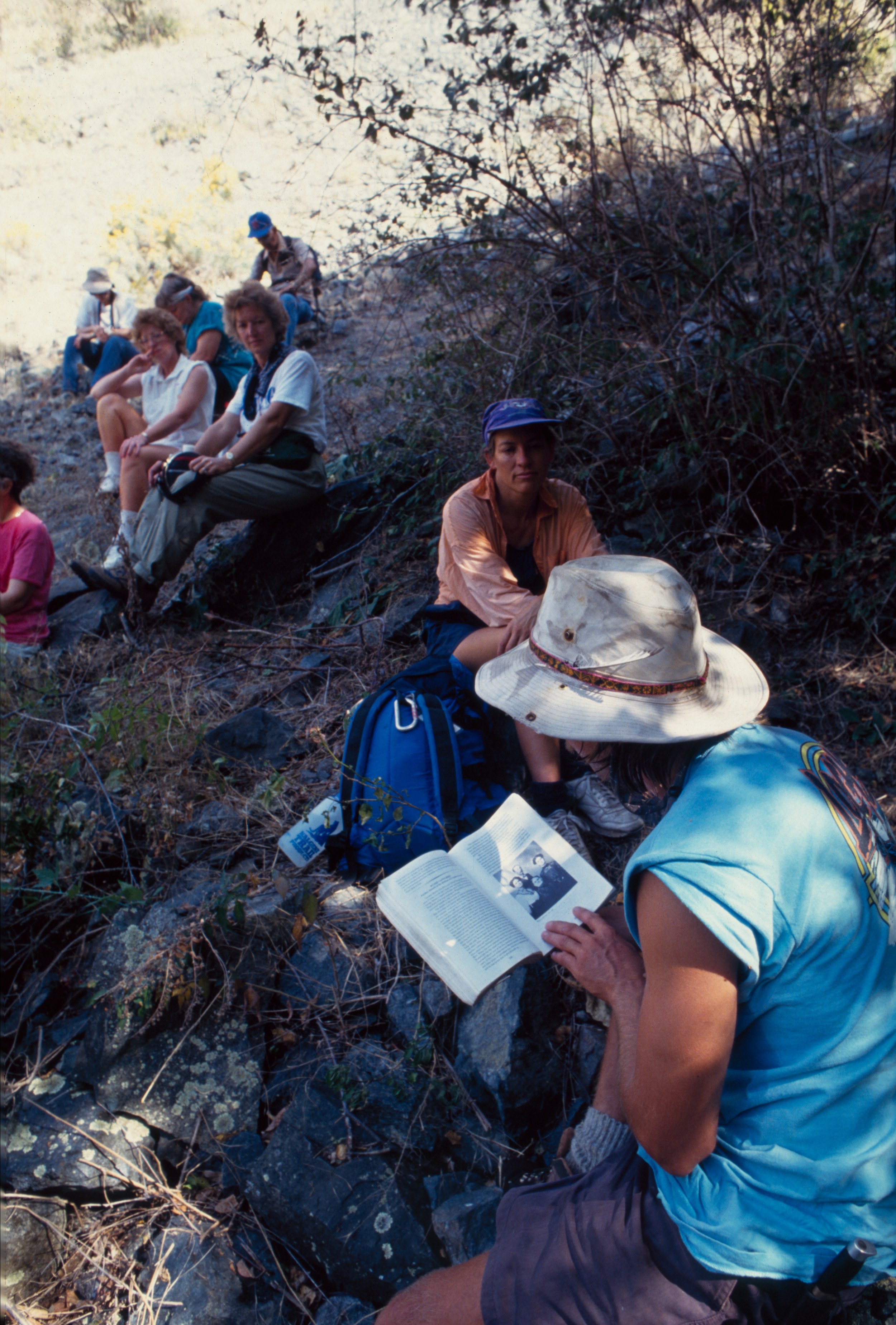
J. Beal Reading to Group[ during a Rest Stop
Between the climbs we gradually fell into a rhythm. Walk for a mile, then take a break for water and trail mix. During these interludes J. Beal would read from Carrey, Conley and Barton's "Snake River of Hells Canyon." A colorful, often violent history haunts Hell's Canyon and sitting in the shade of a crumbling foundation, or pausing before a rusted farm implement, we learned about Chief Joseph's flight to Montana, the development of the upstream dams, their impact on the andromydous fish runs and the hardships of 19th Century pioneers who scratched out a living on the sweltering bars.
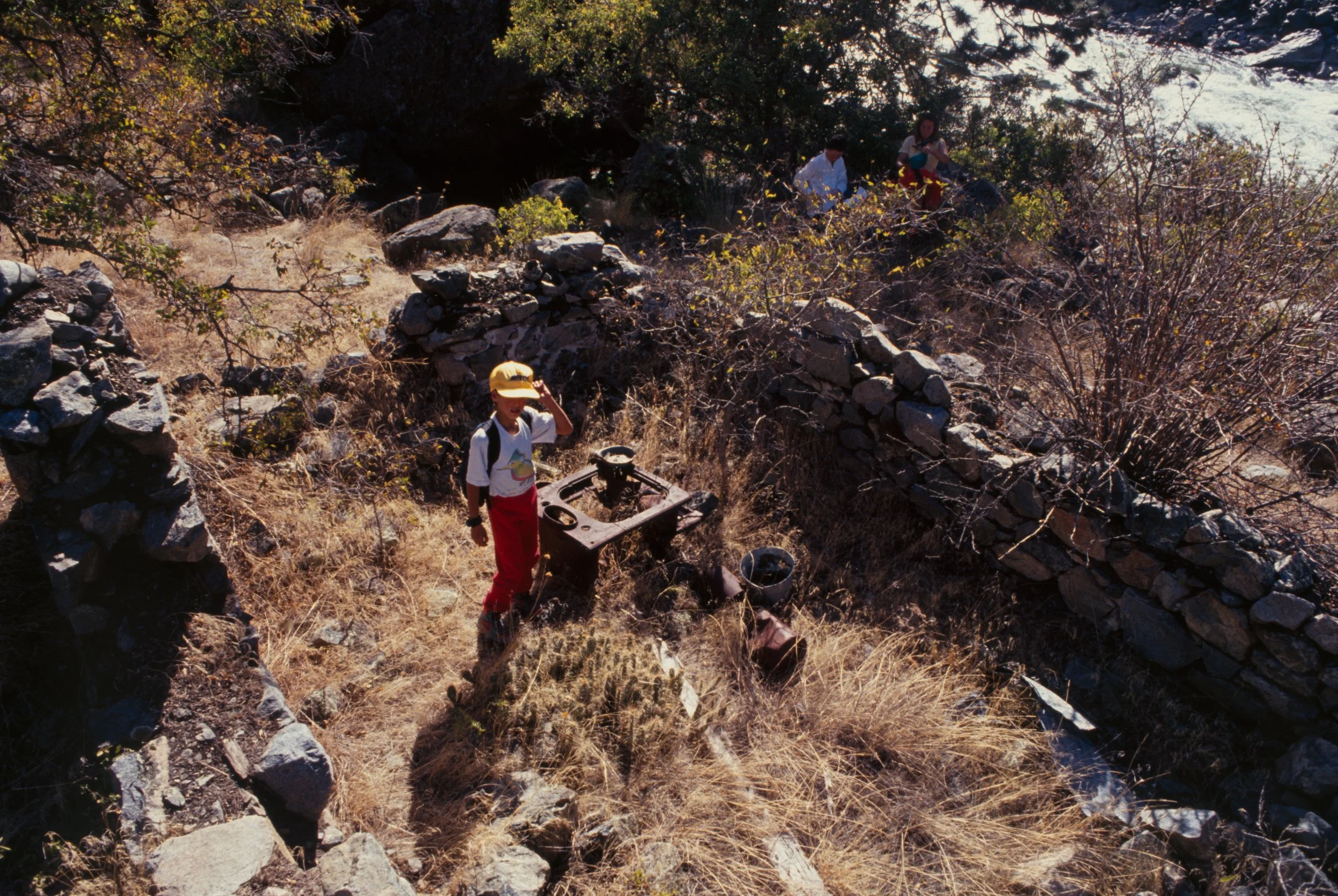
Andrew In Old Homestead Foundation
Prior to the trip, I had obtained an altimeter watch that along with telling time, measured barometric pressure, temperature, and altitude, as well as daily and total vertical. By zeroing the single day total, I calculated that during the first day we climbed 1800 vertical feet and descended 2010 feet to camp at Granite Creek.
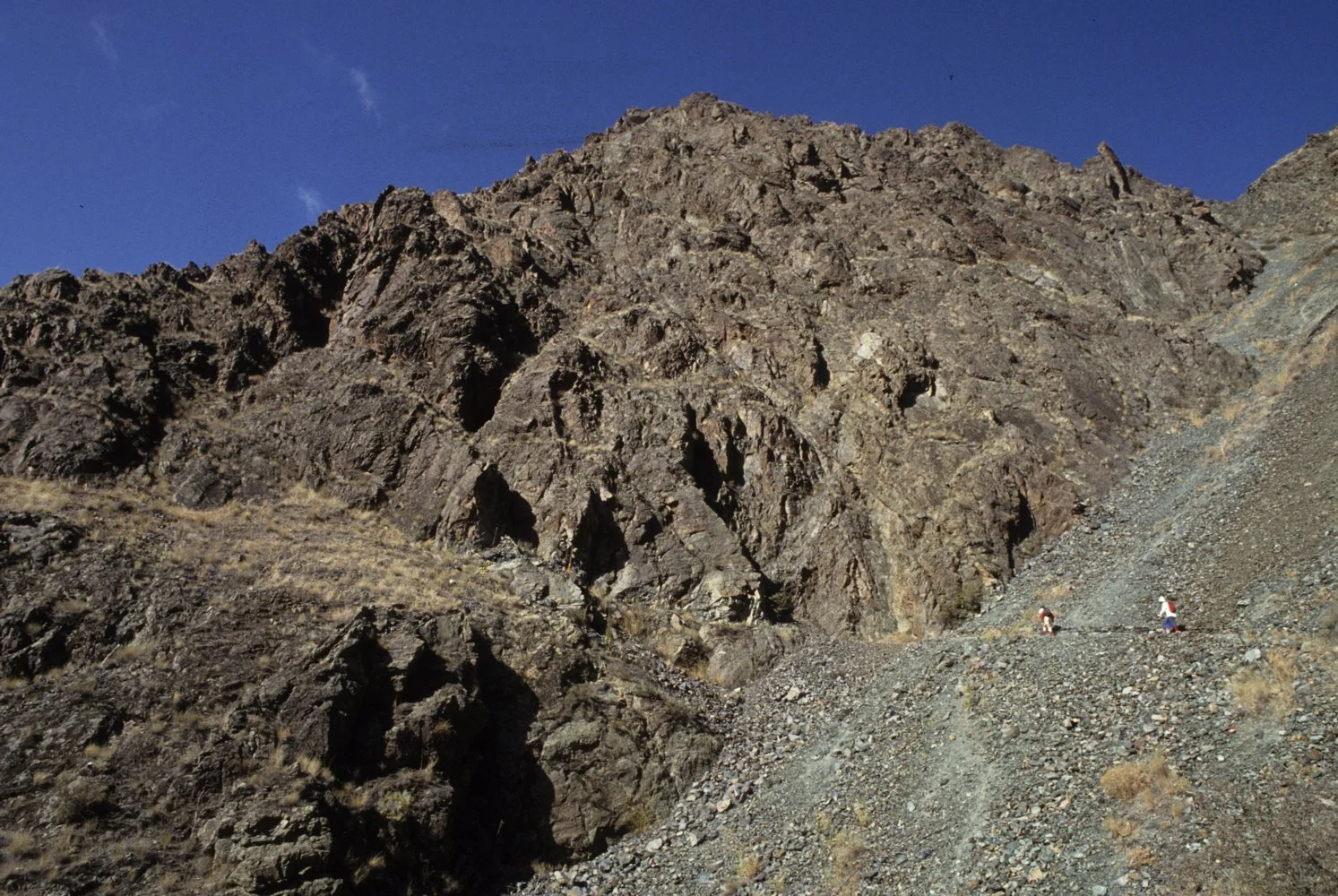
Climbing Above the Snake River
Named for a sheer black wall that towers above a sheltered sandy beach, Granite Creek played a pivotal role in the settlement of Hells Canyon. In response to the Homestead Act of 1862 that allowed heads of family to claim 160 acres of the public domain, Martin Hibbs moved his wife Ellen and six children to Granite Creek in 1902. Canyon life was hard and if Martin Hibbs did not get rich on the cattle, fruit, and vegetables he raised, he did manage to eke out a living. Ellen Hibbs died in 1926, the children moved out of the canyon and, according to one of the regions great unsolved mysterys, in 1935 Hibbs was found shot in the back next to his burned cabin.
A pack trail from the canyon rim enters the river at Granite Creek and from here, twenty-eight miles downstream to Pittsburg Landing the trail is generous, marked with rock cairns and often blasted through solid rock cliffs which eliminates miles of distance and thousands of feet of vertical
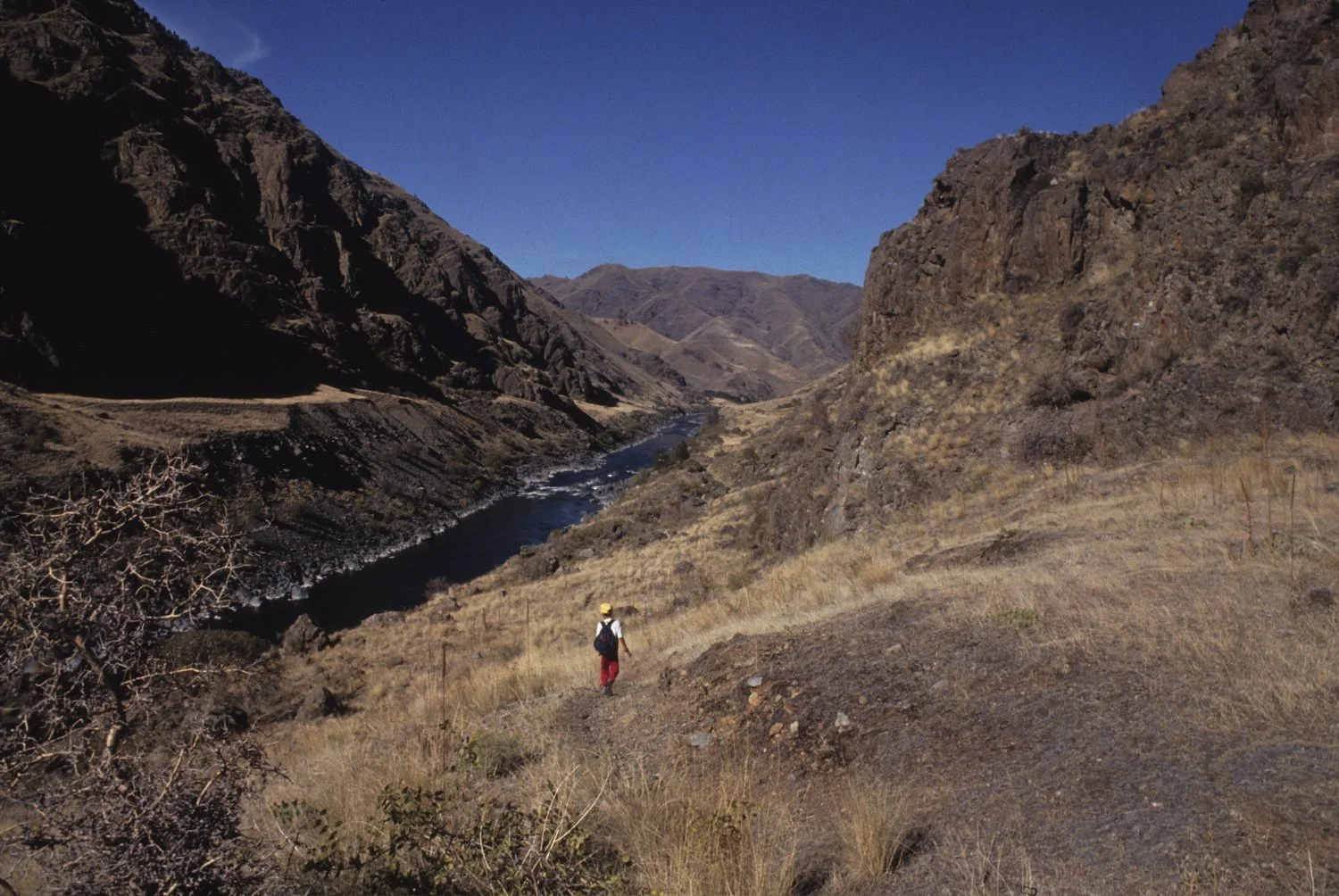
Andrew Hiking Alone along the Hells Canyon of the Snake River
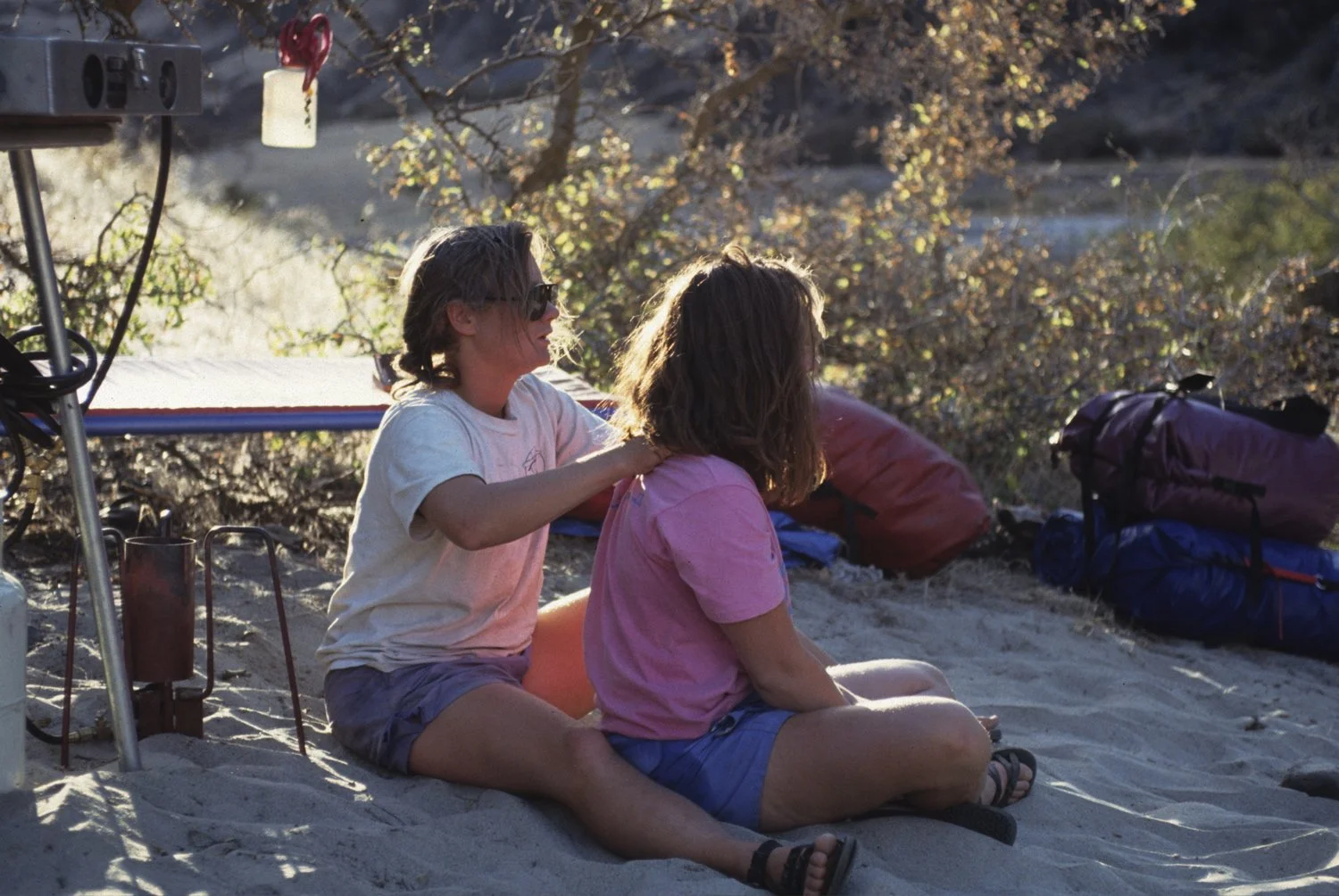
Welcome Massage after hard Day
By the time we reached the sandy flats, the tents, cots and tables were set up and hors d'oeuvres were waiting. After a swim in the Snake, we were treated to a dinner of grilled Salmon steaks, fresh salad, pasta, dutch oven desert and coffee. The evening was cool, but not cold and by the time the guides had finished washing up, stars filled the serpentine slash of sky between the black canyon walls and the wails of coyotes added a mournful note to the river's steady roar.
Heralded by a growing pink light in the south, the second day started at 7:00 a.m. While the guides cooked breakfast and broke camp, we double knotted our boots, fueled up on cowboy coffee and French Toast, dropped our personal dry bags at the rafts and rejoined the trail.
From Granite Creek to the second night's camp at Johnson Bar marks the trip's longest day. We had only covered a half mile when Mike Ardnt stopped beneath a smoke stained overhang. Above us Nez Pierce pictographs revealed a series of geometric patterns, stick figures and big horned sheep.
Known as the Snake People, and dependent on the spring and fall salmon runs, the Nez Pierce both lent their name to the river and left behind a strong physical record of their life. Archeologists have catalogued more than 200 Nez Pierce house pits, burial sites and pictographs in Hell's Canyon. Painted on protected walls above the river the pictographs might have served as petitions for hunting luck or fertility, a rite of passage or simply finger doodles. Pre-dating our own Revolutionary War, the red figures now bear silent witness to the passing river and our own curious, upturned faces.
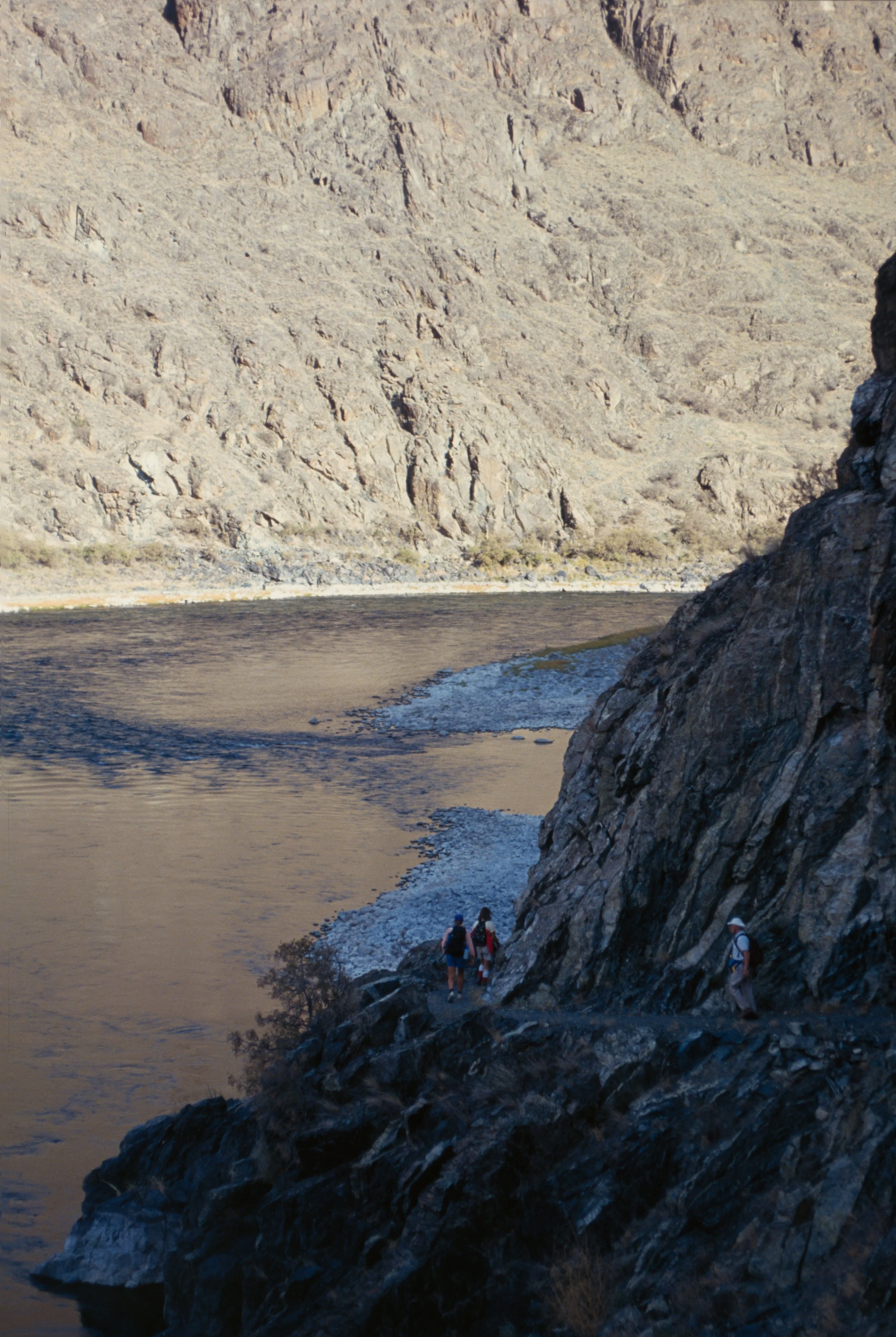
A grateful Respite in the Shadows
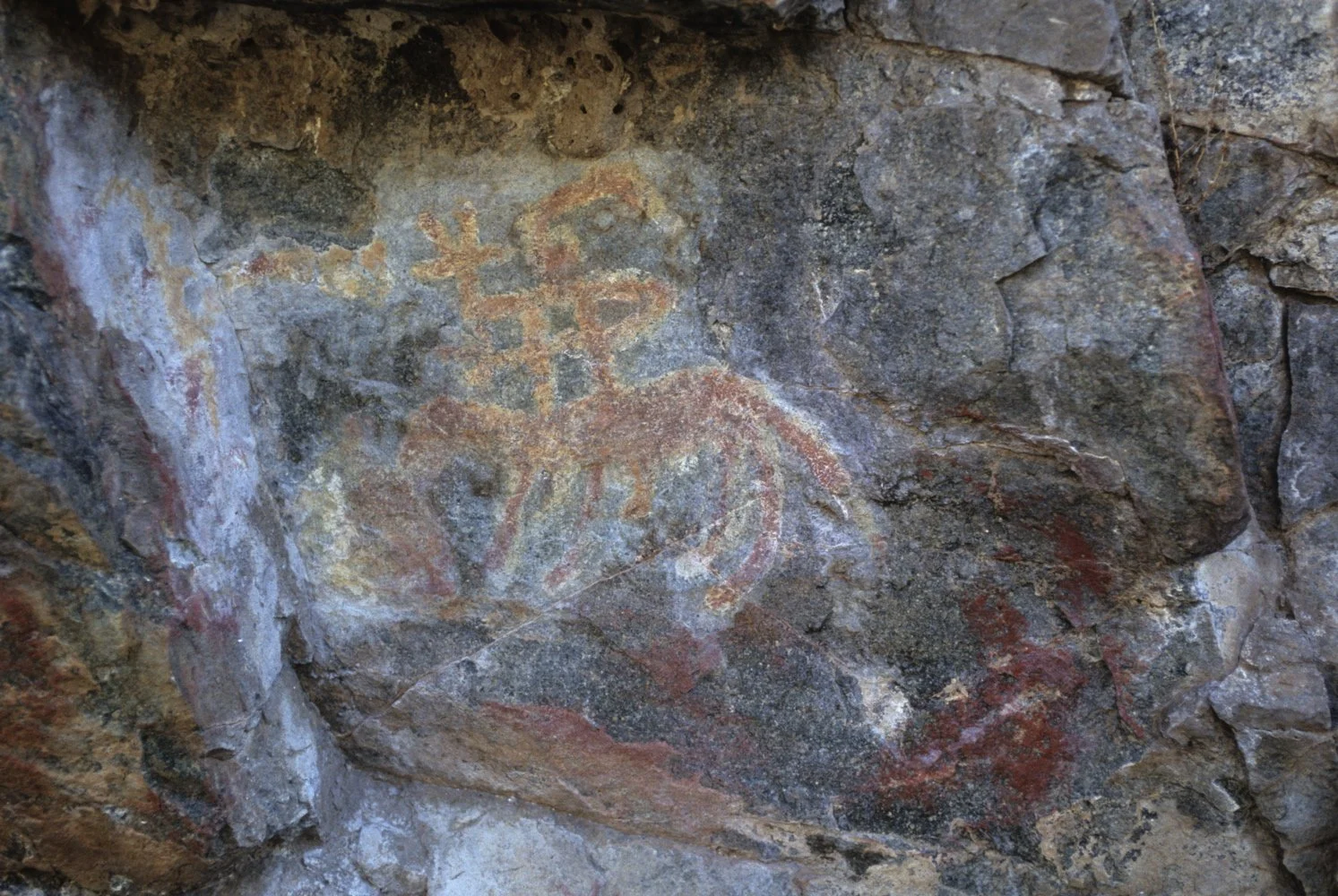
SheepEater Indians Pictograph
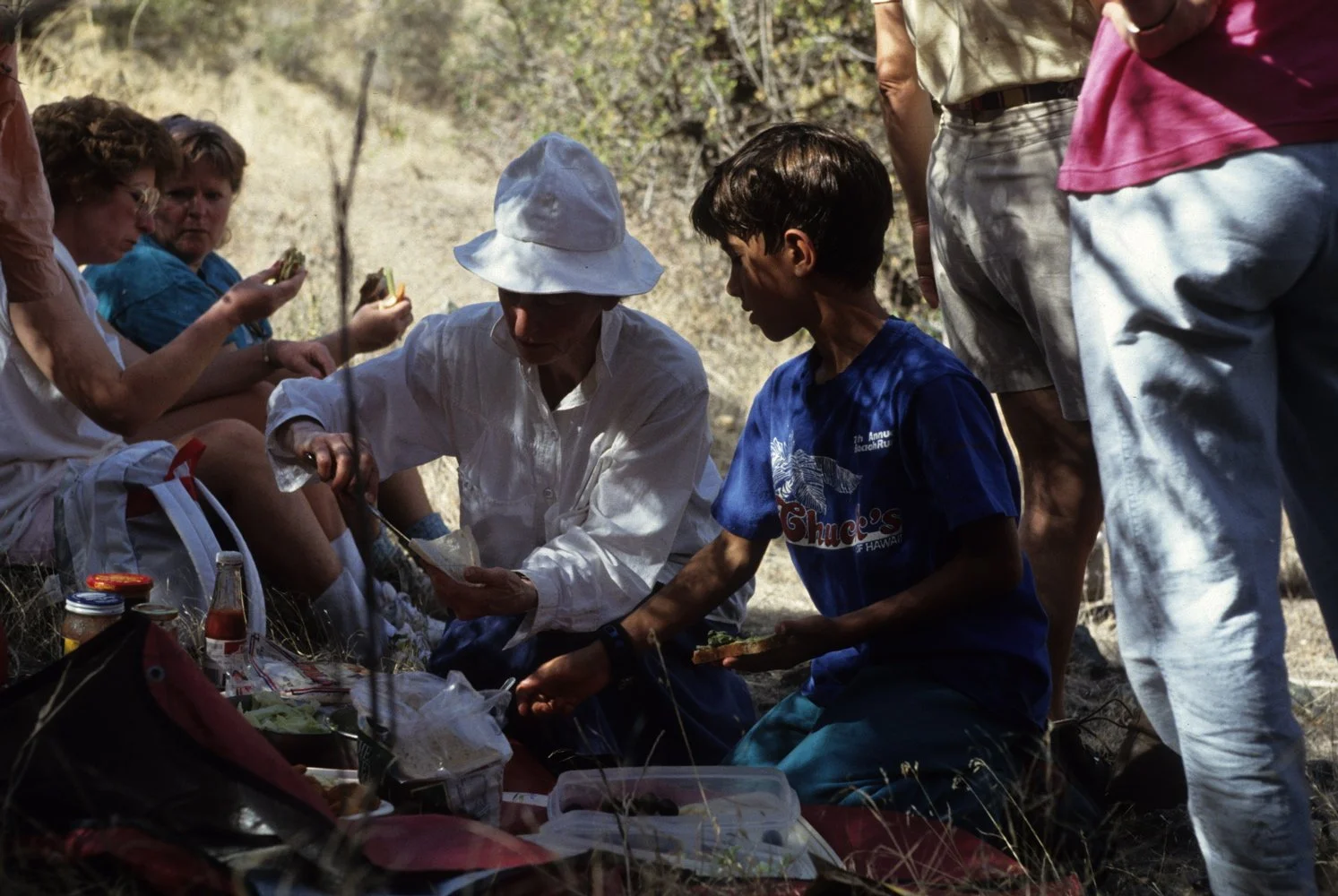
Midday Lunch In the Shade
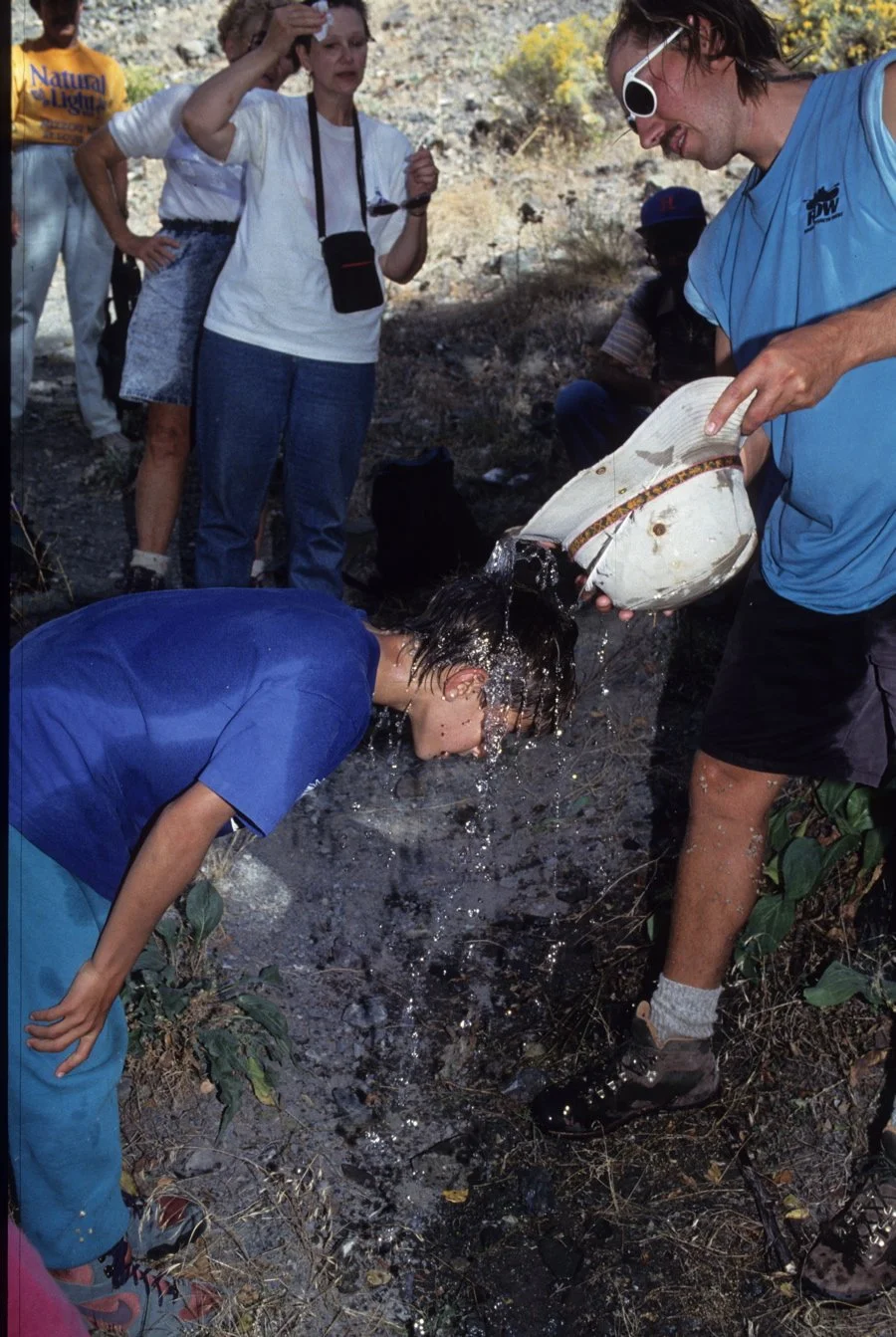
Welcome Cooling off in the Shade
Despite the illusion to Hell, the canyon was not named for the afternoon temperatures but the class 4 rapids which boil below the trail. Due in part to Idaho's six year drought, this September was hotter than most and temperatures reached the high 90s. Averaging seven miles a day and 2000 vertical feet this is not a killer hike, but basic conditioning is important. While shadows cover the eastern shore, the trail is cool and the climbs and descents shrink to insignificance but once the sun reaches its zenith (around 11:30 a.m.) the black lava captures and holds the heat. During lunch at Bernard Creek, J. Beal used a filter pump in combination with fresh lemon to replenish our water bottles.
On this second day, one member was suffering. Saddled with new hiking boots, she was forced to wrap her feet in a sock of mole skin. No one, however, let their blisters stop them and though Tressa Sargent, a Kansas City insurance claims adjuster hiked in Rebok dress shoes, realistically a light pair of breathable hiking boots are best suited to the heat.
I assumed that, at the first sign of foot trouble, the less committed among us could point to a reddened heel and shrug away the next twenty miles. In an emergency, the walking wounded can escape to the raft but ROW believes that a sense of accomplishment rewards those who hike the entire distance and thus blisters are quickly attended to and miscellaneous pains are doctored with ice, ace bandages and Advil.
Rattle Snakes live in the canyon, but the only rattler we saw had been chopped to bits by a party of jet boaters in the grip of some visceral, genetic fury. And while it is true that poison ivy flourishes in the upper canyon, by September 20 the color change was well along and the low bushes brightened the yellow cheat grass with splashes of red, orange and purple. Wearing shorts, at first I attempted to avoid each leaf, but quickly gave it up as a lost cause and simply stomped through all but the worst thickets. Due in part to the dry year and late date, though I've suffered mightily in the past, no screaming rash flared across my legs and I learned to ignore the bright, three leaf blooms.
Jet boaters comprise 85% of Hell's Canyon's annual 39,000 visitors with rafters accounting for the remaining 15 percent. Hikers are so rare as to be ignored and in his three summers of guiding float trips, J. Beal has encountered only one boy scout troop hiking with back packs to Pittsburg Landing. During the five days we did not see another person on the trail, or for that matter find a foot print.
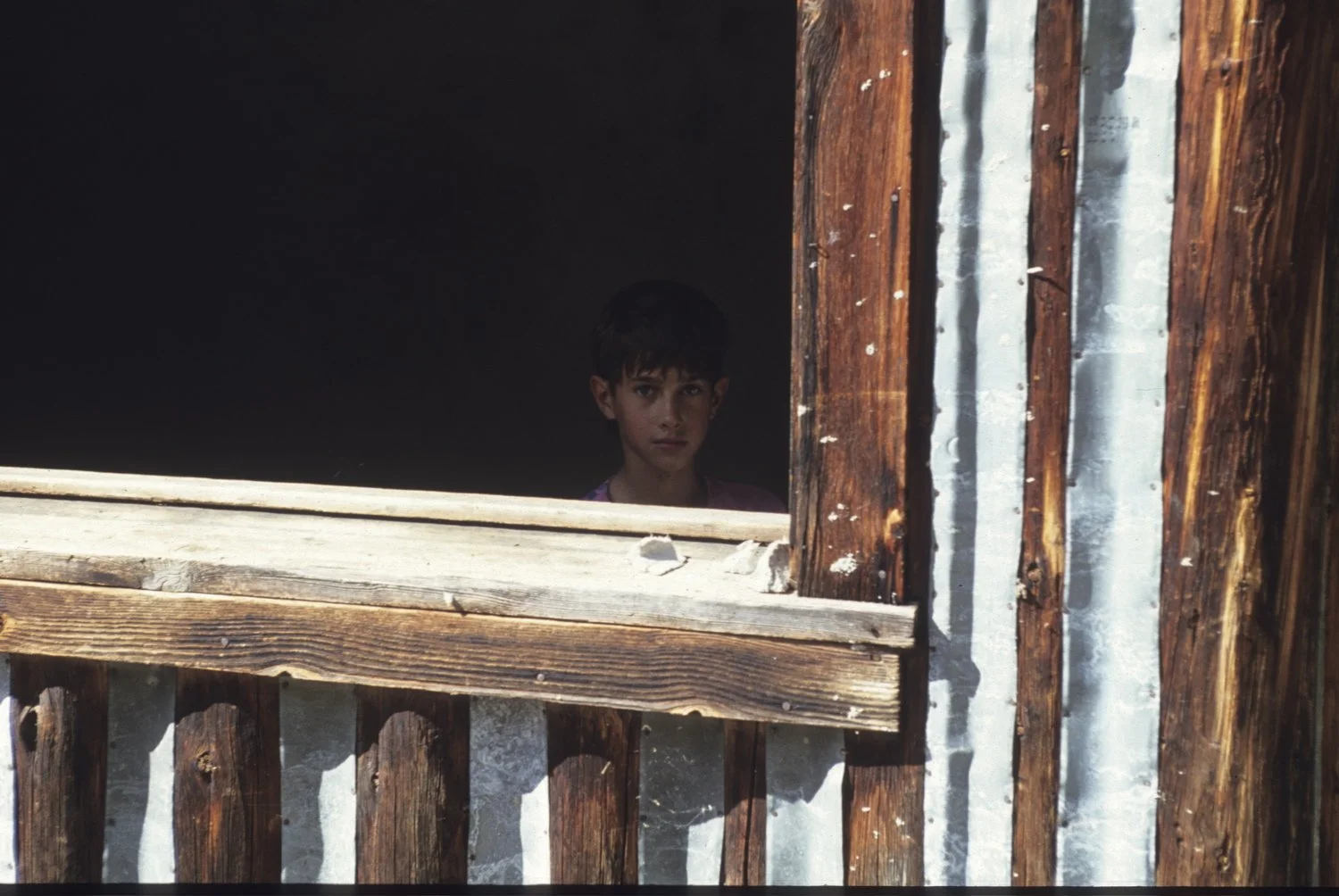
Lunch of the second day, passed on the porch of Bernard Creek's McGaffee Cabin. Named after Fred and Gene McGaffee who occupied the two room cabin from 1915 to 1935, the orchards, hay fields and cattle are long gone but the large Monarch wood burning stove Fred McGaffee travoised up from Johnson bar remains as a symbol of how today's rusted antique was yesterdays modern luxury. Leaving Bernard Creek, we paused above Waterspout Rapids then moved on to a series of pictographs and a deep caldron gouged into the rock when the river pushed a large boulder in endless concentric circles.
The afternoon grew increasingly hot and seeking shade in a crumbling foundation at Bill's Creek, J. Beal recounted the story of Silas Bullock, an asthmatic brick layer who hiked into the Canyon for the cure. A picture in "Snake River of Hells Canyon" reveals Bullock was a roughly dressed, white haired man who lived on white sturgeon, game and a lush garden filled with strawberrys and watermelons. The story took our minds off the hot three miles to camp and when Beal closed the book, Andrew rose to lead the group across the sweltering flats toward Johnson Bar where the tents snapped in a strong downstream breeze.
From Johnson Bar the miles grew progressively shorter. Our third day covered eight miles, the fourth five, the last three. By now the major climbs were behind us and the stands of ponderosa had given way to hackberry bushes, cheat grass and the low, ground hugging cactus. The river rapids had grown smaller, the pools were deeper and longer and that afternoon, Suicide Point appeared through the shimmering heat of Long Bar.
One story claims two Nez Pierce lovers hurled themselves off this towering precipice. "Snake River of Hell's Canyon," however claims it was a whimsical choice. Either way, Suicide Point is the trip's make or break point. From a distance the cliff resembles an outlaw's weathered face. Disfigured by the trail's gray scar running across nose, cheek and jaw, in September's 90 degree heat, its 800 vertical feet offered a daunting barrier to camp on Gracie Bar. Stopping only long enough to refill our water bottles at a cached jug, we started to climb. One foot in front of the other, we leaned into a hot wind and counted the steps. Half an hour later, the trail leveled out. Below us the serpentine Snake stretched to the distant foothills through which we had walked. A sense of accomplishment filled us and with sinking sun throwing shadows across the river, we slowly descended to camp.
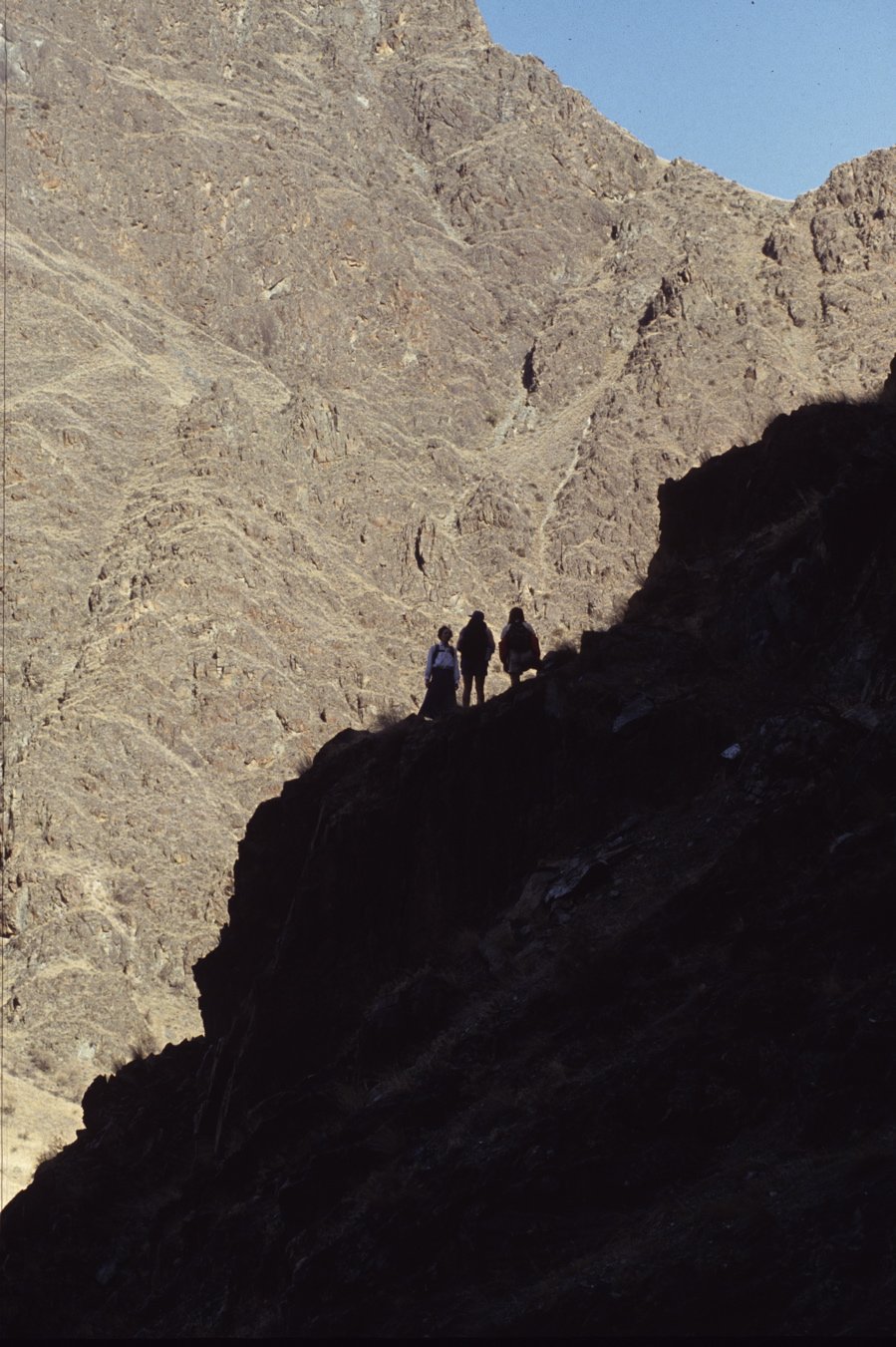
Suicide Point
It was my fault Andrew fell into the cactus. Nine years old and down to seven percent body fat, he'd hadn't as much as whimpered during four days of hiking through Hell's Canyon. Pride, however, comes before the fall and sitting around the fire on Gracie Bar, I suggested he slap me a high five.
Glancing at the twelve other adults, he whispered "Dad...."
"Just one," I insisted, presenting my palm. After all, he had weathered Hells Canyon's, distances and climbs with a stoicism, even joy, that would have done Gunga Din proud. Unfortunately, his light slap failed to do justice to the Snake River's spectacular rapids, or the Canyon's towering cliffs and in an attempt to emulate those frothy beer commercials where real men celebrate the great outdoors, I sent a power five in his direction. Seeing my open palm bearing down on him, Andrew jerked his hand away, the three legged camp stool sank in the sand and arms flailing, he crashed backward into one of the low cactus which flourish on Hells Canyon's dry, southern exposures. He yelped once and when I pulled him free, his left arm bristled with spines.
That night it was past eleven when we stopped plucking spines from Andrew's arm. He bore it well and though I suggested another high five, he quickly vetoed the idea.
"Let's just shake hands instead," he replied holding out his unhurt left hand.
Starting at ten a.m. we made Kirkwood Bar by noon where we met Bonnie Sterling who, with her husband Dick had built the log bunk house that now serves as a museum.
Dozing beneath a large English Walnut tree, I realized that life on the trail revolves around simple pleasures like the hint of lemon in filtered water, collecting walnuts in the green grass, the flush of a chukar partridge and the Snake River's cool embrace at the end of a long walk. Dozens of rafts and jet boats had passed below us during the five days and though I occasionally coveted their coolers brimming with soft drinks, I loved the solitude of the trail, the play of light on the canyon walls, and the time for serious talk about parenting, professions and past and planned adventures
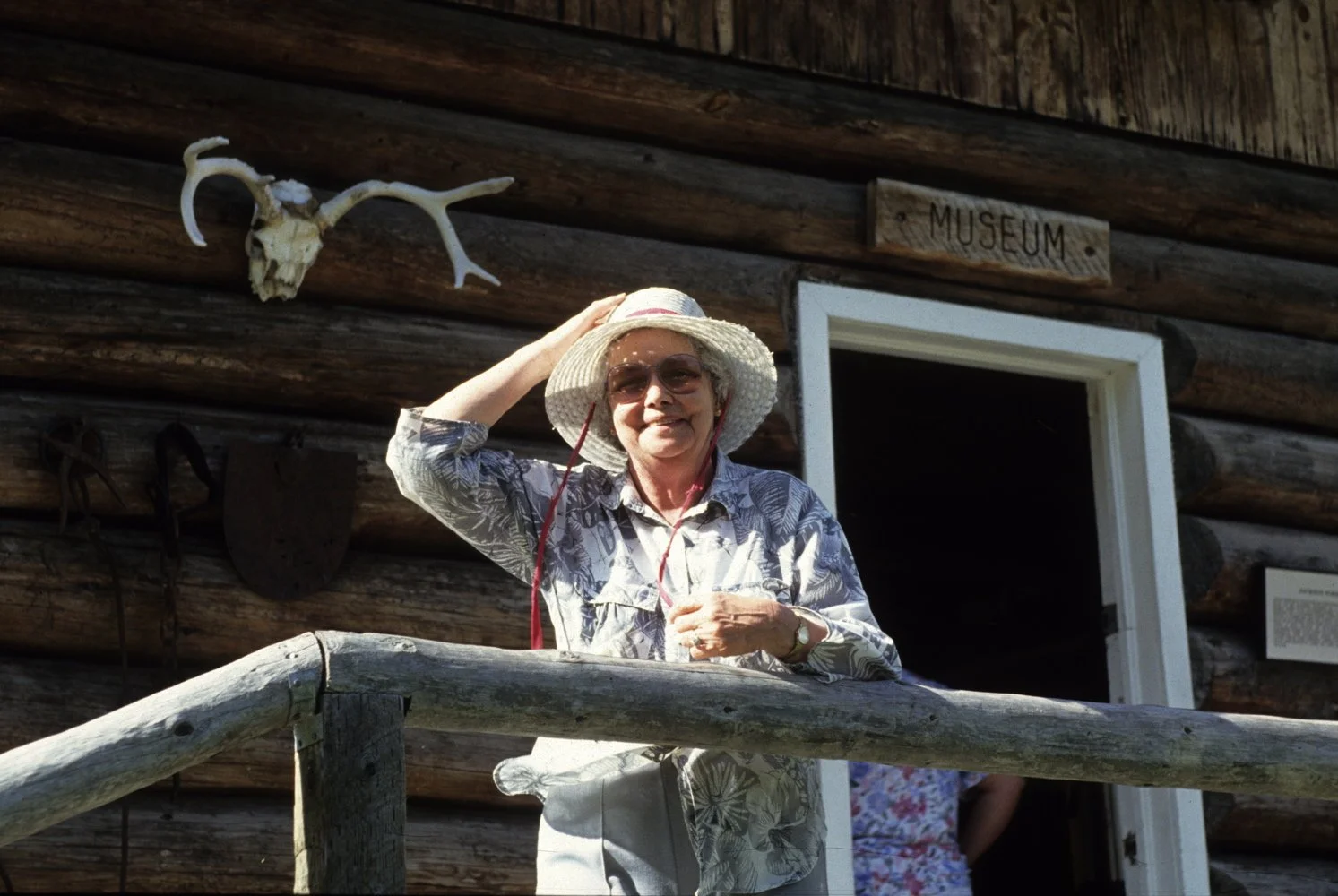
Bonnie Sterling, Kirkwood Bar
. A light rain was falling when we reached Pittsburg Landing the next morning. In five days we had climbed and descended 7200 vertical feet through thirty miles of the northwest's most spectacular river canyon. And boarding ROW's bus for the ride back to civilization, to a person, the group only regretted the trip wasn't longer.