
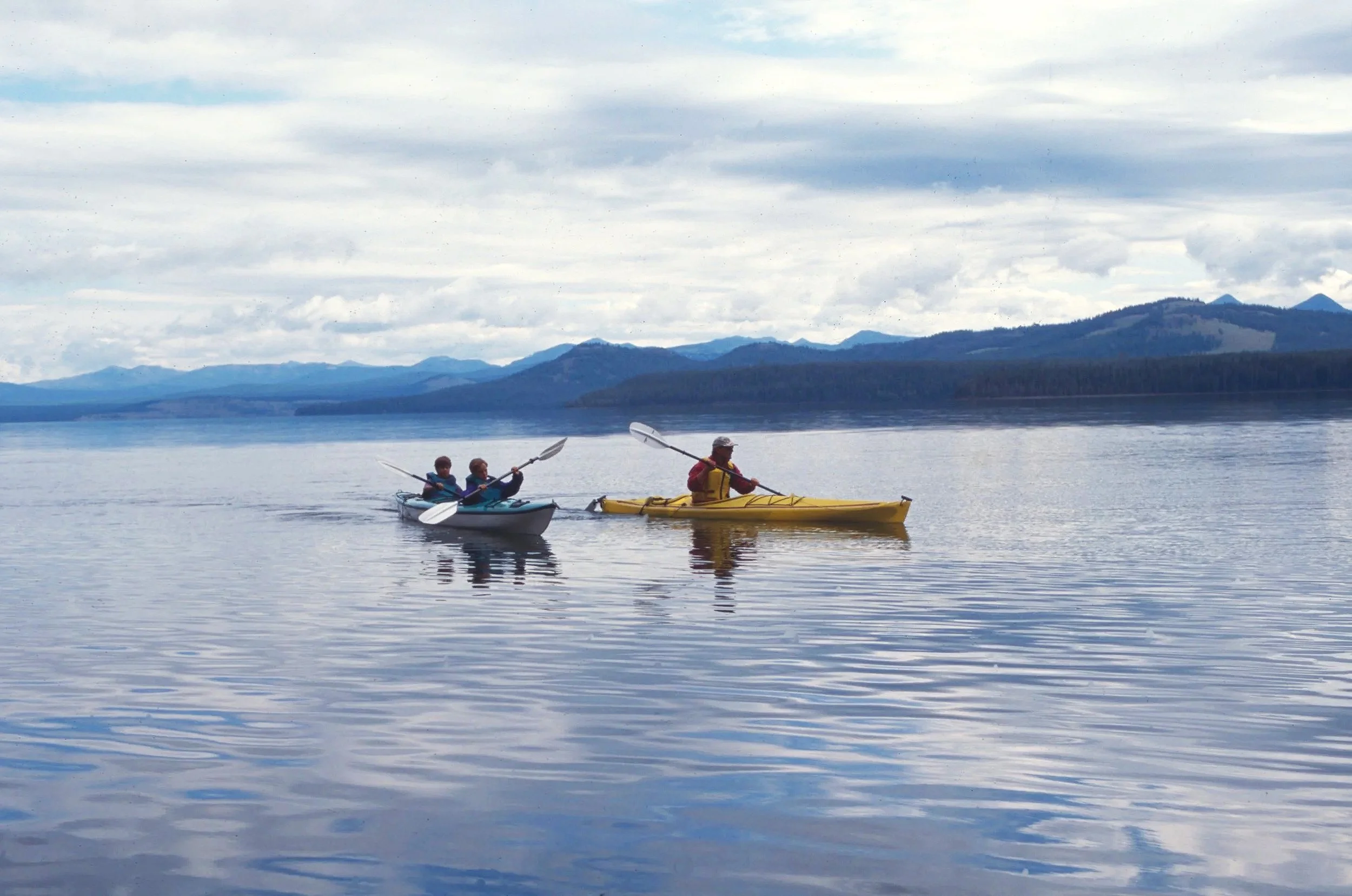
Kayaking on Yellowstone Lake
The first time I saw Yellowstone National Park was from the back seat of my Father's '51 Buick woody. I was ten years old in 1957 and can still remember how it scared the hell out of me when mom rolled down her window to toss a three day old bologna sandwich to a panhandling grizzly. I think the grizzly stood on its hind legs and scratched at her window, but that memory might have come from watching too many "Wild Kingdoms" or a Walt Disney's documentary on Yellowstone. In those years, before wooden walkways held crowds at a safe distance, I remember staring into Old Faithful's sulfurous vent, standing on the edge of a mud pot, overnighting at the Inn at Old Faithful, seeing my first buffalo, packing my first snowball and getting chewed by mosquitoes.
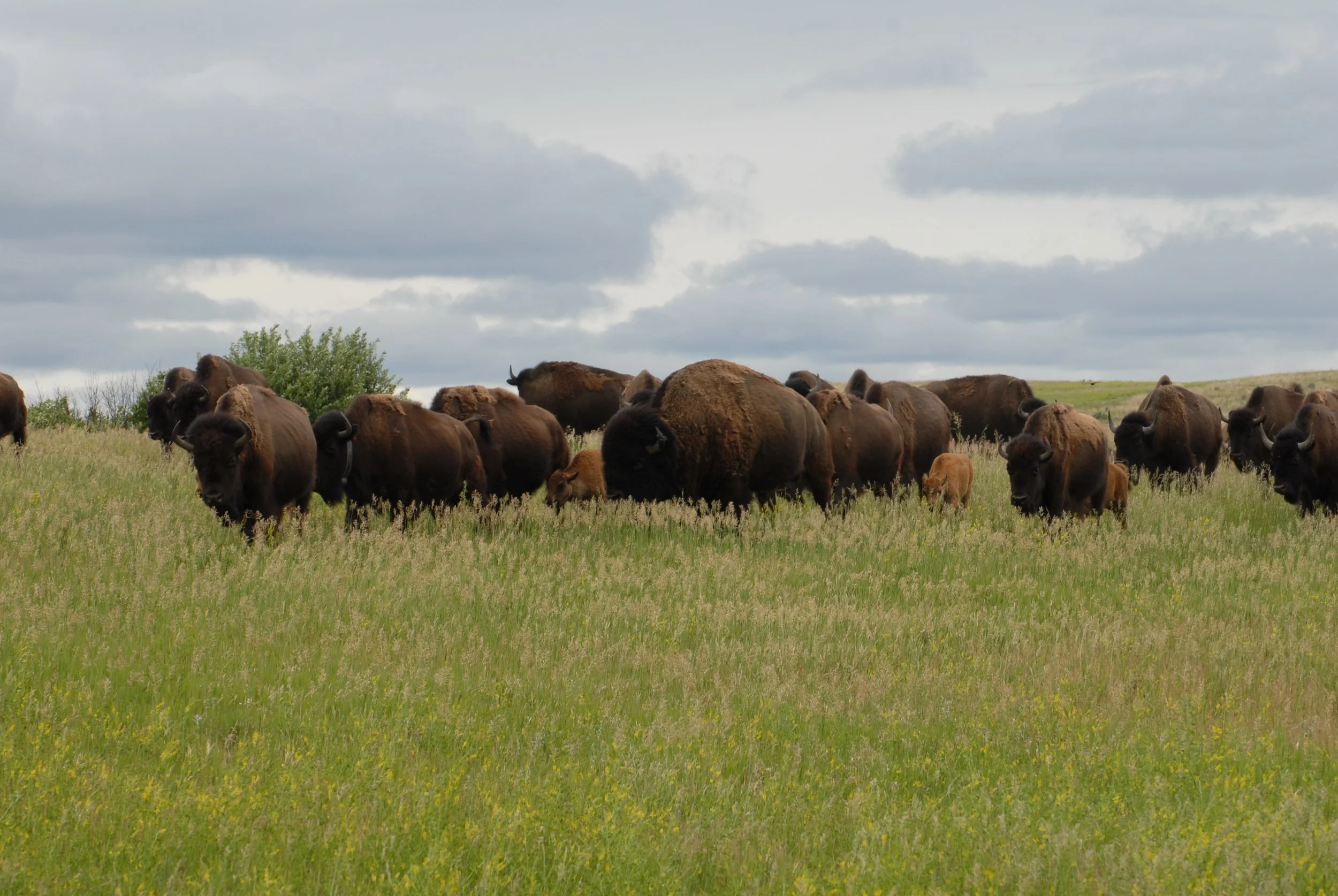

Modern visitors to Yellowstone still cling to images of how America’s most over loved park appeared in the forties and fifties. In those halcyon days, the roads were empty, grizzly sows did indeed scratch at passenger windows for baloney sandwiches, families had Old Faithful to themselves, and bison and elk replicated scenes from the African savannah. The images of the bison and elk still ring true but the rest has long since faded in an EV’s rear view. And, if you now stick to Yellowstone’s crumbling roads, traffic jams occur whenever a buffalo appears near the pavement,
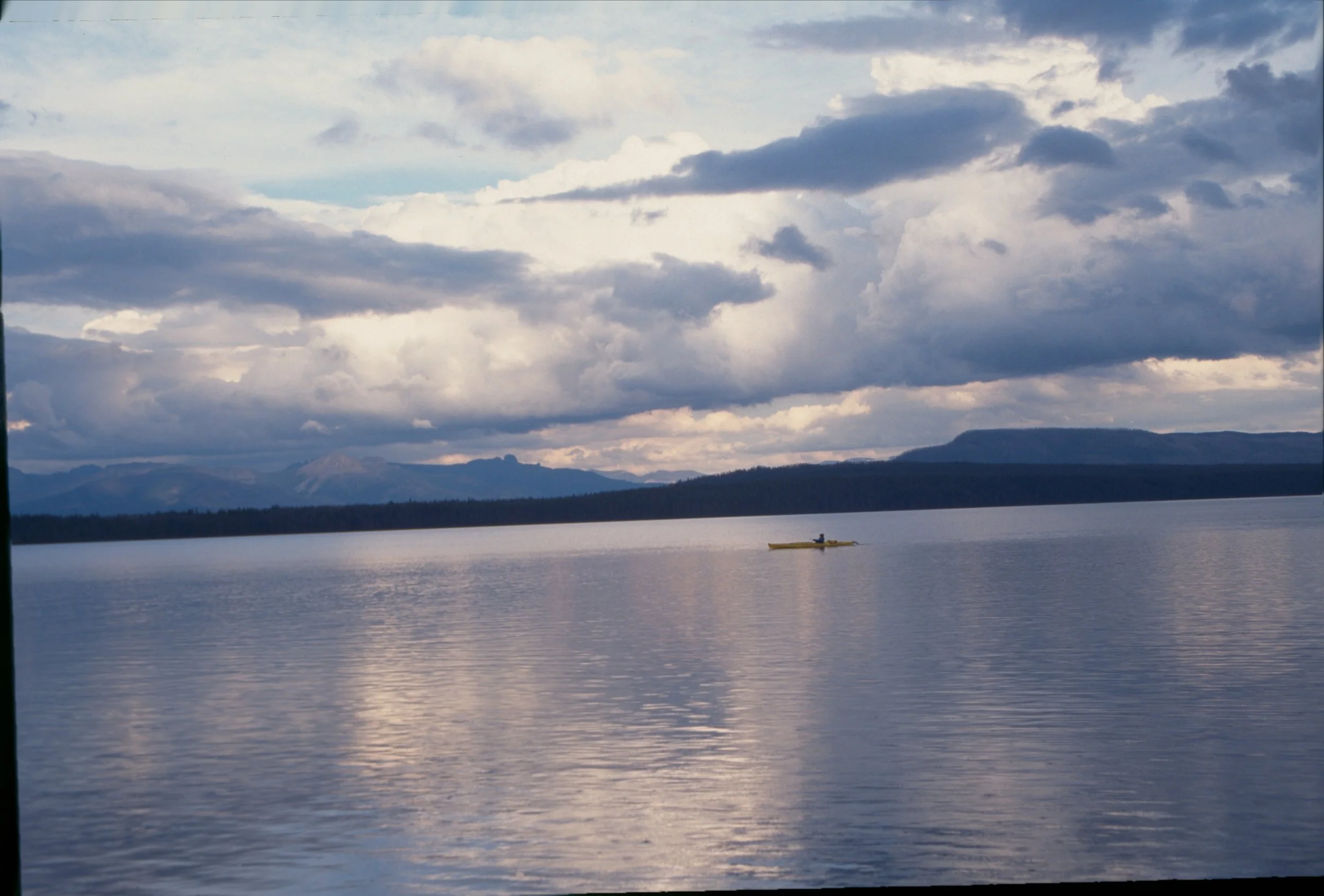
In attempt to glimpse Yellowstone of the fifties, when it was still wilderness filled with empty lakes, rivers and forests that sheltered bears, osprey, elk and bison, I booked a four day kayaking trip on Yellowstone Lake.
It was a fine, blue-sky day with barely a hint of rain in the stratocumulus that lifted above the ancient caldera when my sons Andrew, Robert and I arrived at Marina Bay where guides Mark Harbaugh and John Cole were waiting next to the power boat that would carry us across the lake to Yellowstone Lake’s South Arm Wilderness.
Beyond the park, Harbaugh is a Patagonia representative for the Pacific North West while Cole is a biology teacher who has studied jungle ecology in New Guinea, taught school in Venezuela, rafted many of Alaska, Idaho and Oregon's rivers as well as hunted, fished and hiked through many of the world’s most beautiful corners. Having adventured and taught in the world’s forgotten corners Cole still believes that Yellowstone is the most unique of all.
While helping transfer our gear to the boat, Harbaugh described how Yellowstone Lake sits at 7733 feet above sea level, is twenty miles long, fourteen miles wide and has a maximum depth of 390 feet. It is North America's largest mountain lake, an isolated frigid body of fresh water that, in past geologic eras alternately drained both into the Pacific and the Artic via Hudson Bay. Today it reaches the Atlantic through the Gulf of Mexico.
As the boat turned from the docks, the bison shrunk to brown mounds in green meadows that, in turn were swallowed by the fir forests. Thirty minutes later we were dropped on a sandy spit at the end of West Thumb. Power boats must maintain less than five miles an hour in the two arms while the upper reaches near Chipmunk Creek and the head waters of the Yellowstone River are restricted to nonmotorized, canoes and kayaks.
Our gear was loaded onto a rubber catamaran to be transported to camp. John Cole reminded us that the lake was exceedingly cold. A spill would result in rapid hypothermia and advised us to stay close enough to shore that, in case we got in trouble, we could swim for it. Andrew and Robert were anxious to get started and pulling on waterproof jackets and spray skirts following a few tentative strokes that tested the foot pedal operated rudder, started up the wild thumb. With Robert leading, our small flotilla was making good time when we were hailed by two wilderness rangers in an outboard skiff.
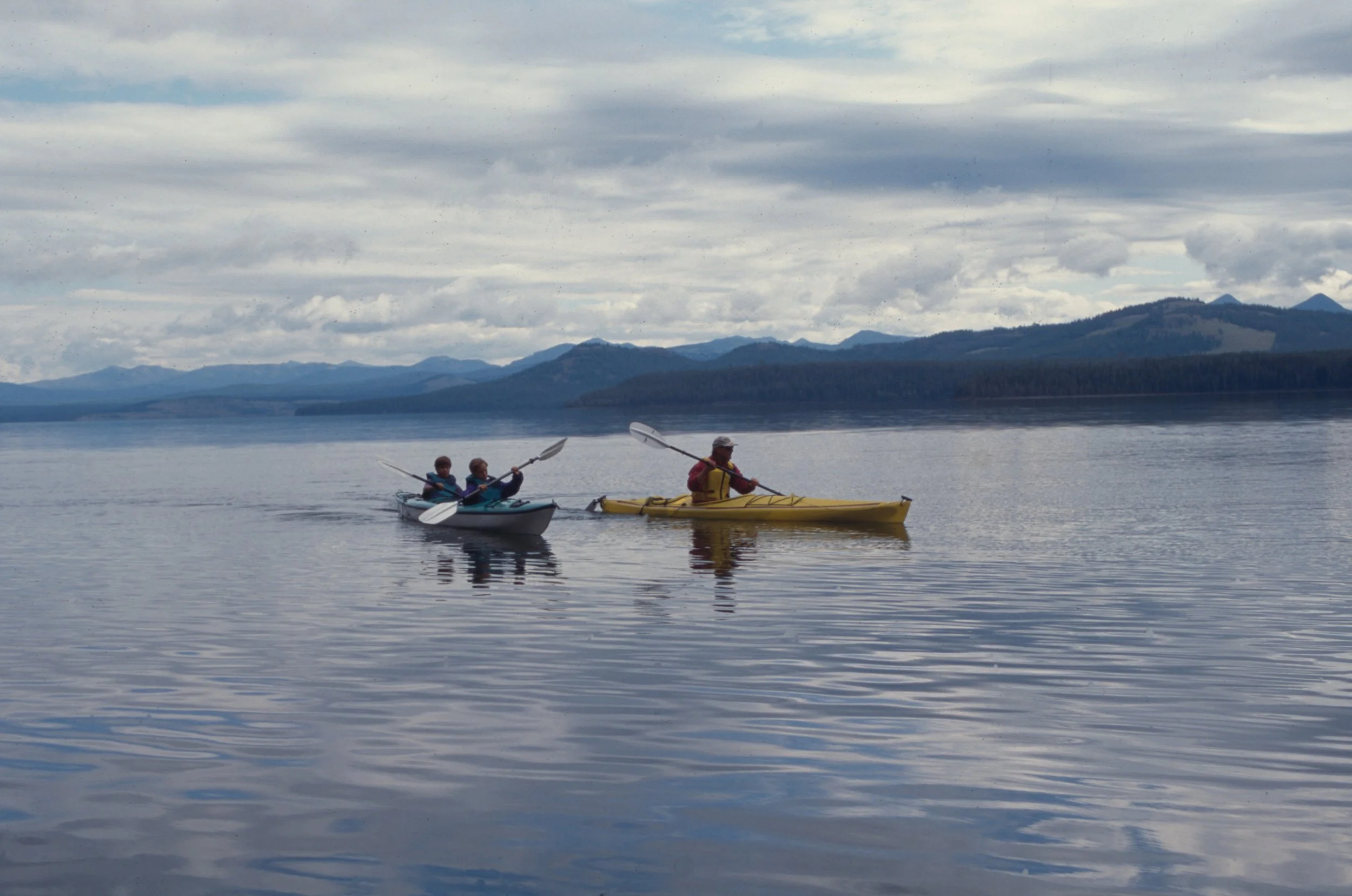
Mark Harbaugh Leads Andrew and Robert
"There's a big grizzly in the area,” they advised us. “Be extra careful about your food.”
It was warning enough.
We soon fell into the the slap of the water against the bow and how the kayak surged ahead with each paddle stroke. Absent a motor, it was possible to glide close to the grebes, loons, mergansers and golden eye that rest in the shallow inlets. Too close and they would run across the water, set their wings and glide down the shore.
The evidence of enormous tectonic pressures also echoed our wakes. Hot springs flowed from green meadows into the lake and ghostly mists rose out of the hillside forests. Following the disastrous fires of 1988 that burned thirty-six percent of the park, few tourists could believe there was an upside to eight hundred thousand acres of standing deads. And yet viewed from the Kayak, today the rolling hills above Yellowstone Lake are a patchwork of lush meadows filled with the jackstraws of fallen lodgepole through which green grass and a profusion of wildflowers signal a continuing rebirth.
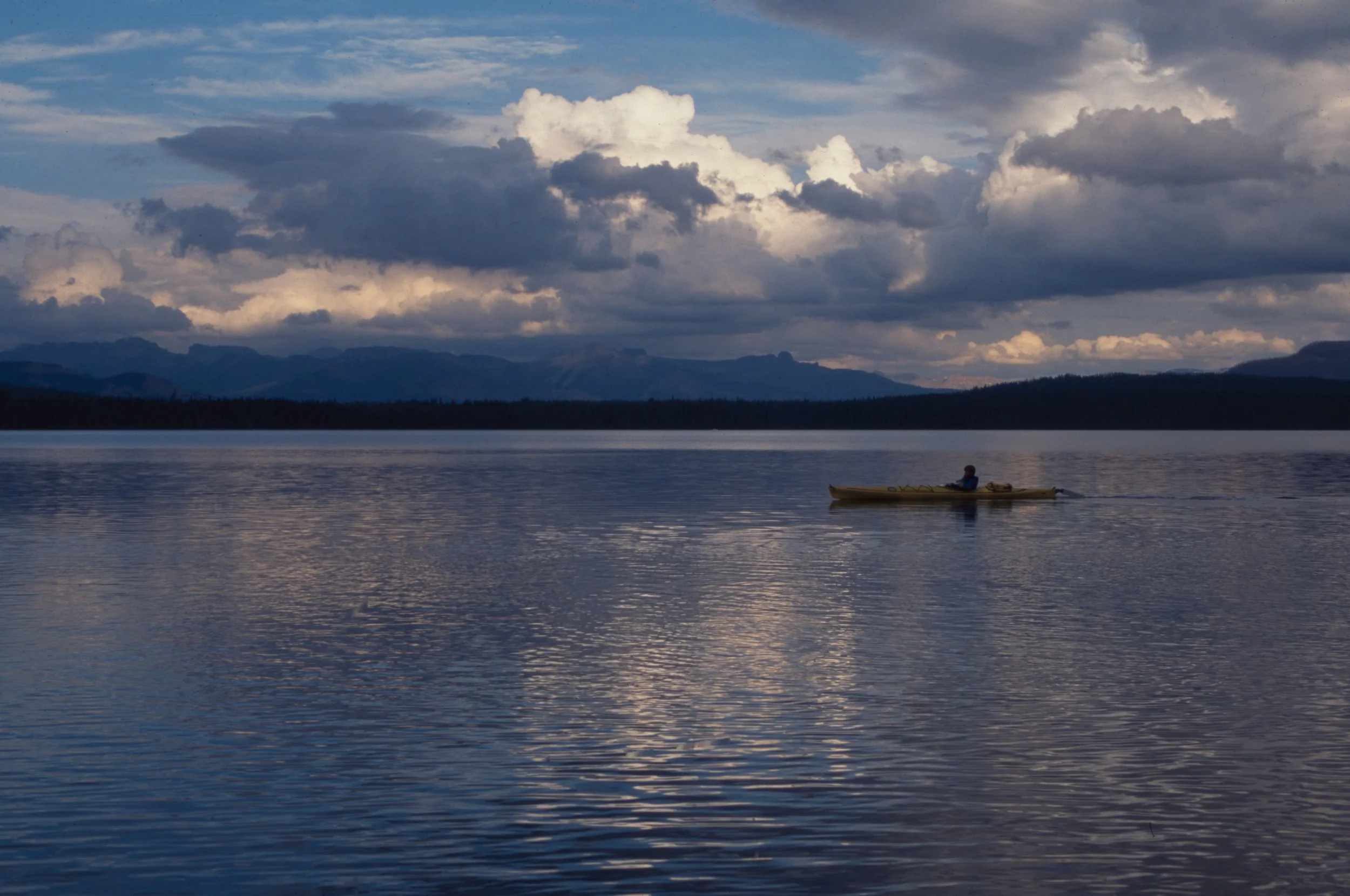
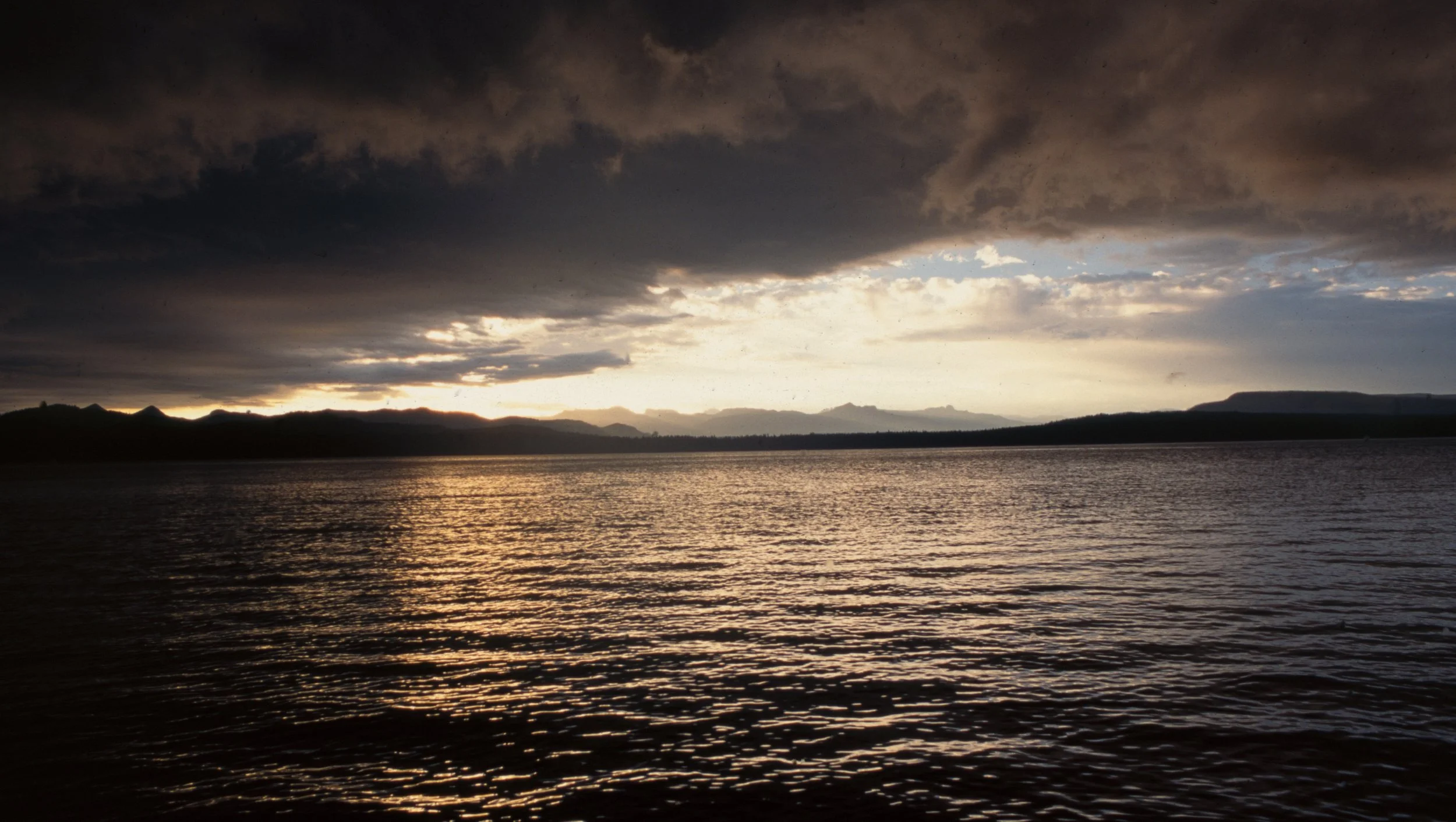
Approaching Storm on Yellowstone Lake
Located on the South Arm, our camp faced both the 10,352 foot Mount Stevenson, and Mont Doane in the Absaroka Range. Due in part to its elevation Yellowstone Lake is often swept by afternoon thunderstorms that build from the west in black walls flanked by slanting gray sheets of rain.
During the hour and a half paddle, clouds began to build from the west and by the time we reached camp the sun had disappeared behind a dark thunder head. Lightening forked into the forest and moments later thunder rumbled down the lake. Comparable to the magma that is presently lifting the caldera north of the lake an inch a year, the thunderstorms speak of a land shaped by violent natural forces.
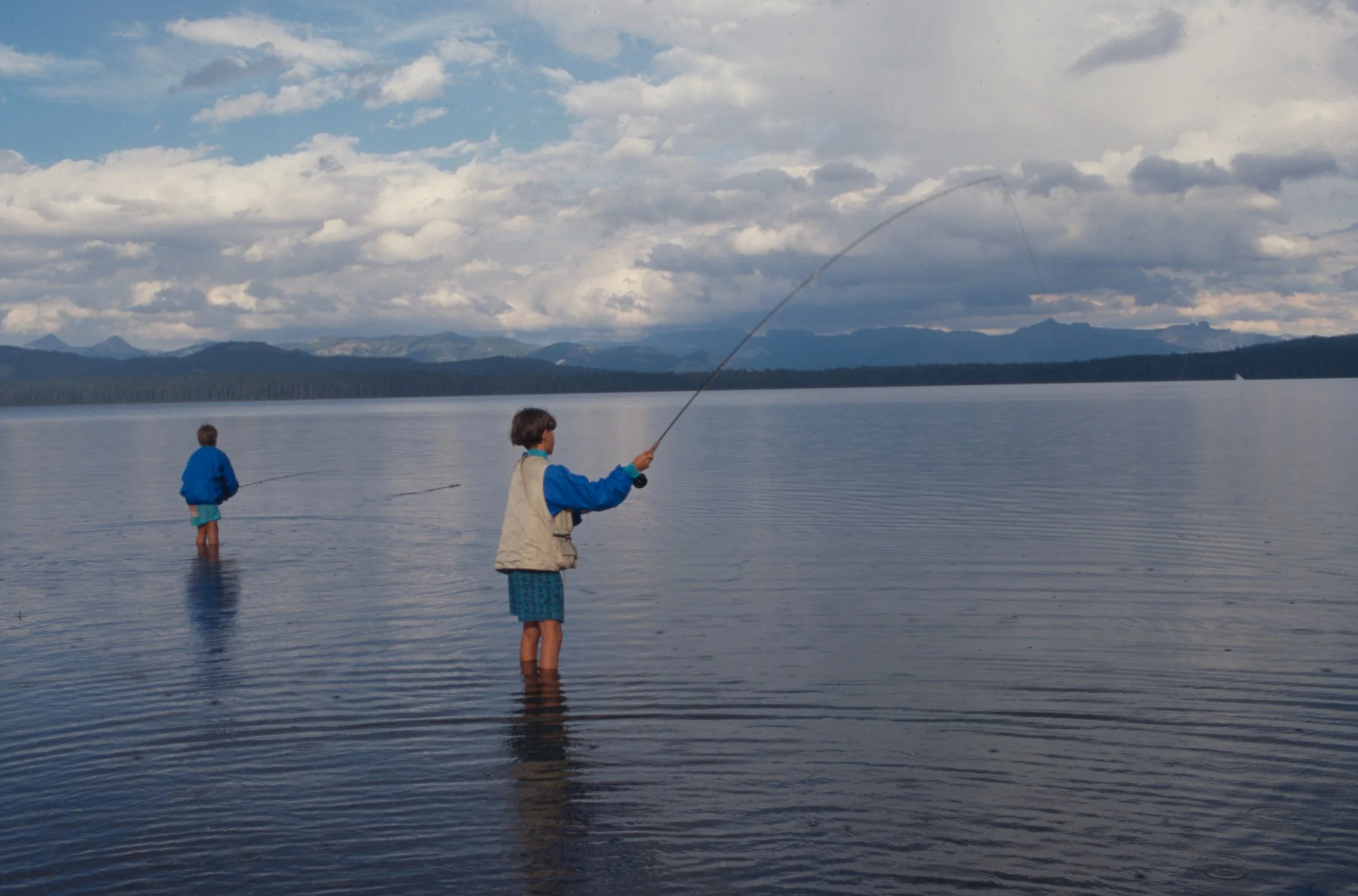
Andrew and Robert Casting to Rises
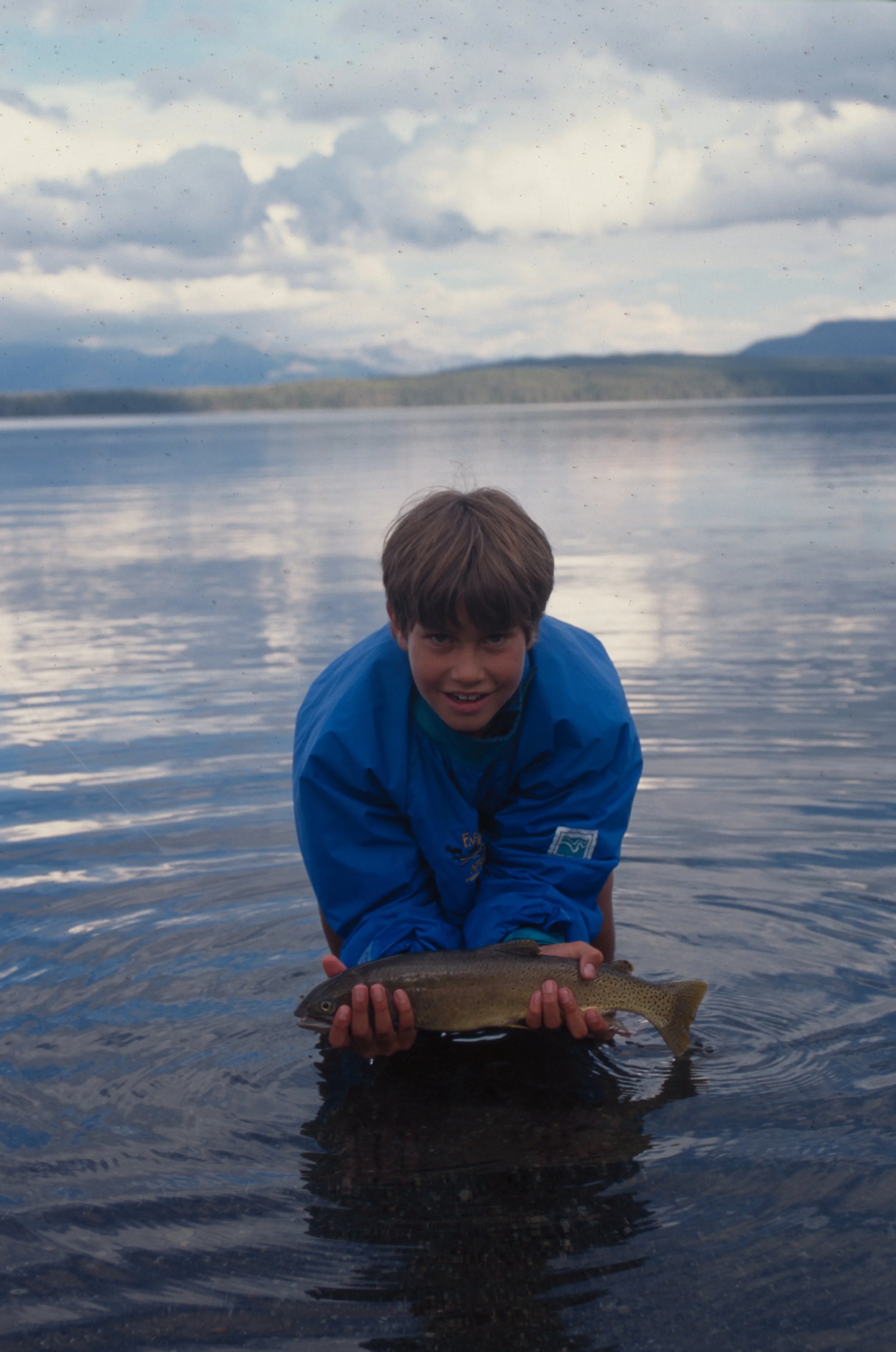
Robert with Beautiful Cutthroat
The trout rose with a ferocity that spoke to the long winters when the insects faded to nymphs that waited in drifting eggs and short summers when they hatched and appeared to erupt through the rain speckled surface. We were lucky to catch the hatch and for the next days the trout rose without fear.
The storm did not last long and when the rain waned, the suns sudden reappearance triggered insect hatches Concentric rings that betrayed the rises of native cutthroat trout, started to dimple the surface. While stringing a tarp between two trees, Harbaugh said that introduced Lake Trout were outcompeting the native West Slope Cutthroat. “If you hook a Lake Trout, just keep it. We’ll have it for breakfast.”
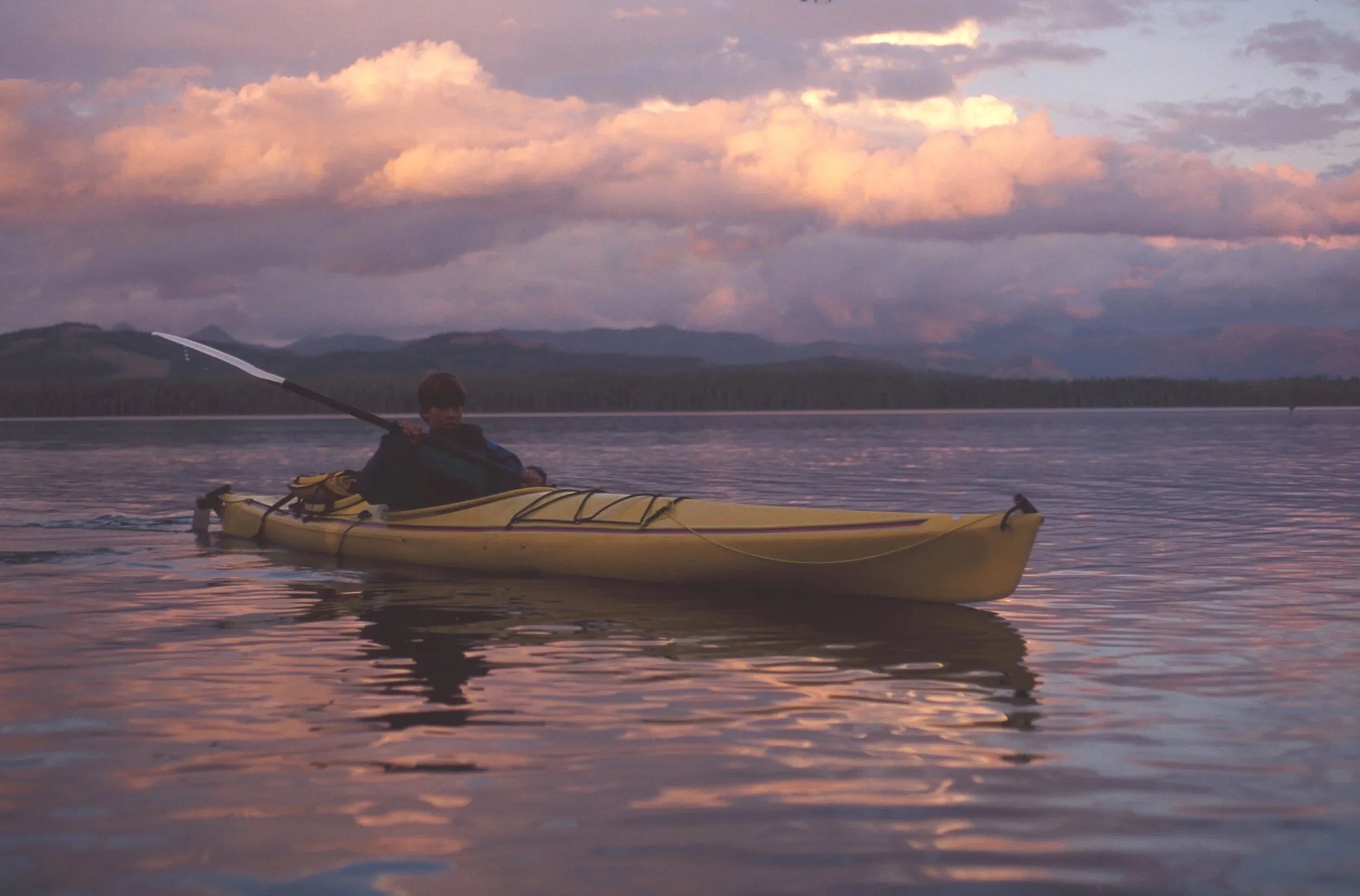
Robert Kakaying in the Late Afternoon
The boys uncased their rods and wading into the lake, began to cast Muddler Minnows up against the bank where burned lodgepole had fallen into the lake. Andrew took two pulls on the sinking line and felt the weight of a heavy fish.The Cutthroat fought to return to the drowned deadfall and break off. In time, however, Andrew nursed it into the shallow water, removed the barbless hook and released it.
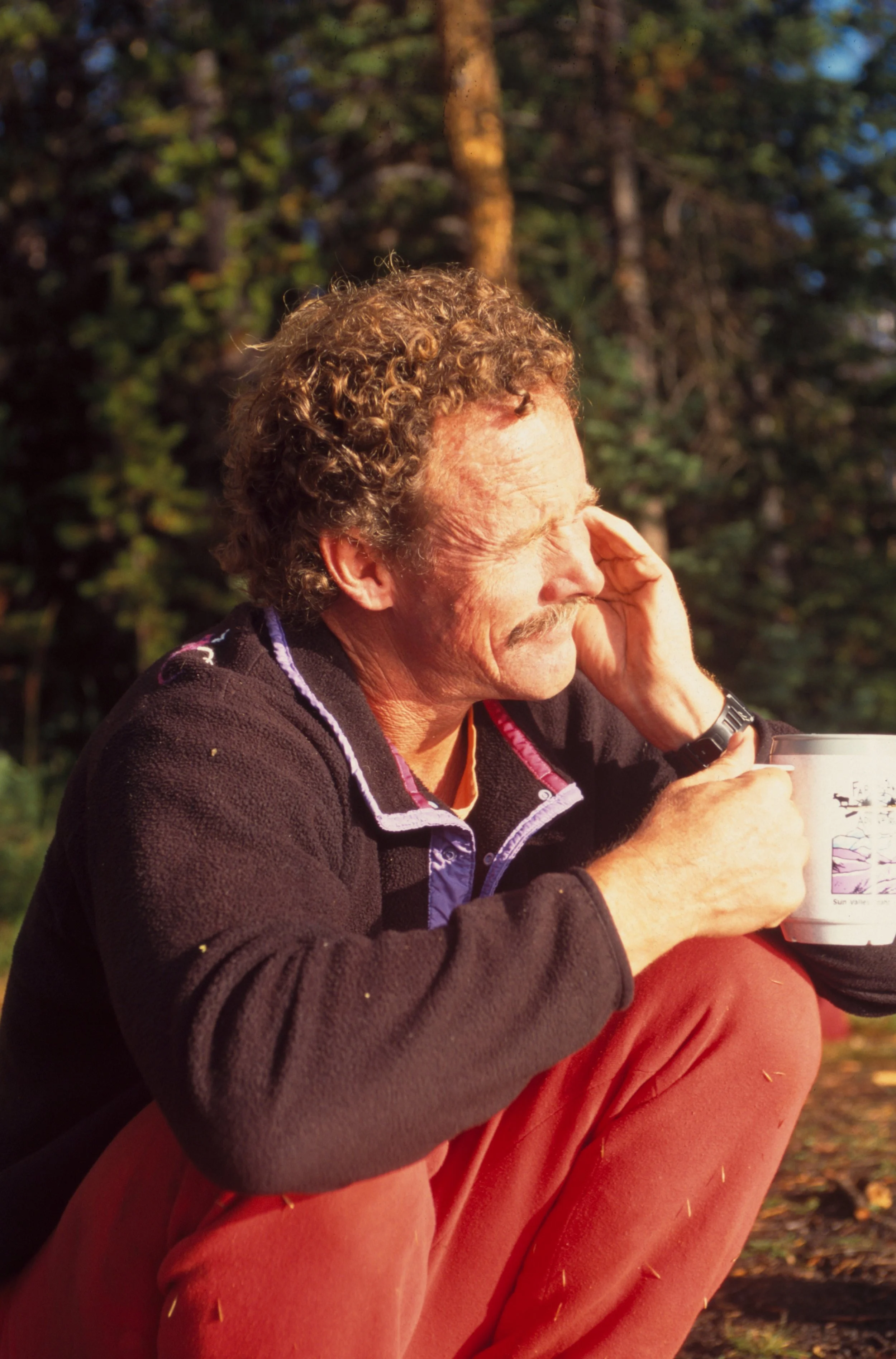
john Cole Enjoying CowBoy Coffee
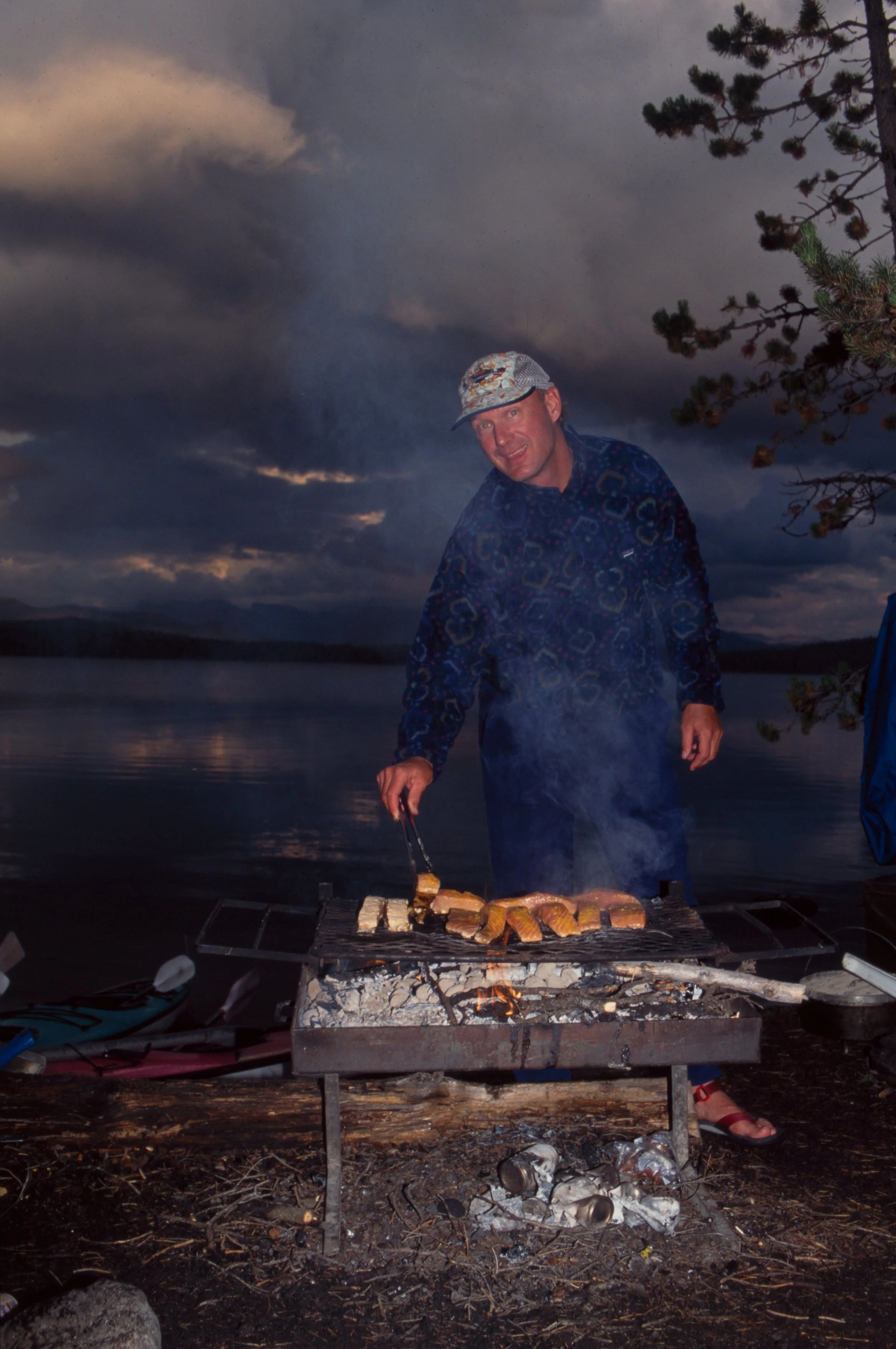
Mark harbaugh Barbecuing Salmon Steaks
Years of guiding on Idaho's Middlefork, Salmon and Snake rivers had taught John Cole what does and doesn't work in a wilderness setting and dinner that night proved to be grilled salmon filets, Dutch oven biscuits and broccoli with hollandaise sauce. Following a desert of pineapple upside down cake, whipped cream and hot coffee, heeding the ranger’s warning, anything that smelled of food was bagged, and lifted into the bear pole. And with campfire fading to bright orange coals, the cold Wyoming night crowded around us and we crawled into our bags.
The following morning a gray eastern light settled upon the mirrored lake. An osprey hovered above an unwary trout and a cow moose and her calf fed on the aquatic plants off the sand spit south of camp.
Andrew and Robert made the best use of the time before a breakfast of eggs benedict and chocolate raspberry cake by fabricating climbing harnesses out of safety straps and hoisting themselves high onto the bear pole. While the boy’s efforts amused John and Mark, the bears were not a joke. Though we did not see, Ursus Arctos Horriblus we made a major effort to guard against food smells.
During the next three days we kayaked to the headwaters of the West Arm, witness brightly lit stratocumulus, told life stories as we stared into the campfire, listened to howling coyotes, wolves, calling loons and the distant crash of distant burned spars.
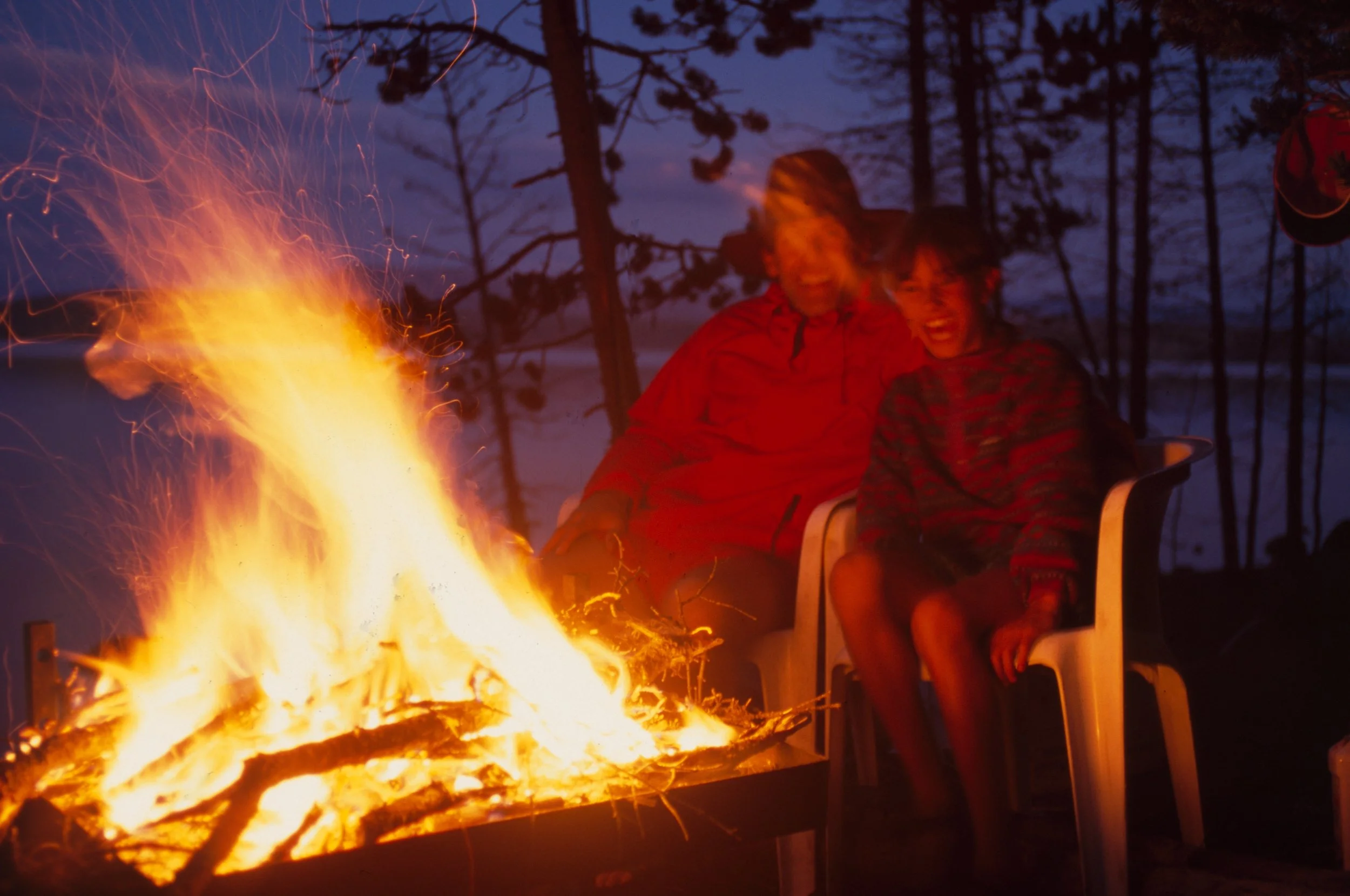
Andrew and Andy at Evening Fire
Before the trip, I had dismissed stories of twenty fish days as simply a fortuitous combination of the right weather, right hatch and right fly. The truth is, during those three days we far eclipsed that number. Casting into a deep hole next to a log I felt a heavy fish that bowed the rod toward the frigid water. A minute later a sixteen-inch Cut rolled next to the kayak. Leaving the fish in the water, I freed the barbless hook and returned it to the lake.
Days and night in the wilderness always pass too quickly and too soon we were thanking John and Mark for an amazing adventure. And loading our old station wagon we turned west toward Idaho. Exhausted by the full days, the boys fell asleep and as the road bisected sage filled lava flows, it occurred to me that while it may be true that Yellowstone's annual two million visitors are loving this northwestern corner of Wyoming half to death, only a very small percentage of those multitudes ever venture off the roads. Surrounded by vast lakes and barely touched wilderness, Yellowstone of the forties and fifties is still alive and well.
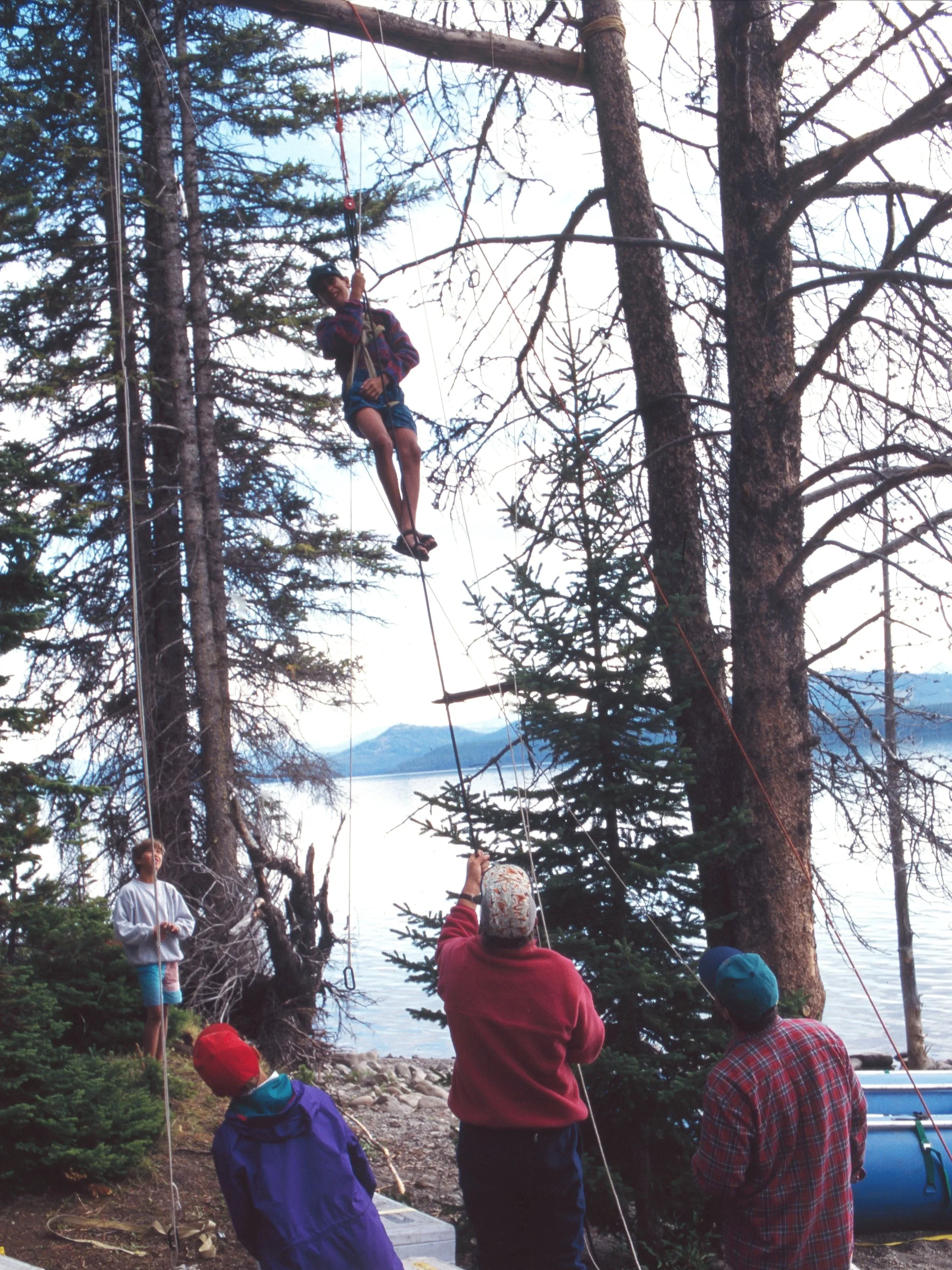
bOys and Harbaugh Rapeling off Bear Pole
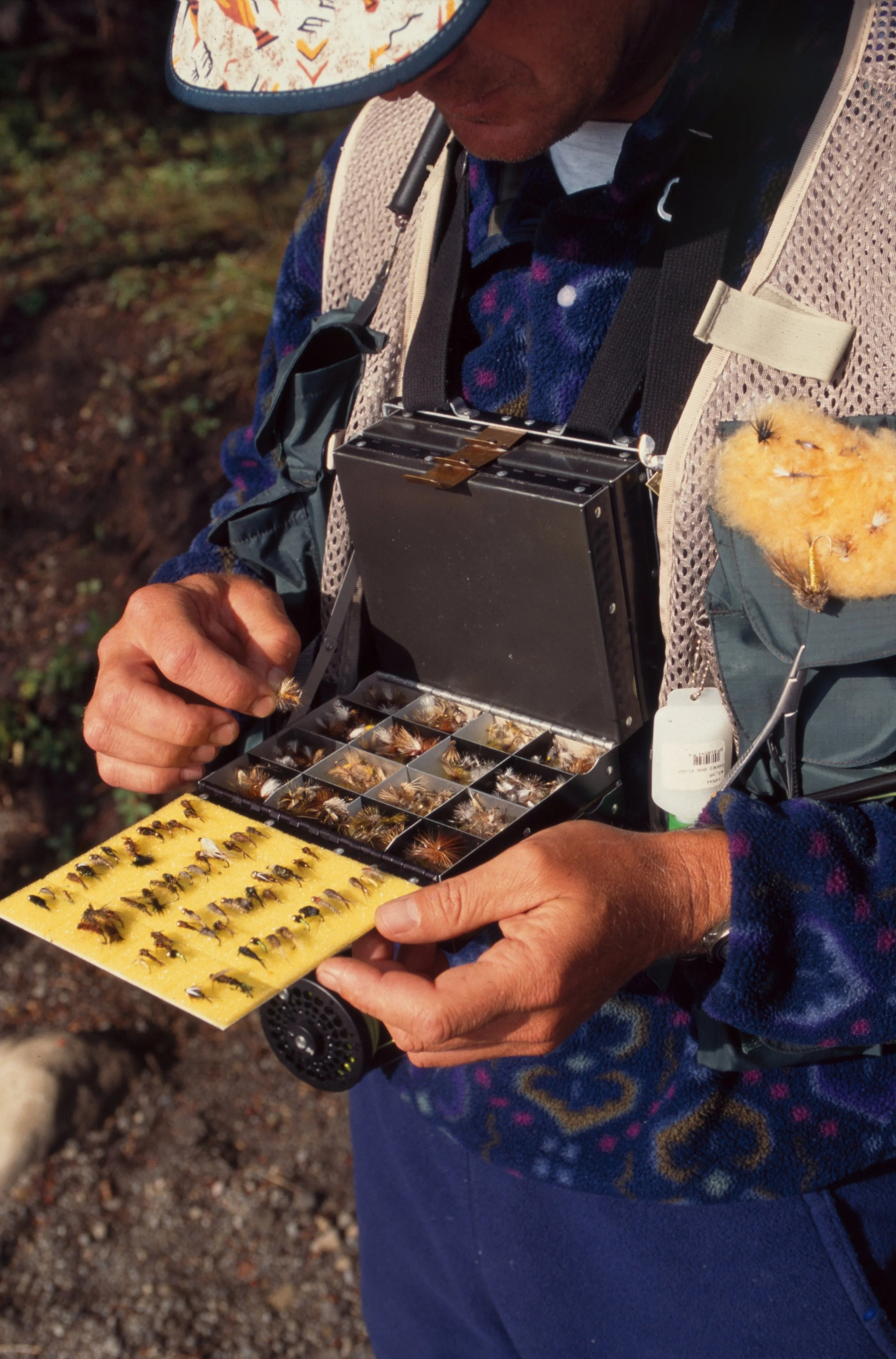
Mark Harbaugh’s Valuable Fly Box