Riding the Rails to Jasper
It is nine p.m. on a late winter night in Jasper National Park and my sons Robert, Andrew and I are howling at a full moon. Led by Cléone Todgham, the owner of “Jasper Nature Experience” we are giving vent to Jack London’s law of fang and claw. Standing above a frozen lake where park rangers dump road killed elk, we’re trying to trigger a reply. A yip or a bark will do. Even better would be an electric jolt, a tap into our deep genetic fear, a drawn out, spine tingling “hellooooooo!” kind of howl. We wait a minute before Cléone nods and Andrew and Robert pick up the high parts and I take the role of the Alpha Male, deep, commanding and aggressive. Trying to prolong the note, however, I run out of air, my voice cracks and instead of sounding powerful and dangerous, my howl fades to toothless, thin and mangy. The boys choke down giggles until, coming from a great distance, we hear what might be an answer. It may be nothing more than our imaginations. Or, it could be a wolf telling us we have the wrong number.
Waiting on the dark road, Cléone tells us we are excellent howlers. “You sound like a strong family pack,” she whispers.
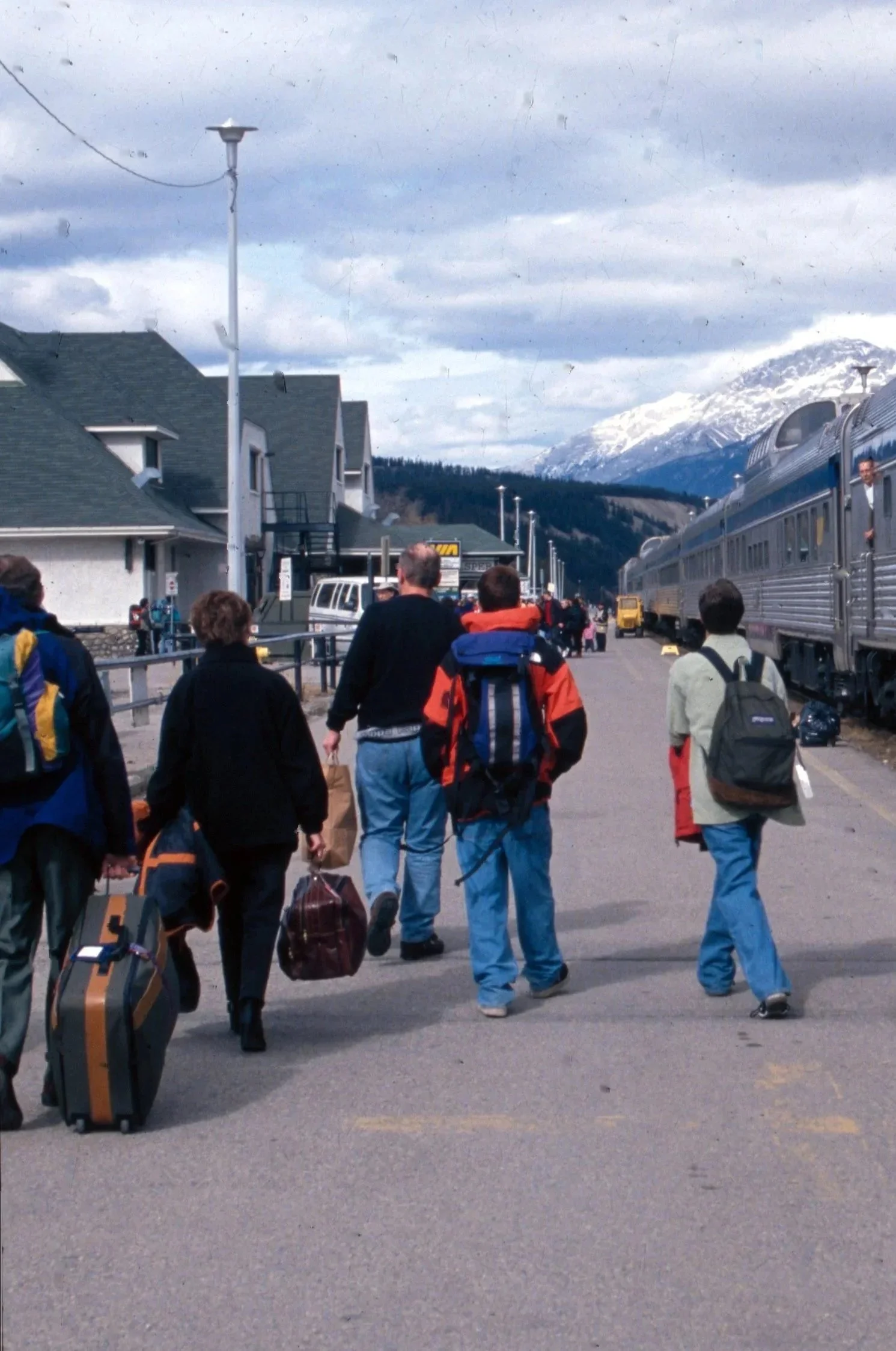
Following a long, deep winter, while much of Ketchum, Idaho departed for the southern tier for Spring Break--The Caribbean, Lake Powell and Disney Land we caught VIA Rail’s Canadian passenger train from Vancouver, British Columbia to Jasper National Park and Marmot Basin ski area.
Boarding the Canadian to Jasper
"The Canadian" is one of the few that survived. Linked closely to the history of our northern neighbor, "The Canadian" tied Canada's east and west coasts together with a ribbon of steel. Today the Canadian, departs three times a week from Vancouver's Central Station for a three-day run through Jasper National Park to Toronto.
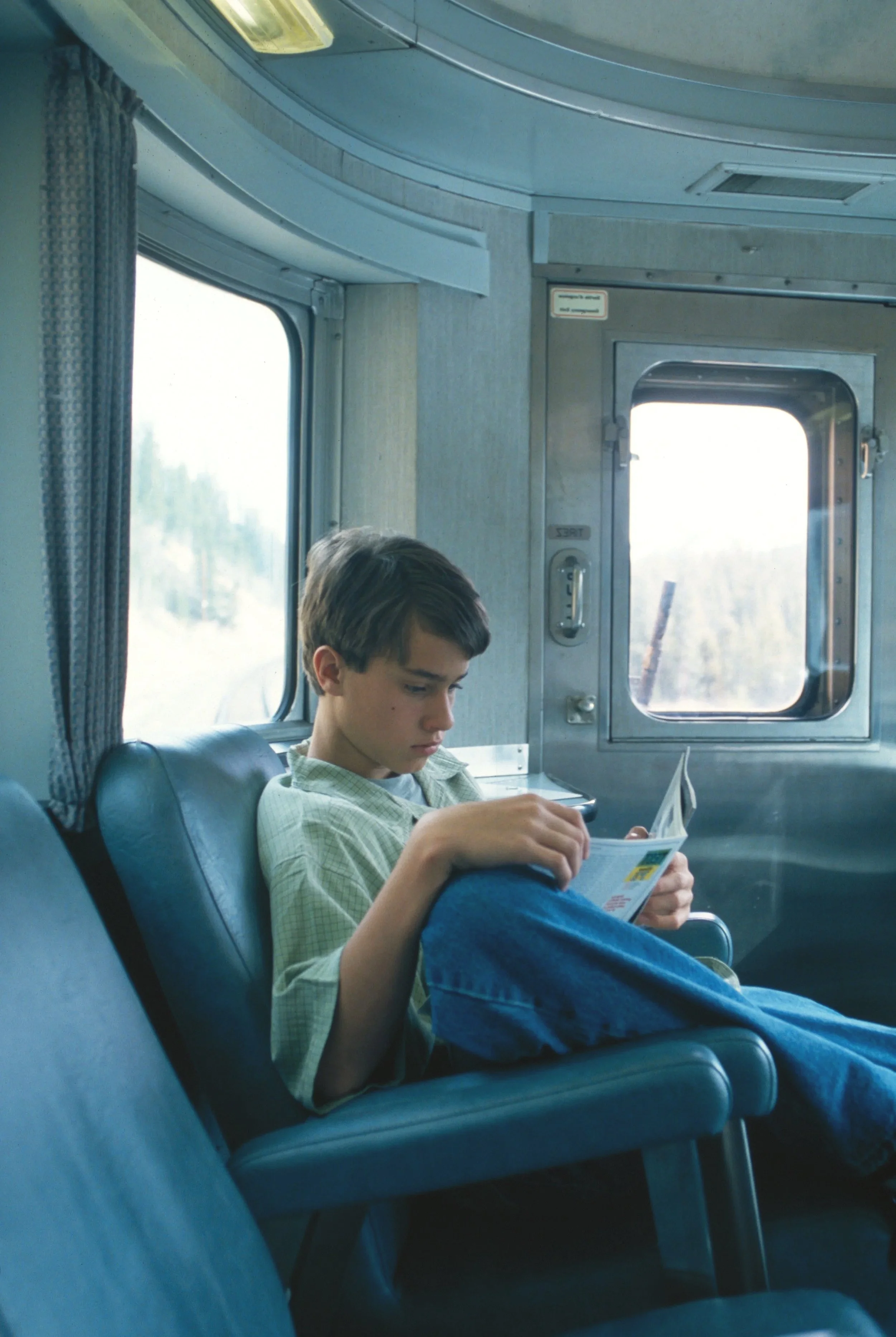
To tell the truth, train travel lives in my blood. My dad rode empty boxcars during the Great Depression and I was thirteen when I rode the Santa Fe Chief from Oakland, California to Saint Louis, Missouri where I spent the first of three summers bucking hay on my Uncle Carl’s farm. And now, some thirty-five years later, I hoped this train trip to Marmot Basin, would instill a love of trains and the Canadian Rockies in my own sons.
I believe one of greatest threats to the American family is, it doesn’t ride trains together. Families may fly, everyone does, but a middle seat, a bag of honey mustard pretzels and plastic cup of apple juice isn’t travel. The flip side of aping Icarus is nail biting, teeth grinding stress--crowded terminals, canceled flights, lost baggage and weird seat mates.
Having studied the U.S., England, Switzerland, France and Germany through train windows, I’m convinced you cannot raise a productive member of society without studying the nature of democracy, man, god and the universe. Such discussions, however, make flight attendants nervous. At thirty-six thousand feet, they do not like talk about God or the Universe any more than they like you to order a double shot with a beer chaser.
During the Thirties and Forties, train passengers slept in private sleepers, dined on white tablecloths and watched the eastern forests and western plains unfold outside panoramic windows. The romance of intercontinental streamliners unfortunately could not compete with the speed of coast-to-coast air travel and the legendary trains faded into history.
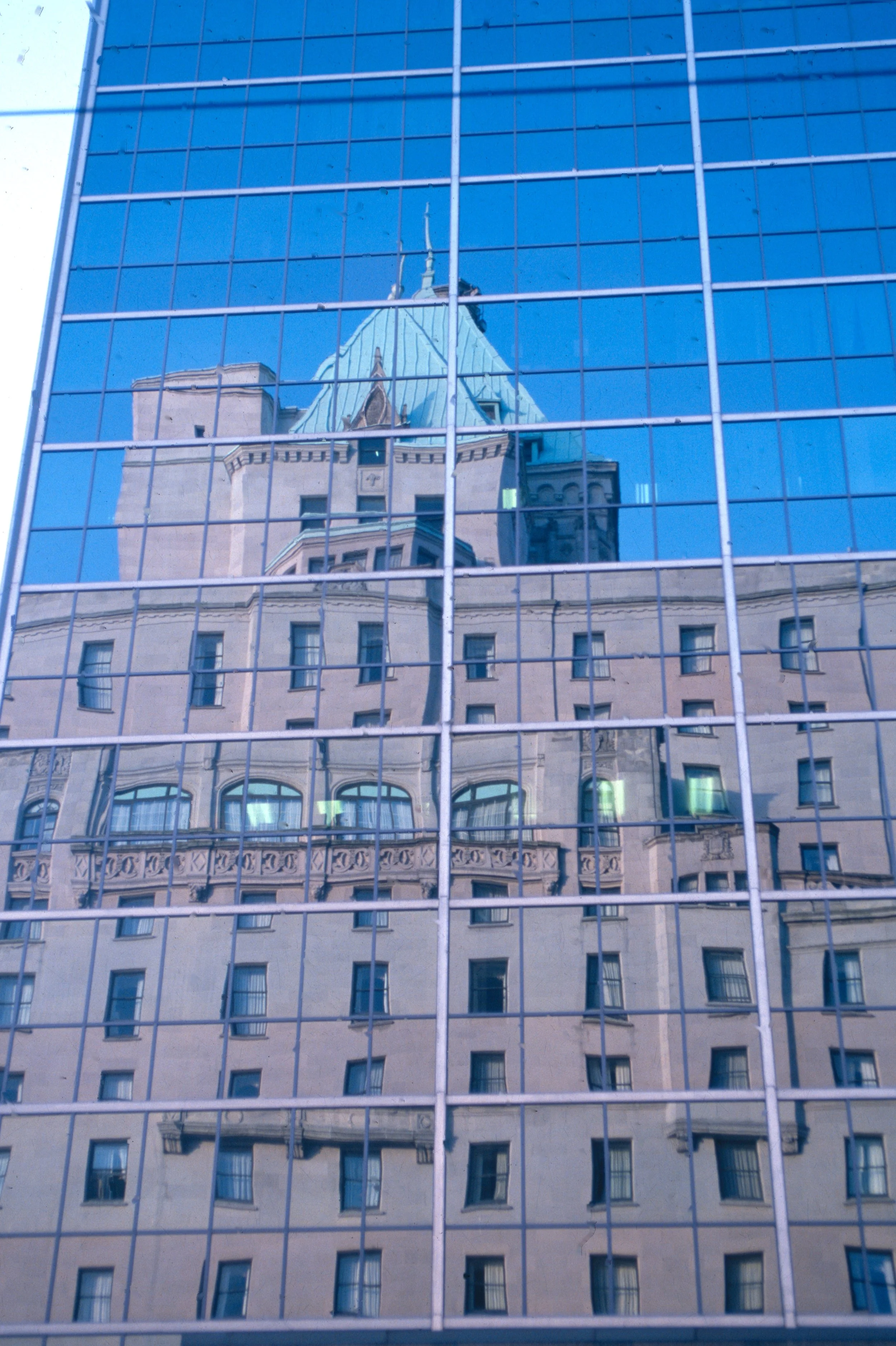
Shortly after we landed in British Columbia, we checked into the Hotel Vancouver. One of Canadian Pacific's classic hotels, the Vancouver was built in 1887 and continues to offer a colorful history and excellent service. Daylight was fading when we left the hotel and walked down Robson Street which pulsed with neon, coffee shops and a dynamic mix of nationalities.
Among the most cosmopolitan of west coast cities, Vancouver supports symphonies, plays, art shows and a vibrant China Town. It also takes equal pride in the Vancouver Canooks hockey team and Grouse Mountain’s ski runs that cascade toward the sea.
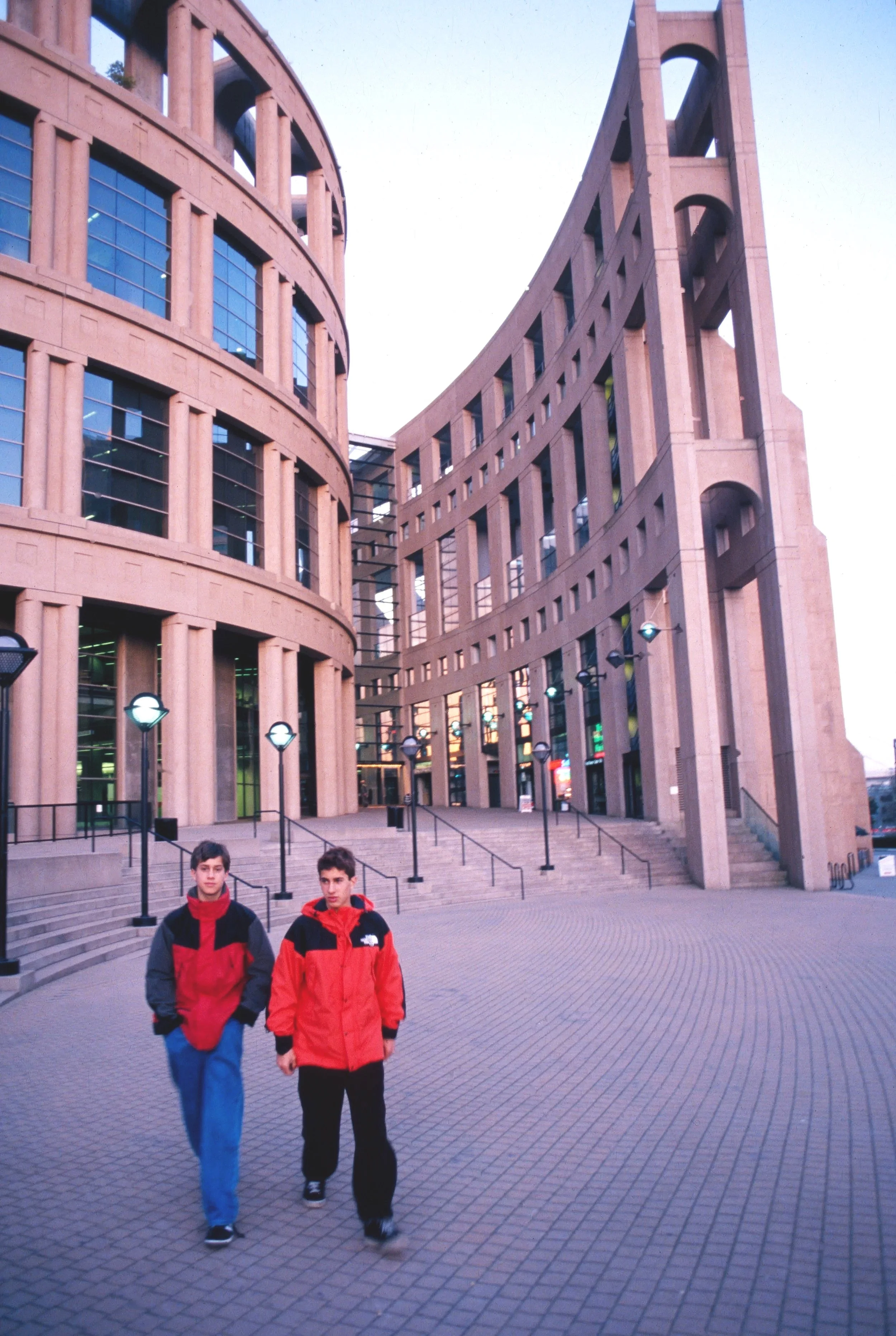
When Captain George Vancouver first explored this combination of old growth rain forest, blue glaciers and placid bays, he called it "the most lovely country that could be imagined." Nature continues to play a major role in this city of half a million and the following morning, we explored Stanley Park. Created in 1886, Stanley Park’s thousand acres of cedar, hemlock and fir trees provide but one leafy oasis among Vancouver’s hundred urban parks.
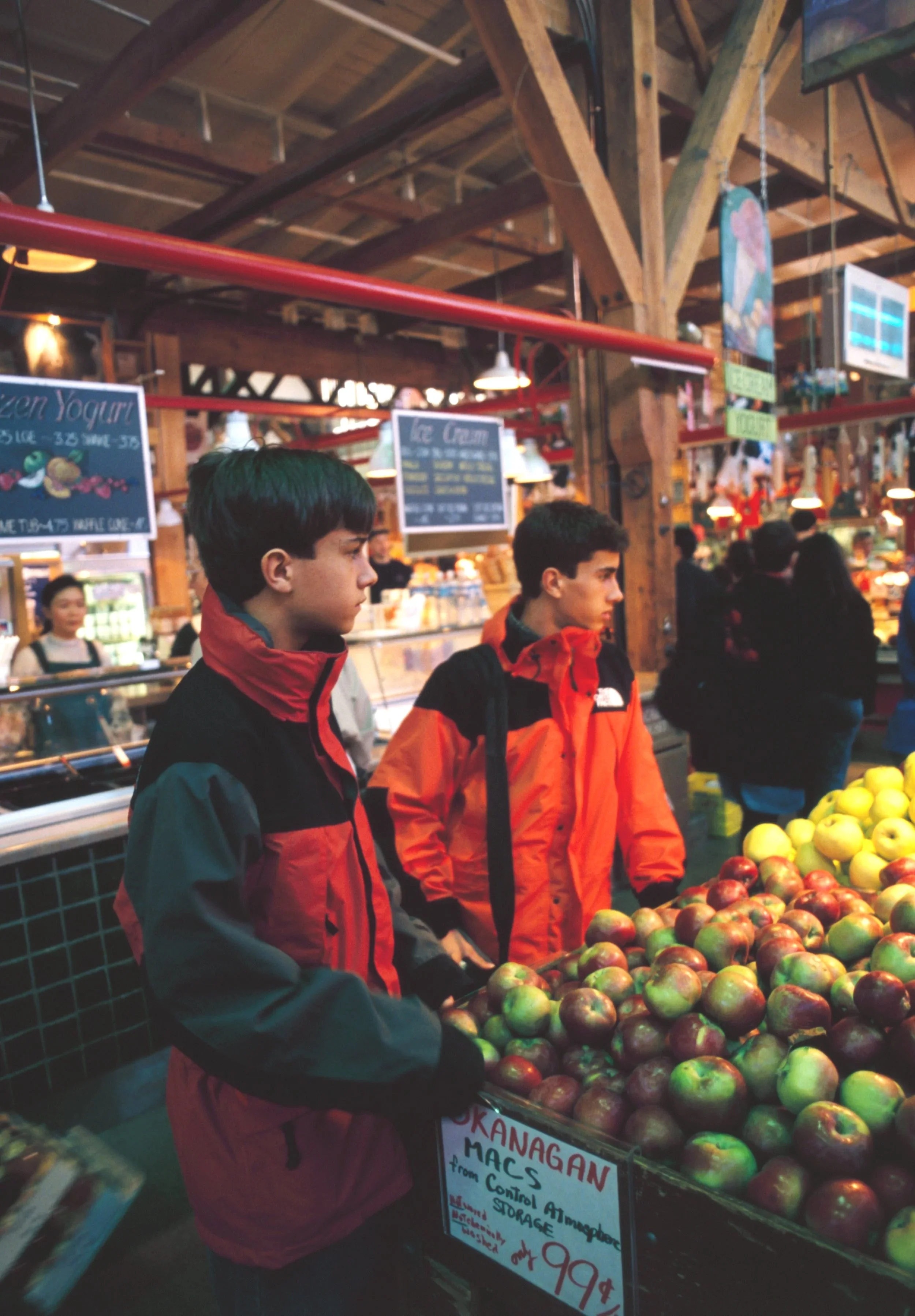
That afternoon we shopped Granville Island’s eclectic mix of handcrafts, restaurants, live theater, museums and farmers market. By the time we returned to the Hotel Vancouver we had less than an hour to gather our bags, hail a cab and check in at Central Station.
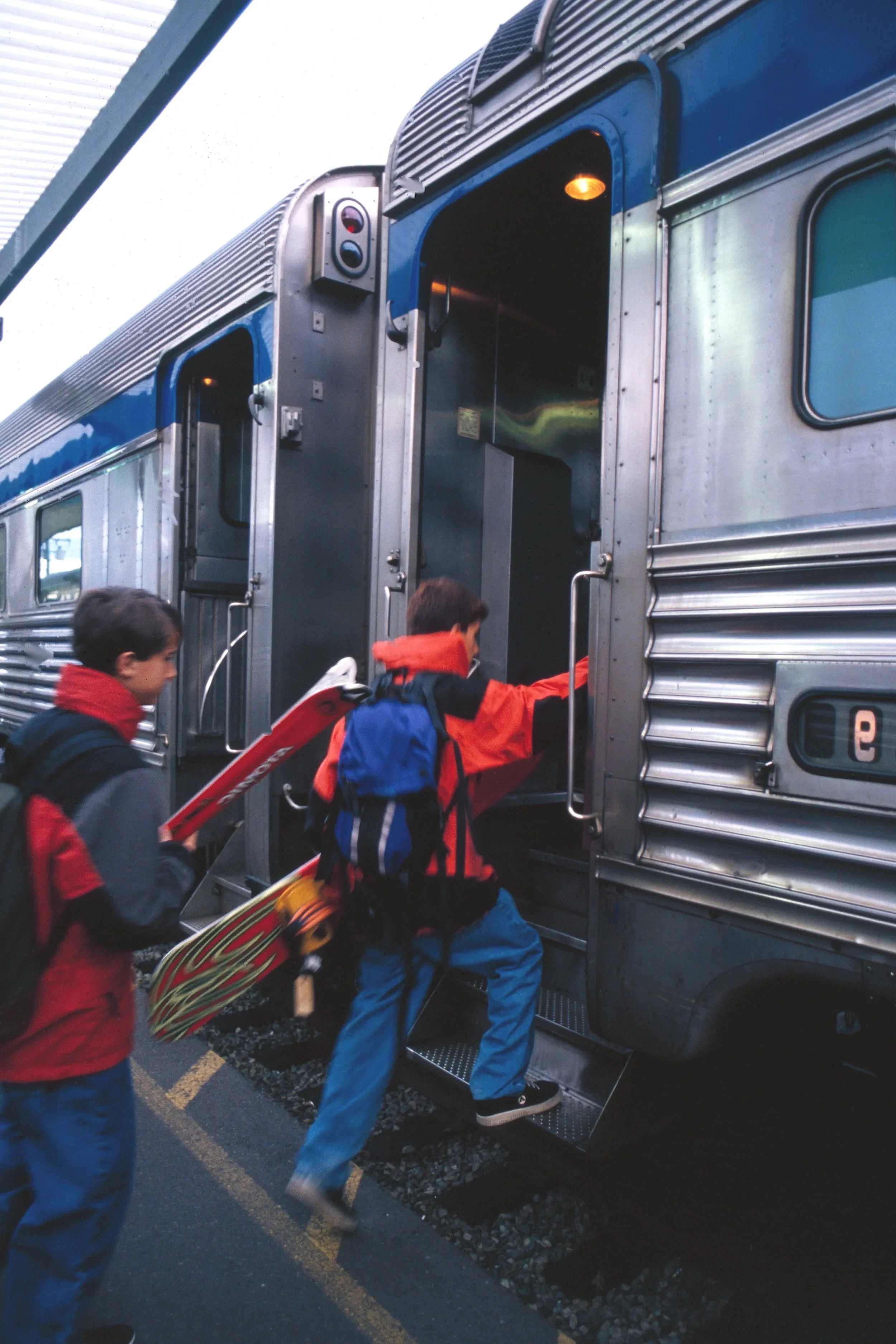
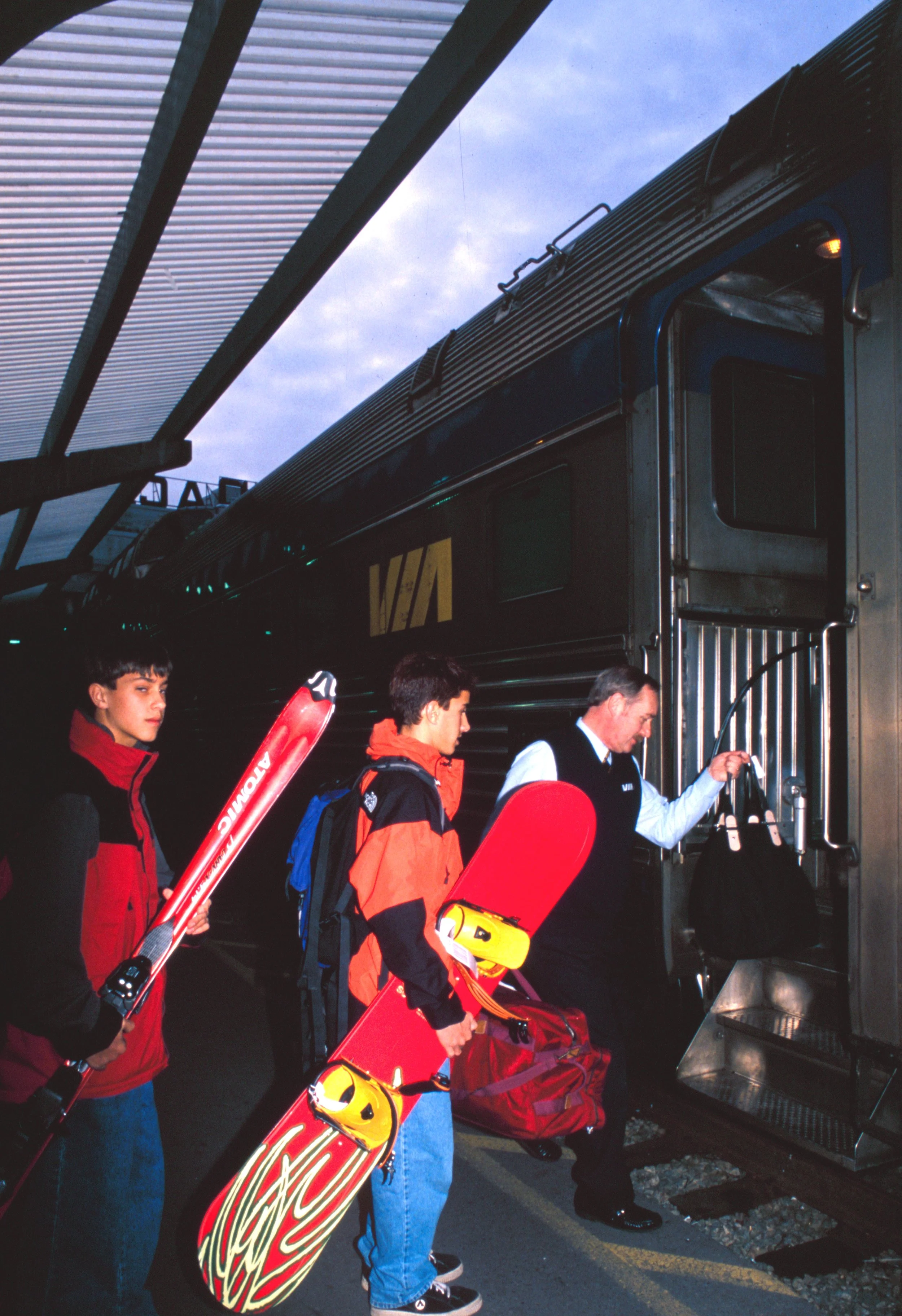
Once aboard, the boys disappeared in the direction of the locomotives. Known as the "Silver and Blue" and built in 1955, these immaculate stainless-steel cars were recently renovated at a cost of $200 million. Sleepers offer private toilets, basins, small closets and fold down tables while showers are available in each car.
More than the rolling stock, however, VIA Rail's investment can be seen in details such as Art Deco cut glass, thick carpets, bright tablecloths and fresh flowers. It was 7:00 p.m. when The Canadian rolled quietly from Vancouver’s Central Train Station. We had just dropped our bags in our rooms, when the first dinner seating was announced. To accommodate passengers, the service is divided into the Sunset, Twilight and Moonlight seatings. With the Frazier River flowing outside the dining car, dinner consisted of soup and salad, a choice of steak or salmon, vegetable and desert.
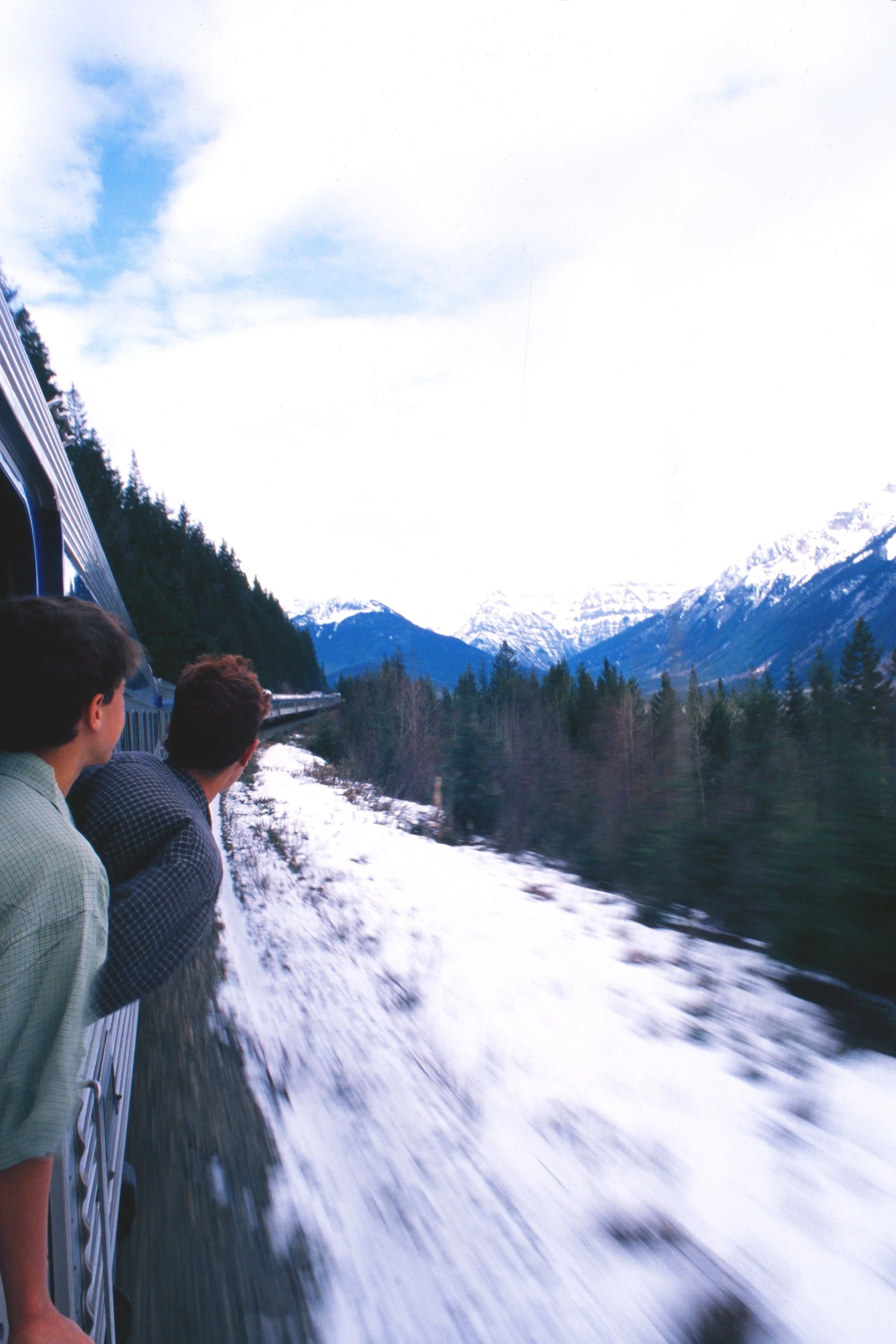
We had booked two sleepers and, shortly after we returned from dinner, Hugh Moore, our porter, made up the beds. It is hard to say why sleeping on a train resembles sleeping under the stars. Night passes in time to the distant dopplered sound of railway crossings and a sense of movement--if not through history, then through some of North America's most spectacular scenery. For that reason alone, sleep is impossible when the first purple and pink tints light British Columbia's high eastern horizon.
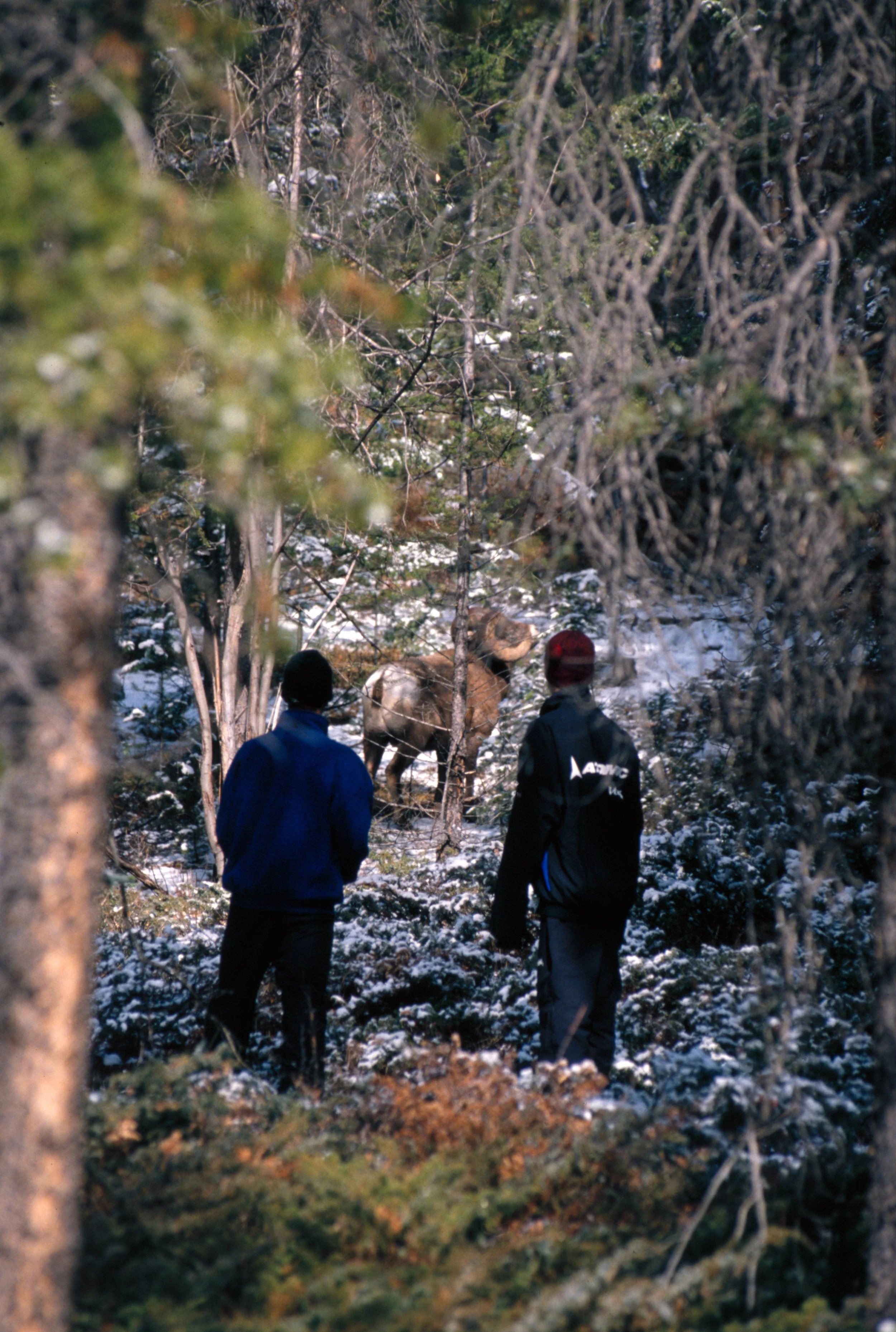
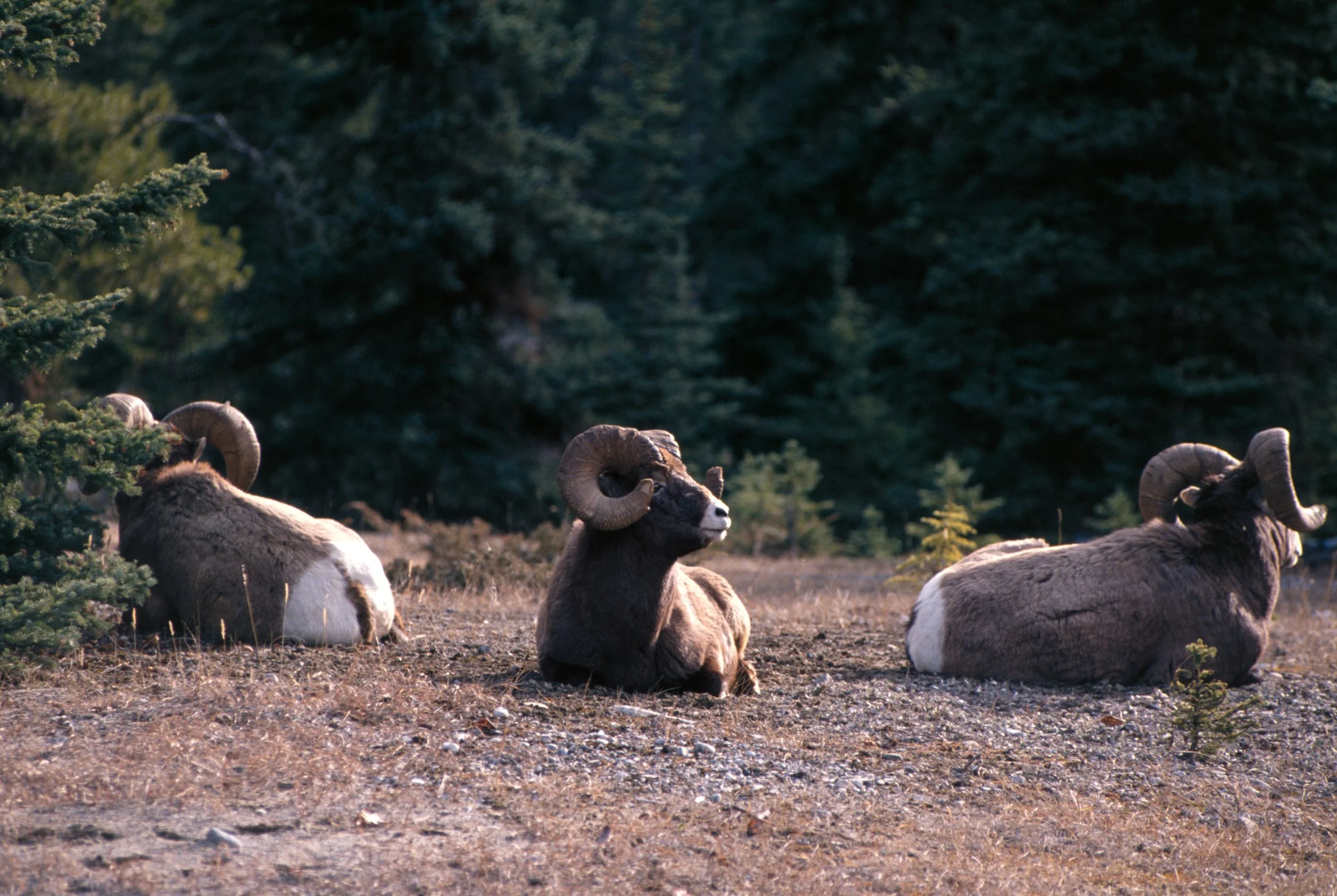
In its eighteen-hour run from Vancouver to Jasper, the Canadian slips from the dark Frazier to the clear Thompson River, climbs through glaciated valleys and curves around the foot of Mt. Robson. At 12,972 feet, Robson is the highest peak in the Canadian Rockies and appears shortly before the train slows for Jasper at 1:00 p.m. In winter, Jasper is a quiet, nearly deserted collection of restaurants, hotels and shops set in the Northern Rockies spectacular Athabasca Valley. Mature Big Horn Sheep, deer and elk have migrated out of the high country and now haunt Jasper’s empty roads. After a day on the train, the boys immediately wanted to catch a cab to Marmot Basin which sits thirteen miles and roughly twenty-five minutes out of Jasper on Highway 93.
A van from the Canadian Pacific Jasper Park Lodge was waiting for us in front of the train station. Set on a low hill above Lac Beauvert, the Lodge opened in 1915 as a collection of tents which were later replaced by log cabins. In its eighty-three-year history, the resort has hosted a variety of politicians, artists and movie stars. Marilyn Monroe and Robert Mitchum stayed at the Lodge during the filming “River of No Return” and Queen Elizabeth, the Kennedys and Sir Arthur Conan Doyle have all explored the paths that ring the lake.
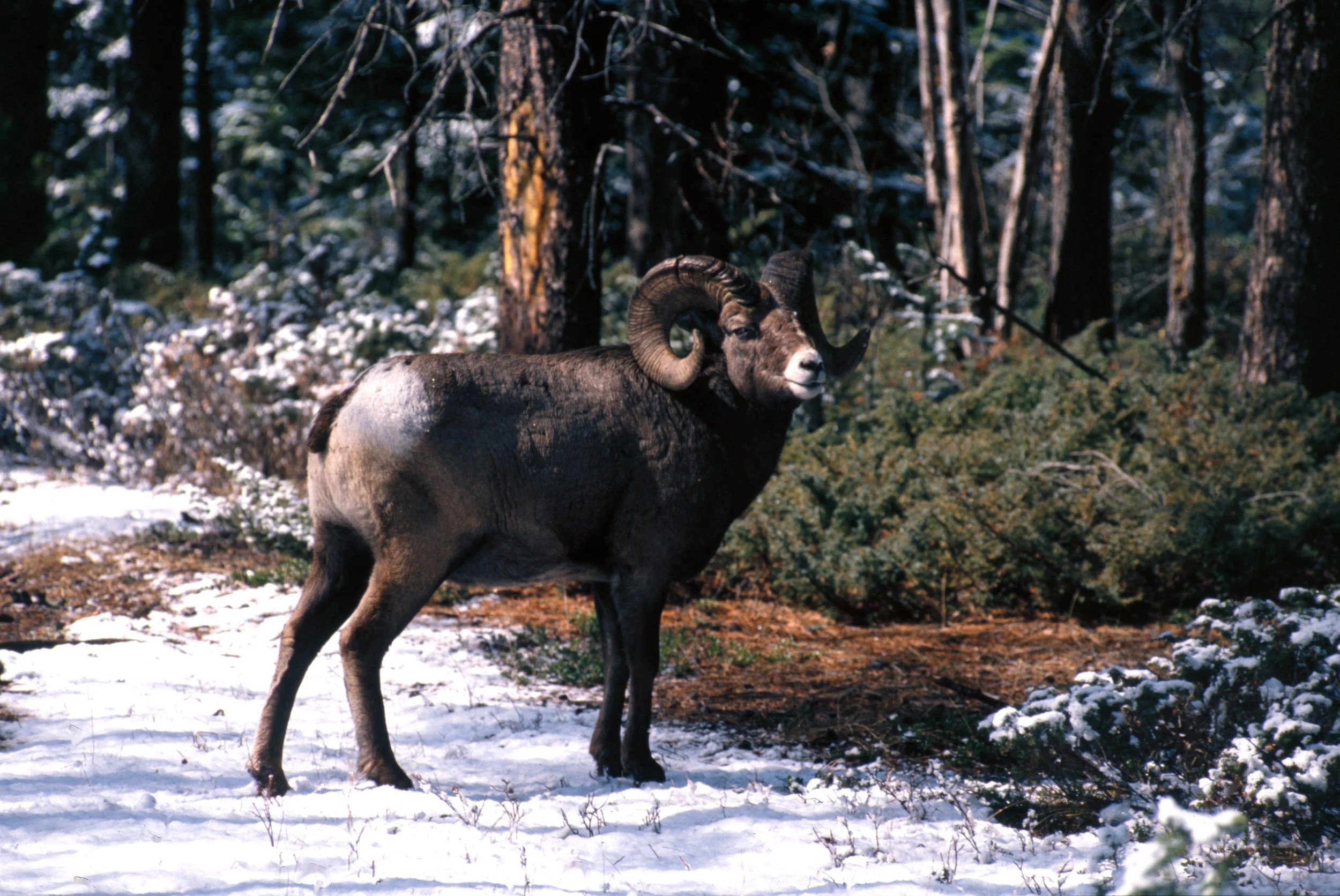
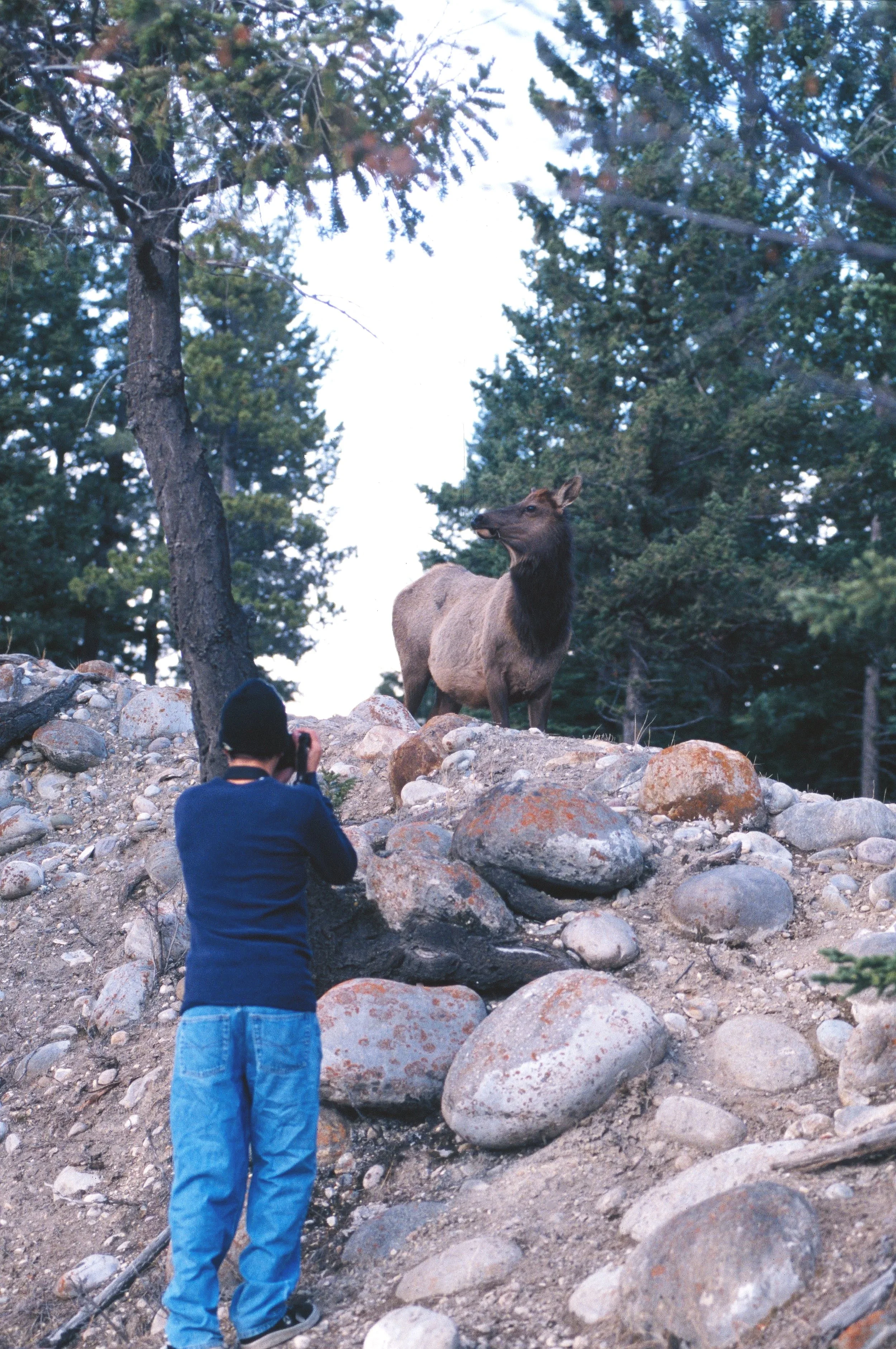
Though snow covered Jasper’s surrounding peaks, the valley floor was bare and we skirted a herd of elk eating and fertilizing the lawn in front of our cabin. The Lodge desk clerk warned us that the local amorous bulls bit, kicked, gored, chased and stomped. The cows were worse. “It is best to maintain a safe distance.” she advised us.
Andrew had recently taken up elk calling and for the past three months our living room had echoed with the whistles and whines of a bull in rut and now, studying this cantankerous, but attentive audience lamented, “I wish I’d brought my grunt tube,”
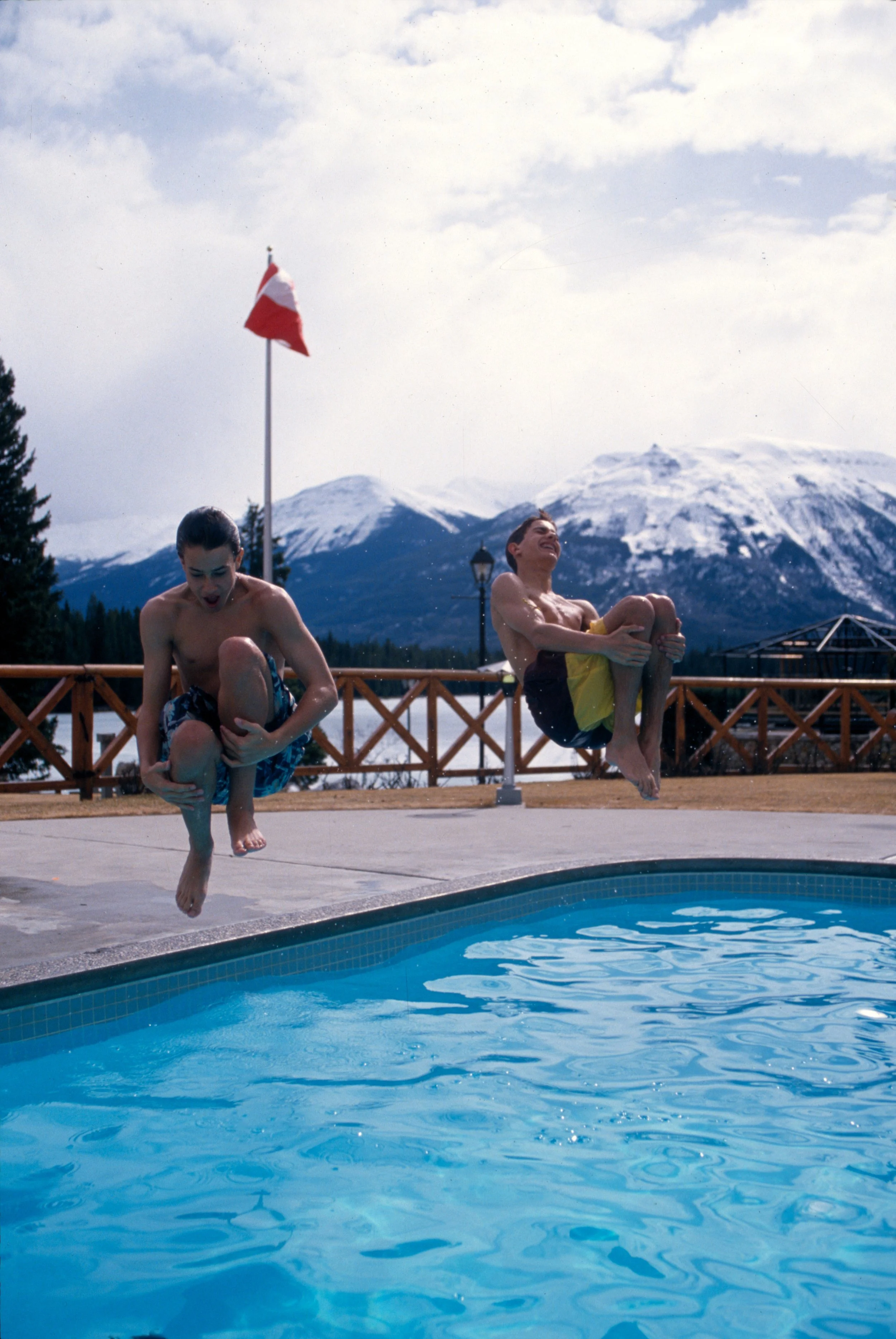
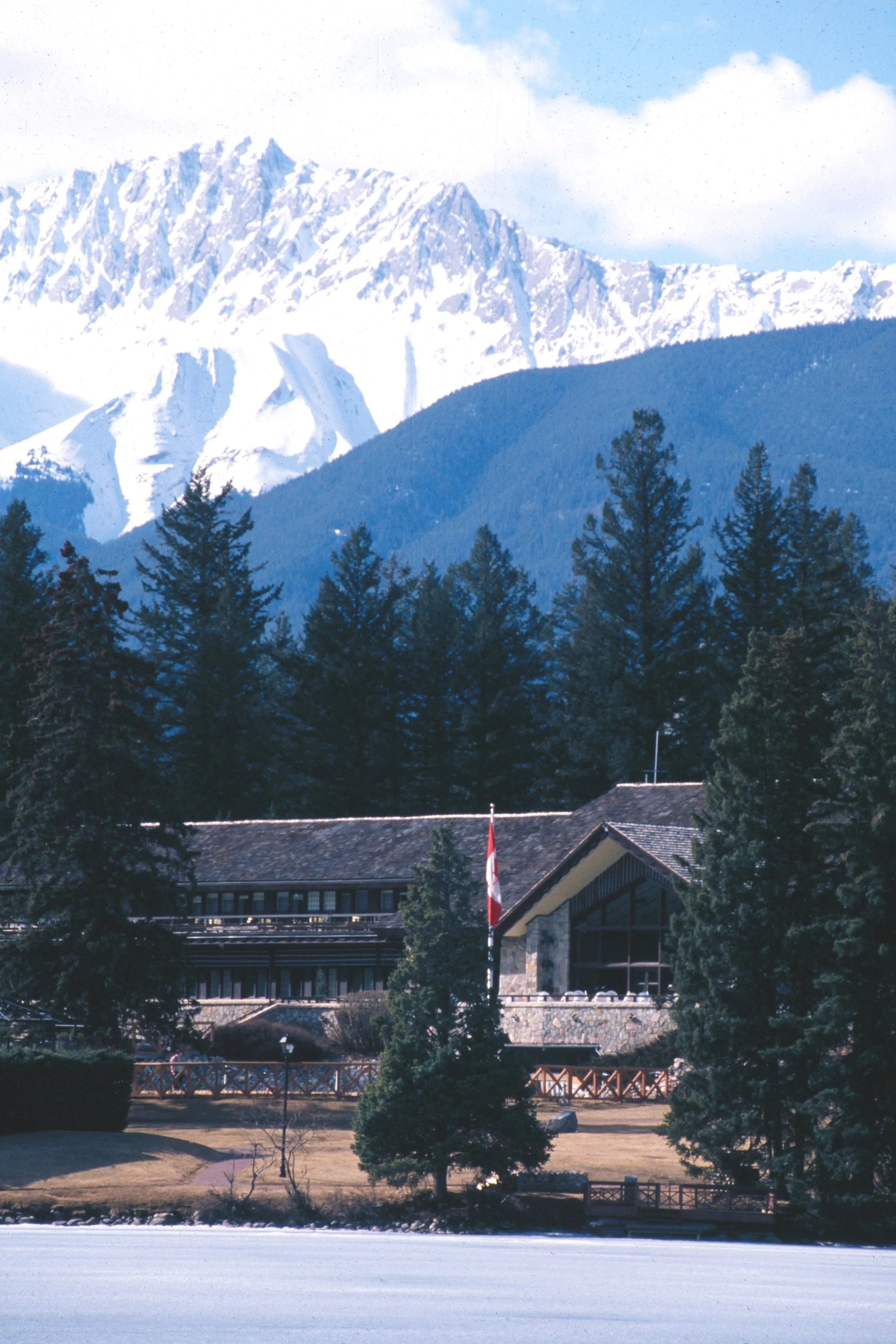
The Lodge swimming pool, game room, shops and dinner at the superb Edith Cavell Dining Room, occupied the rest of the day and we were up early the next morning for the thirty-five-minute bus ride to Marmot Basin.
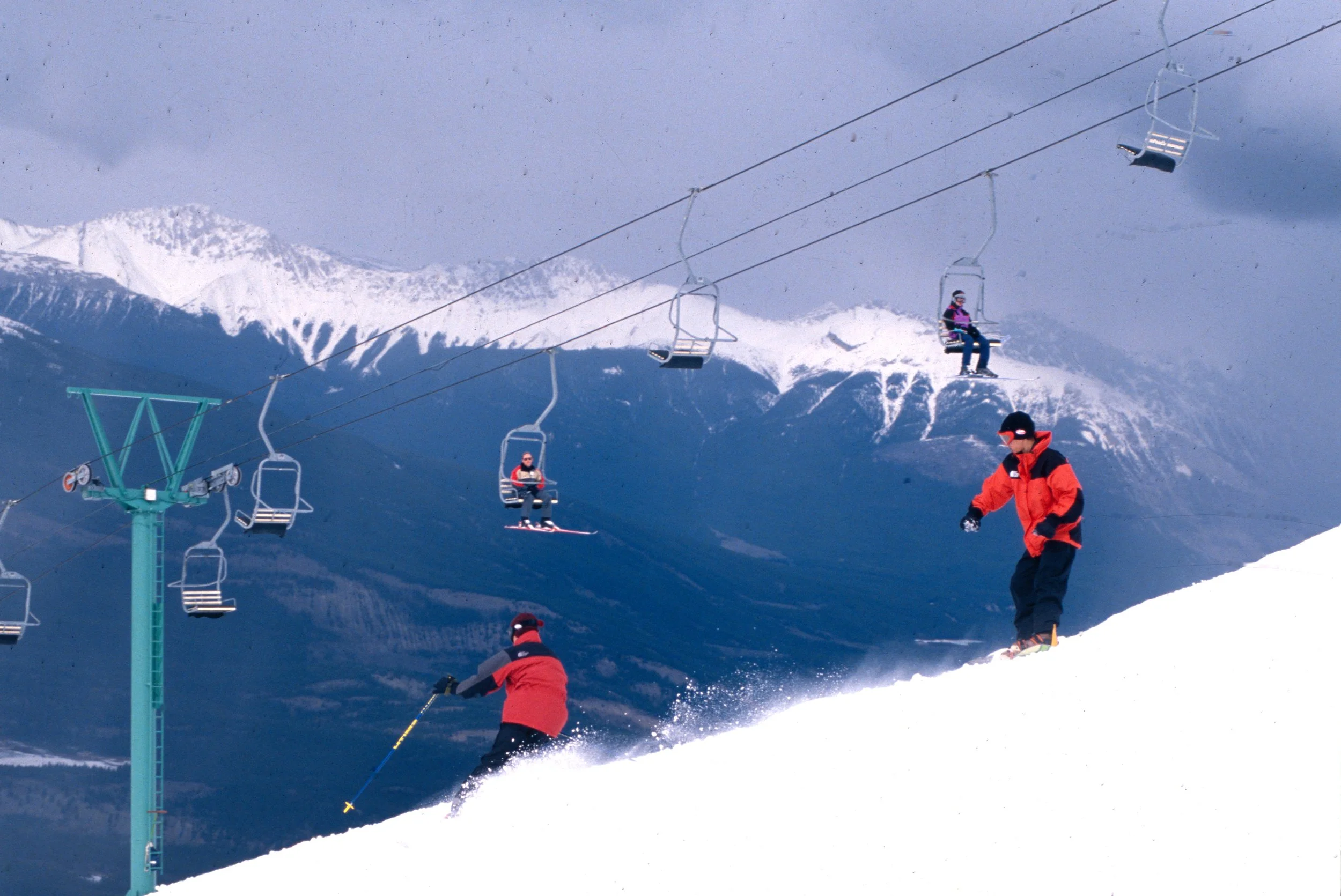
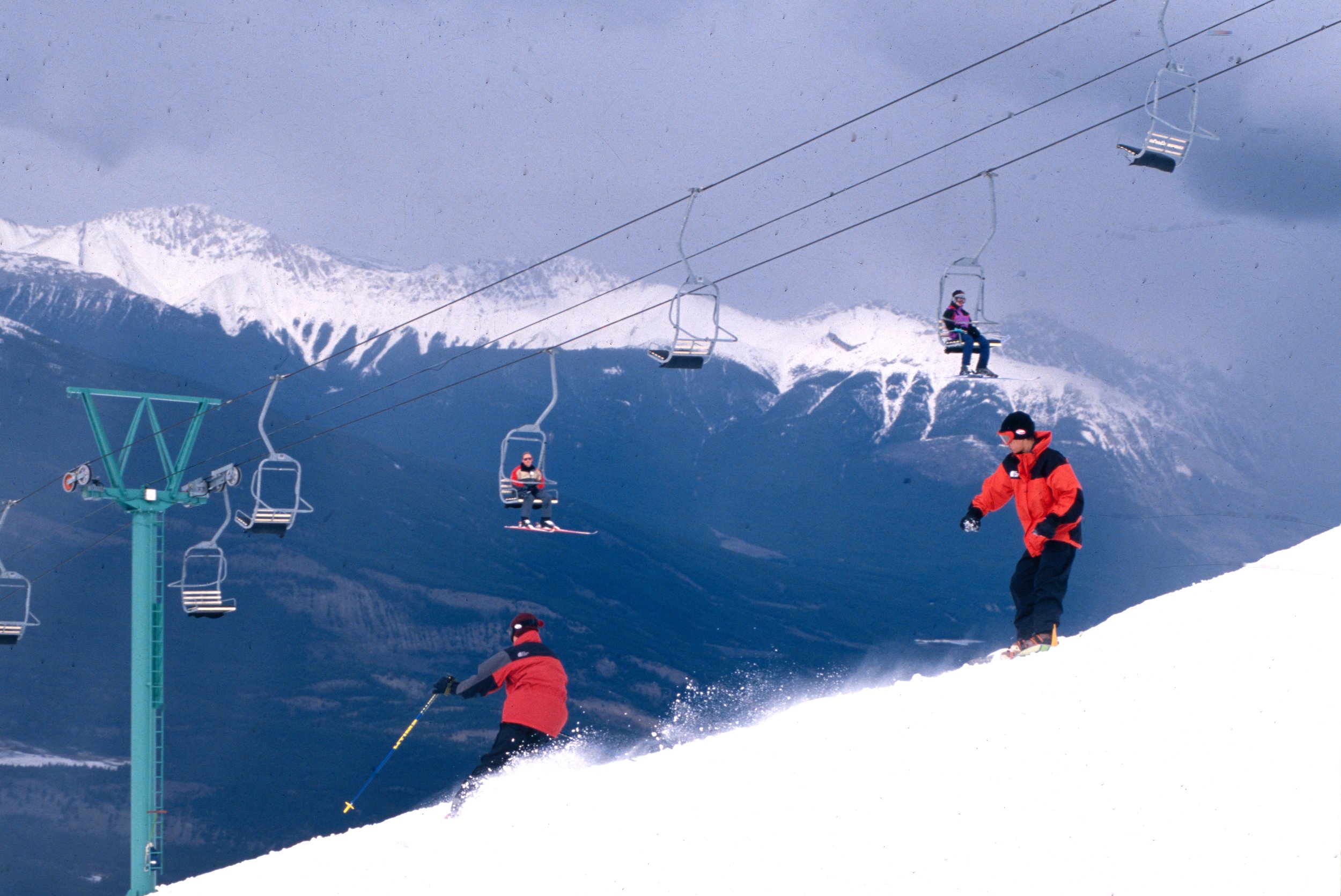
Stepping off the bus we met Patrick Harvey, an English adventurer now living in Jasper who offered to show us the mountain. Set in the shadow of Marmot Peak, the ski area is deceptively large. With a vertical drop of 2944 feet and 1000 skiable acres divided evenly between 53 beginner, intermediate and advanced runs, Marmot prides itself on nonexistent lift lines and deep, dry snow.
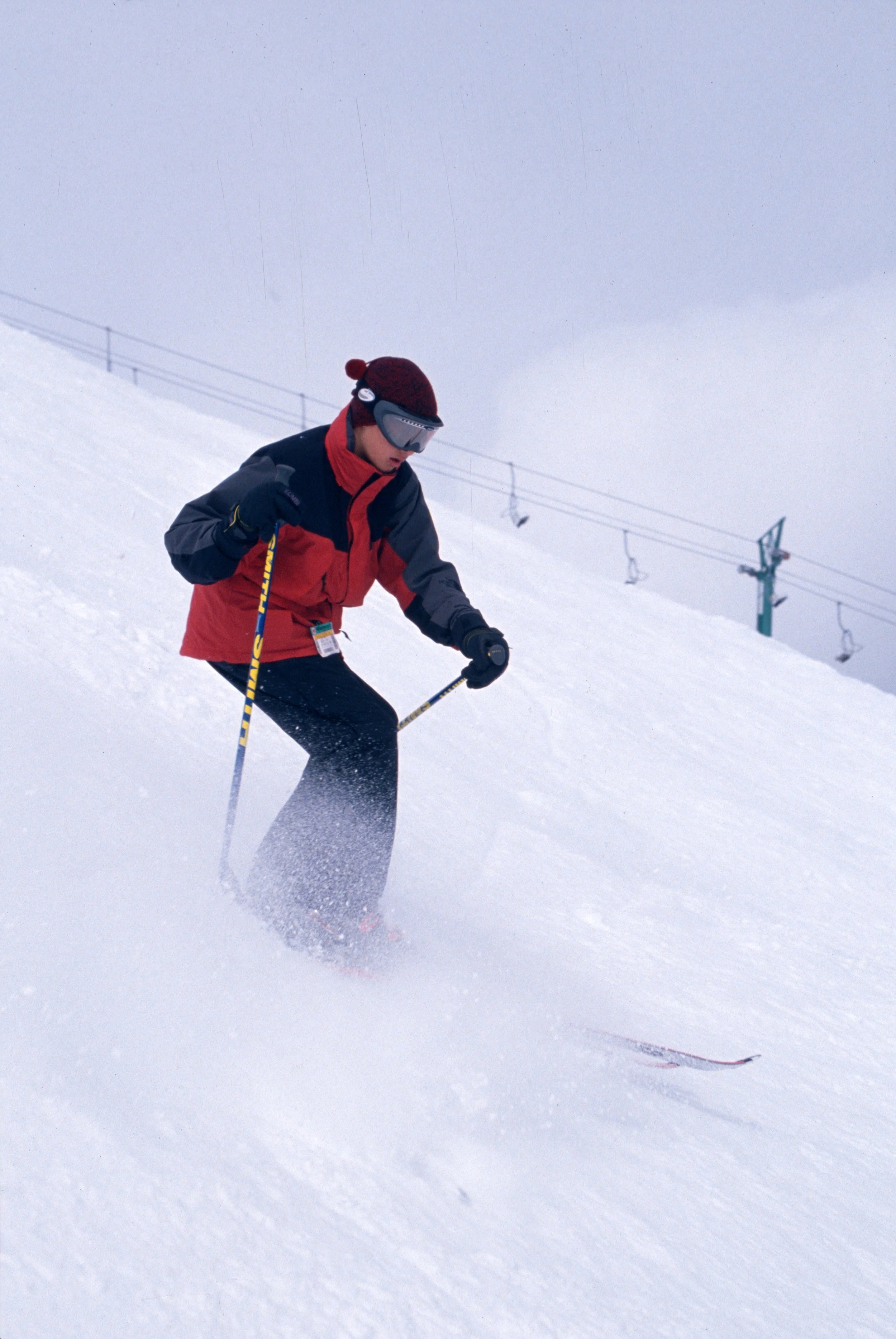
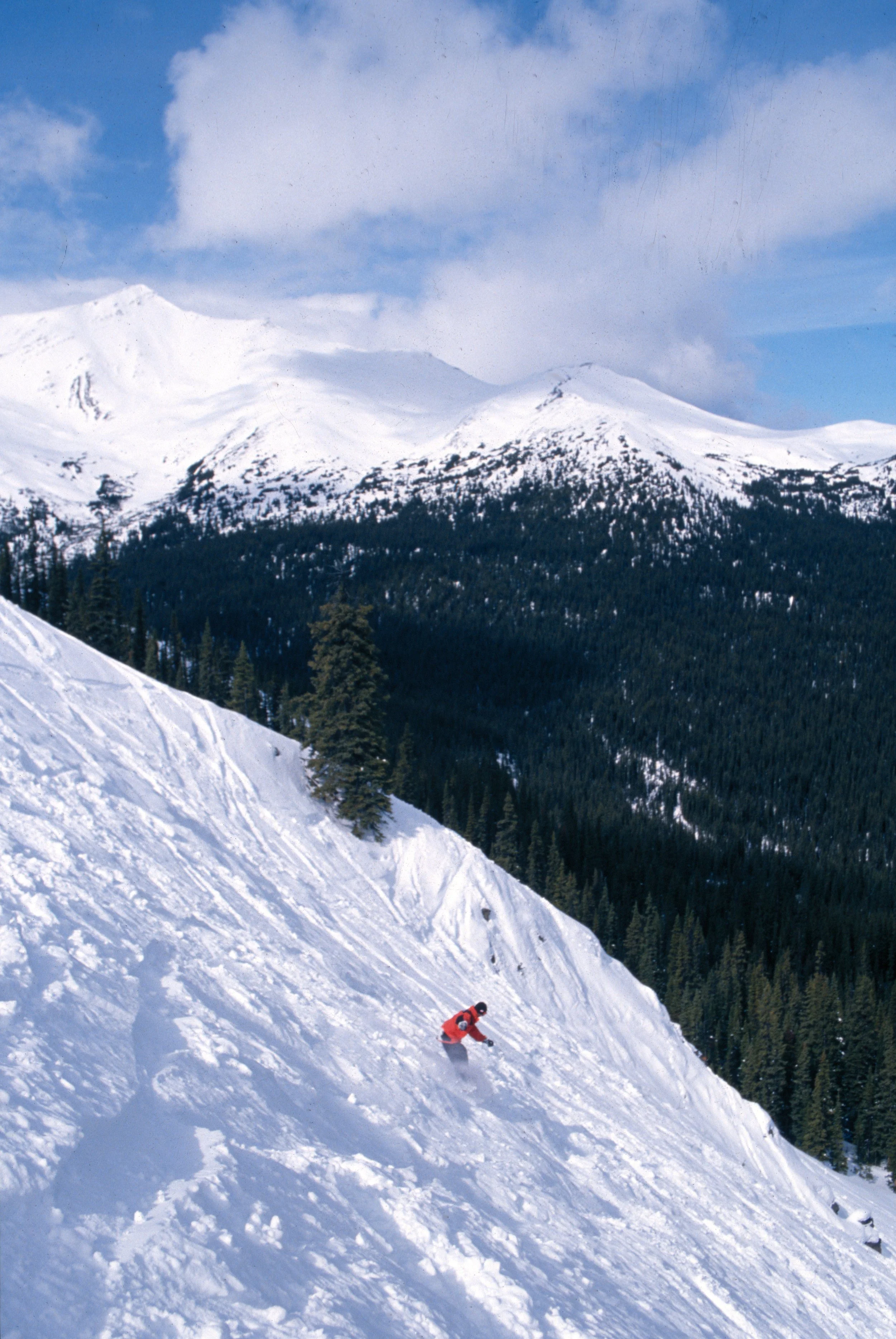
Marmot’s runs are both varied, and except for those that are left to bump up, meticulously groomed. We skied the black diamond runs of “Lift Line” and “Spillway” then transferred to the Triple Chair that rises to the 7523 foot Caribou Ridge. From there the steep black diamond “Exhibition” led to “Caribou Knoll.” Slipping into the trees, we skied a deep, powder face to a second track that traversed back to the main run.
It was an incandescent day, framed by blue skies, horsetail clouds and in the late afternoon, the first flakes of an approaching storm. Skiing Marmot gave us time to ride chairs and talk about school, ski team, driver training and the nature of man. Though both boys fell asleep on the bus ride back to Jasper, the mention of the planned rendezvous with wolves revived them and dusk found us standing on a remote gravel road with Cléone Todgham, howling across the lake.
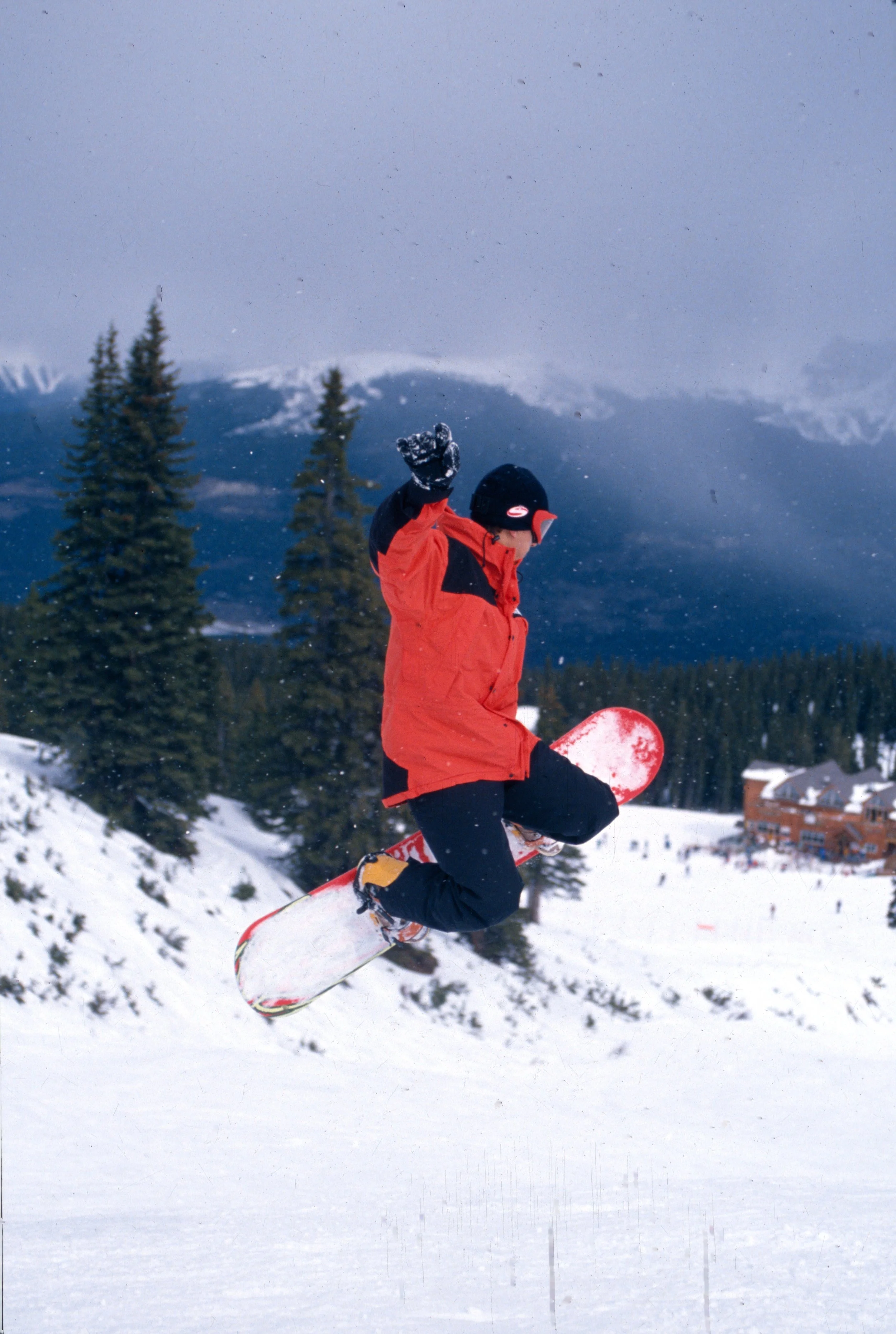
Patrick led us to the Eagle Express Quad Chair, where he gave us insights into the park, the forest lakes, the surrounding peaks, classic hikes and the occasional grizzly visitors meet on the trails. Unloading from the chair at mid mountain, he then showed us “Dromedary,” a groomed single black diamond that fell toward the wild Athabasca Valley. The snow was cold and firm and while Andrew hit jumps on his board, Robert skied the nearly perfect bump line.
The following morning we met Paula Beauchamp of “Walks and Talks Jasper,” a guide service that offers hikes to mountain lakes, cross country ski tours and interpretive walks. Fluent in both French and English, Paula was raised in Jasper and, as a result of working as an Interpretive Ranger for the National Park Service, is intimately acquainted with the hardships faced by early explorers, what grizzlies feed upon and the carrying capacity of the Jasper elk herd. Driving us to the Maligne Canyon, she tells us the wild geologic cleft was named from the original French “bad.” Over eons, the Maligne River has cut a deep, tortured rift through the native limestone and during winter, it is possible to fix crampons and hike up the canyon through a labyrinth of blue icefall.
From the Maligne Canyon, we continued to Medicine Lake that pulses to the ebb and flow of water into huge underground caverns, then to Maligne Lake--the second largest glacial fed lake in the world. Stepping into Nordic skis, we strode across the frozen surface to a wooded point from where, in late afternoon, the Canadian Rockies rose in a collage of white, black and rose colored walls.
Though we spent four days in Jasper, it was not nearly enough time. On Thursday afternoon, during the few minutes before the train departed, we hurried into a souvenir shop where we hoped to find something that captured Jasper’s high mountains, abundant wildlife and incredible skiing. Nothing of the colored tchotchkes came close. When the train’s horn sounded we sprinted across Jasper’s deserted Connaught Drive to our car where Hugh Moore was working the return trip to Vancouver. Hugh greeted each of us by name as we reached the platform. In the instant before the conductor yelled, “Aboard!” I watched a Golden Eagle circle above the Athabasca River.
Helping Andrew and Robert lift their duffels onto the train, it occurred to me that both my sons were now fully fledged. On this trip to Jasper, they had been lifted by rising air currents and glimpsed far horizons. Metaphorical gifts of ground squirrels, rattle snakes or freshly caught trout would not hold them much longer. Soon, they would groom their flight feathers and, without as much as a backward glance, launch into a hazardous world. In five years both would be off to college, a job, or a high, icy face on a sheer, foreign peak.
And when the day arrives that I’m reduced to waiting for Thanksgiving, Christmas or the stray weekend call, I’ll be grateful for Jasper, the moments on the train, Marmot Basin and my young son Robert who, while we were checking out of the Jasper Park Lodge, studied the wood and stone interior, the elk, deer and snow covered mountains and confessed, ‘Dad, you take the coolest trips.”