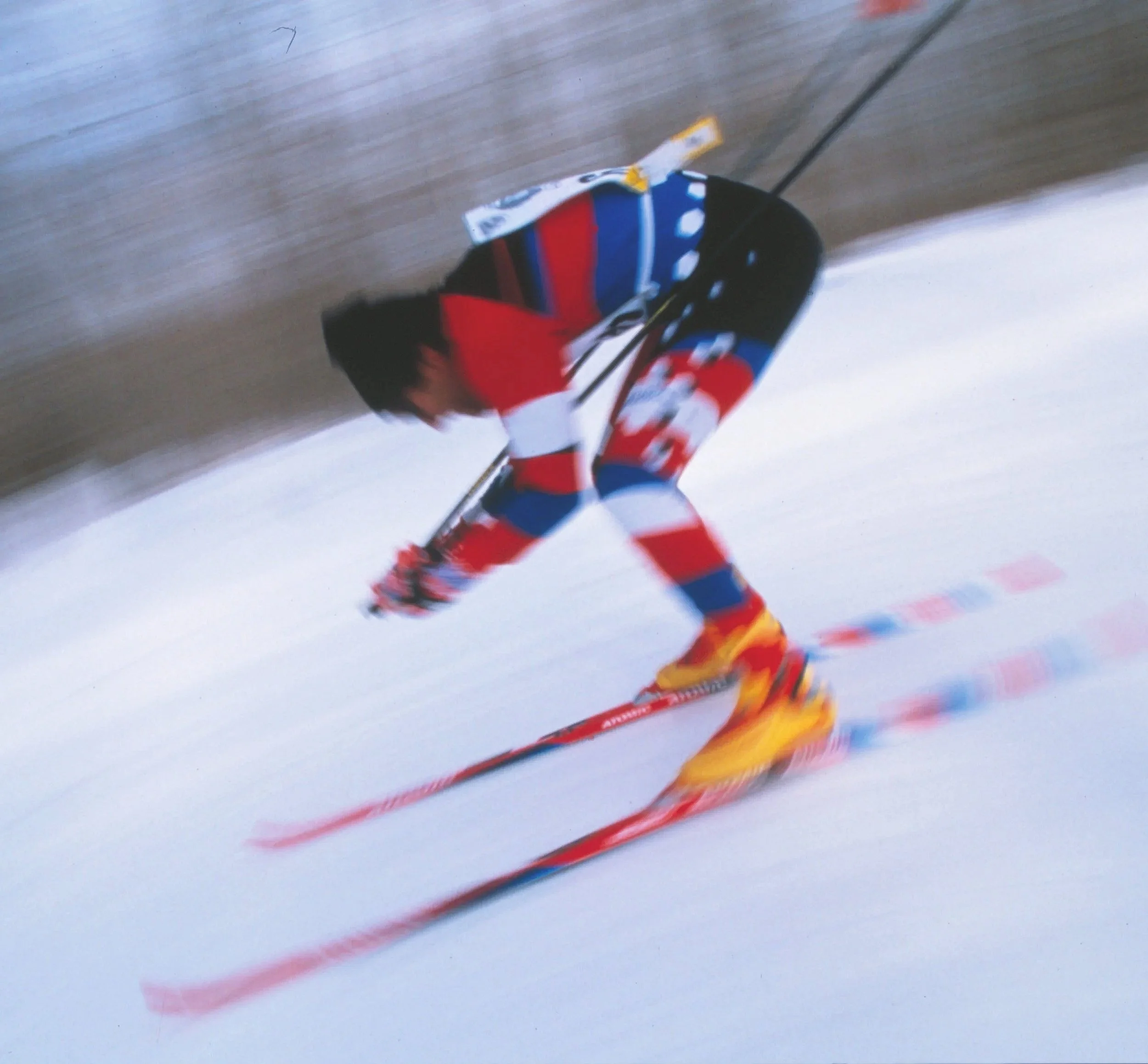
The Birkebeiner
In my life, I have ridden a bicycle 106 miles and 15,000 vertical feet over four Swiss passes in a single day. I have skied 80 miles along the Haute Route from Saas Fee, Switzerland, to Chamonix, France; raced in the Inferno Downhill in Murren, Switzerland; climbed the 14,690 foot high Matterhorn; survived the Vail Colorado, Mountain Man Triathlon; and finished Bend, Oregon's Pole, Peddle and Paddle. But none of these intimidated me half as much as the 52-kilometer Birkebeiner cross-country ski race in northern Wisconsin.
Why the Birkebeiner? Why would I ever want to close my fifth decade with this anaerobic holy grail of unrelenting climbs, heart in your throat downhills and, on this, the Birky’s 25th anniversary, 8,000 overrevved cross-country skiers who mark time as BB or AB—Before Birkebeiner or After Birkebeiner—a single defining day to measure all great events: births, deaths, marriage and career. For all but a tiny percentage of the field, the Birky is a test—a sustained anaerobic effort pinned to a time. Less than three hours makes you a Nordic God. Fewer than four, a stud. To finish at all is something to tell your grandchildren. To win is a form of immortality.
There was also the training. Or my lack of it. I was at best a tourer, a downhill skier on skinny skis, struggling to remember the difference between a V1 and a V8. For me, Nordic had always been a way to keep fat cells from claiming the high ground around my navel. Christmas of 1996 hadn't been kind. A cornucopia of egg nogs, hams, yams and candy canes had metamorphosed into an inch of butter cream frosting that now circled my middle.
At six-foot even and 165 pounds, I'd always regarded my body not as some kind of inviolate temple, but as a dependable tool. Except for a series of high speed crashes that resulted in a broken shoulder, ribs, knees, fingers and toes, I'd managed to keep the basic structure straight and intact. In the last five years, however, I had noticed a perceptible slowing of my reactions and power. Unlike the passions of my youth, I no longer looked at athletics as an all or nothing, win or puke trying proposition. More recently I competed to finish, and if in the attempt, I cloaked myself with even a faint, fleeting or subtle glory, then the bill for pain was paid in full. I sensed that the running the Birky might be my last chance to dance with the devil of deep anaerobic pain.
My first day on the tracks was Sunday, January 12—one day shy of six weeks before race day. During the first kilometer I congratulated myself on my constitution. I mused that the training would do me good. Tighten up the stomach, harden the triceps and improve my wind. At two kilometers, I figured skiing 52K would be a piece of cake. By 15K my tongue was dragging in the corduroy, my left knee ached, my arms were numb and my lungs felt as if I'd inhaled a cheese grater.
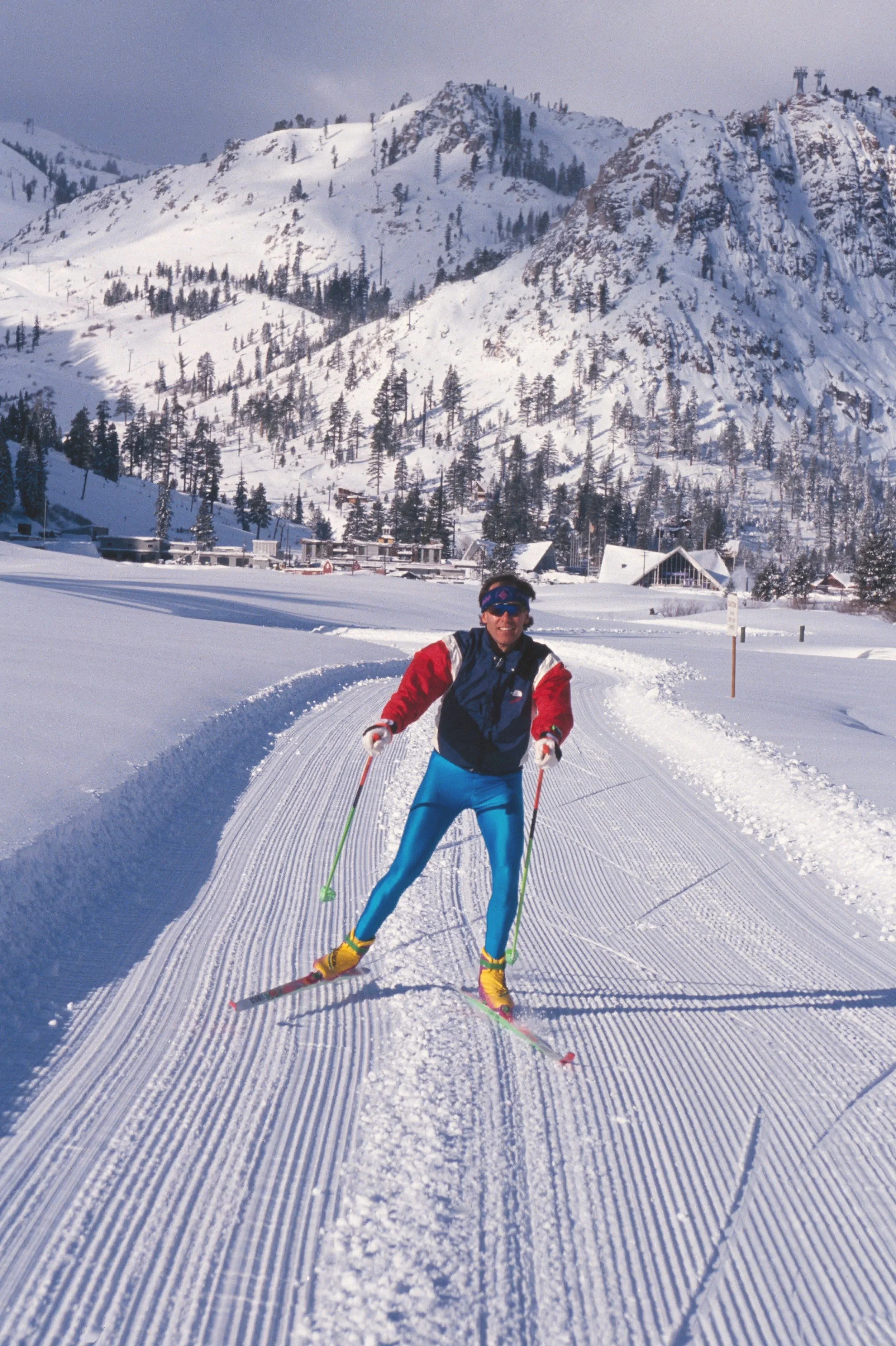
My technique was so bad, in fact, that I attempted to train in secret. Camouflaged in black on black polypro, black glasses and a black ski hat, I V’d up and down the Blaine County bike path until I knew every rut, every road crossing and every mean little cow dog that lay in wait off the trail. As long as I stuck to the flats I sailed right along, but as soon as the track started to climb, my wind died and, like the Ancient Mariner, I lay becalmed beneath a bright winter sun. My poles turned to oars trying to row me up mountainous white waves. My skis became anchors and surrounded by an ocean of snow covered hills, I suffered mightily. Blinded by the salty sweat dripping in my eyes, I admitted I needed help.
Luckily, I was in the right place. Taking my Nordic cap in hand, I begged Alison Kiesel for help. Alison is the only American woman ever to win a Nordic World Cup race; she did it, coincidentally, in Telemark, Wis., where the Birky begins. Kiesel today lives in Ketchum, where she coaches a talented group of four female Nordic racers, members of the Sun Valley Ski Club who have set their sights on the Nagano Olympics.
Alison and team member Beth Crittendon met me at Ketchum's Lake Creek one crystalline morning in late January. Watching these two women ski was like "Swan Lake" on snow. With their long legs and graceful arms clothed in bright lycra they appeared to flow across the snow in an effortless and beautiful ballet.
When it was my turn they quietly skied behind me, analyzing my technique. "You have a very strong V1," Beth observed. "Now do V2." The major difference between V1 and V2 is poles. In V1 you pole on one step while in V2 you pole on both steps. Try as I might, however, V2 wouldn't come. My transmission was locked in V1, which at the Birky would roughly compare to driving your car from coast to coast in low gear.
"Do this," Alison suggested as she flew away from me. I copied her exactly but it was still V1. Beth then slowed the V2's skate, pole, skate sequence down to mime speed. I gave 120 percent, but still remained locked in V1. An hour later I had done a thousand excellent V1s and three incredibly spastic V2s.
That night, after 20 kilometers of V1s and a hundred yards of V2s, I sought relief from my aching muscles in friend Chip and Susan Stanek's hot tub. Shoveling the deck while I soaked in the hot water, Chip commented, "You still have two weeks to get in shape. You'll do fine."
By the first week in February, I was hitting on six cylinders. The hills had ceased to be quite as intimidating, my V2 was struggling to be born and I could maintain a steady if not spectacular pace on the flats. Then, for added inspiration, I arranged to meet Audun Endestad. Audun, who lives in Alaska, has won TK U.S. national titles, more than any other human being (CK). This likable Norwegian emigre must rank among the world's more charismatic men. He was conducting a clinic at Galena Lodge, 22 miles north of Sun Valley, where crowds of lycra-clad, skate-skied faithful hung on his every word. After his clinic, I introduced myself, told him about the Birky and asked if he could give me a few pointers.
"Let me see you ski," he said, watching closely as I skated away. "With two weeks left until the Birky, training hard won't make you a lot stronger....only more tired,” he advised. “If I were you, I'd do sprints one day, hills another and distance a third. Get lots of rest, drink gallons of water and...."
At this point Audun delivered what amounted to divine revelation. "Ski your own race. Don't get caught up in the starting frenzy, go out too fast and bonk. Ski within yourself."
I nodded like a disciple.
"And buy some new equipment," he recommended as he looked down upon my ancient boots and skis. Then stepping out of his bindings, he said, "Here.....try my mine!" If Audun's Atomics looked as if they were built in some Nordic god's workshop, his wax was brewed by Odin himself. The secret combination of $100 a gram fluorocarbons carbons lent a magic, glistening glide to his skis that seemed to tow me uphill.
Taking Audun's advice, the next morning I bought a pair of Salomon 9.7 RS Energizer skating boots, Atomic ARC skating skis and Swix Star Poles—works of art in graphite that I figured were worth four to five K alone.
The eve of February 21 arrived before I was ready. One minute I was skating the Boulder Mountain Trail north of Ketchum, the next I was sitting in Cable's beautiful Spider Mountain Lodge, talking to 34-year-old Jim Shultz. Schultz works for Fedex in Minneapolis and has skied the Birky 10 consecutive years. He is soft spoken and articulate, utterly devoid of artifice, a man whose commitment to cross country is total and consuming. To balance family and job, he skis at night with a headlamp. "I think about the Birky every day, summer spring and fall. For me, it's far and away the most important day of the year," he confesses.
To handle the 8,000 entrants, the Birky is run in 12 waves. Dominated by the world's best skiers, the Elite Wave starts first and offers the best chance for a fast time. To be accepted in the wave is a high honor, to be dropped a major defeat. The birth of a new daughter cut into Jim's training time, and last year he fell out of the top 200 skiers that comprise the Elite group. His goal this year is to ski his way back in.
Forty-year-old Steve Chiodo, an eletronic salesman from Minneapolis, is also starting in the First Wave in this, his 16th Birkebeiner. Rarely, if ever, does a day go by that he doesn't think about the race. He knows where the climbs and downhills are located, where to go fast and where to rein it in. "It goes by so quickly, it's as if I've run a movie," he admits. He then tells me you can train, use the right equipment, hit the right wax, but if you don't have the engine, you'll never be fast.
McBeth's witch’s spell—"Double, double, toil and trouble; fire burn and cauldron bubble"—paled in comparison to the waxy alchemy that filled the Spider Lake Lodge's basement ski room. My approach to waxing was simple. I checked the forecast and ironed green into my bases. Then I scraped it and buffed it with an old plastic block. Steve Chiodo, on the other hand, took the Star Wars approach. First he ironed in a rainbow of secret colors, then seasoned it with plastic chips and some kind of special sauce. Then he scraped it for about half an hour, brushed it for another 20 minutes, pulled on a professional air filter and went to work with a thing that looked like a duck plucker on a drill. When I asked what the thought about green, Steve dropped the bomb. Studying my bases, he wrinkled his brow. "What temperature setting did you use?" he inquired.
"Linen?" I replied, checking my still smoking iron.
"I think you've sealed your bases," he observed, scraping his fingernail across a series of shiny patches. It seems Nordic waxes are designed to soak into the base's pores. Even a marginally hot iron will seal the base, making the wax sit like saran wrap on a day old baguette. Once sealed, there isn't much you can do but stone grind the bases. "And you won't find a stone grinder tonight," added Steve.
Birky Day. I woke at 3:30 am, fought to go back to sleep and when I couldn't, suited up at 5 in my red, white, black and blue race suit. Arriving in Telemark an hour before the Elite Wave stared, I tried to psyche myself up by skiing the first hill. Though 7,999 skiers milled around the start line, I realized there were no quail in this race, only falcons. None of these V-shaped guys or gals would roll over and let me pass. I joined the long lines standing in front of the porta-potties and tried not to think about the start.
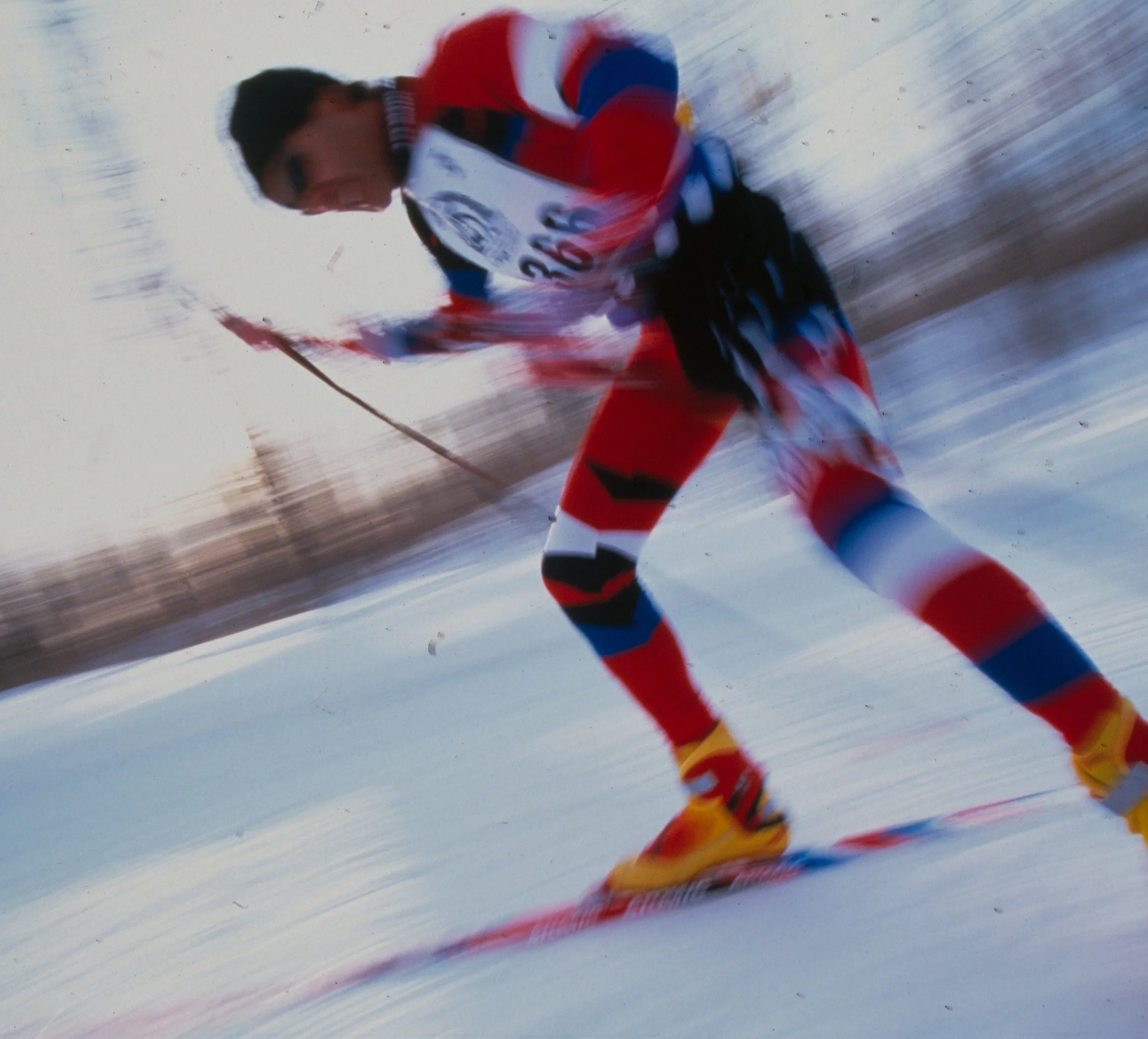
You could feel the Elite Wave's starting howitzer in your diaphragm. The thunderous report seemed to blow a sea of color from the gates, across the flats and up the first hill toward Hayward. The 25th annual Birkebeiner was under way. The elite women started next, followed by the first, second and third waves. Minutes later I was surrounded by the friendly looking folks on the far right of the sixth wave. I was by far the most colorful skier in sight and could sense what the surrounding hundreds were thinking, "If I can only pass that guy in the team suit..."
"Are you skating?" someone finally inquired.
I admitted I was.
"Then you're in the wrong group," he advised. "This is the classic side, you should be over there with the skaters," he pointed past a hundred people.
"How am I going to get over there?" I asked.
"I don't know, but you can't start here," he replied. At that moment the cannon roared for the Sixth Wave and I said to hell with it and took off with the classic group. I remember the start and finish of the Birky better than the middle. "Protect your poles," everyone had advised, so for the first 5 kilometers I hung near the back of the pack.
It was a mistake. As soon as the course started to climb, the hills became choked with lines of skiers herring-boning slowly uphill. By the Sixth Wave, the uphills were covered with four inches of pulverized ice, while the downhills had been ground into hay rows of crystalline shavings. Little conversation passed between the competitors. Most kept their own thoughts and hoarded their energy. When they did talk it was to apologize for stepping on my skis.
The congestion made it difficult to ski fast. Still trying to protect my poles, I waited patiently for a place to pass. The uphills were impossible, but the downhills showed promise. "Caution! Steep Hill" a sign warned at 15Ks. The scene was hilarious as hundreds of racers were locked in desperate snow plows while hundreds more simply removed their skis and walked down. After 20 years in Sun Valley, I wasn't about to let a glorified bunny hill intimidate me. Pointing my Atomics into the crystal debris on the right, I passed a hundred people in 10 seconds. This was too easy! I was skiing by dozens of racers. I felt strong, invincible! I was a Nordic God who foolishly turned to gloat at the slow souls floundering in the jet wash.
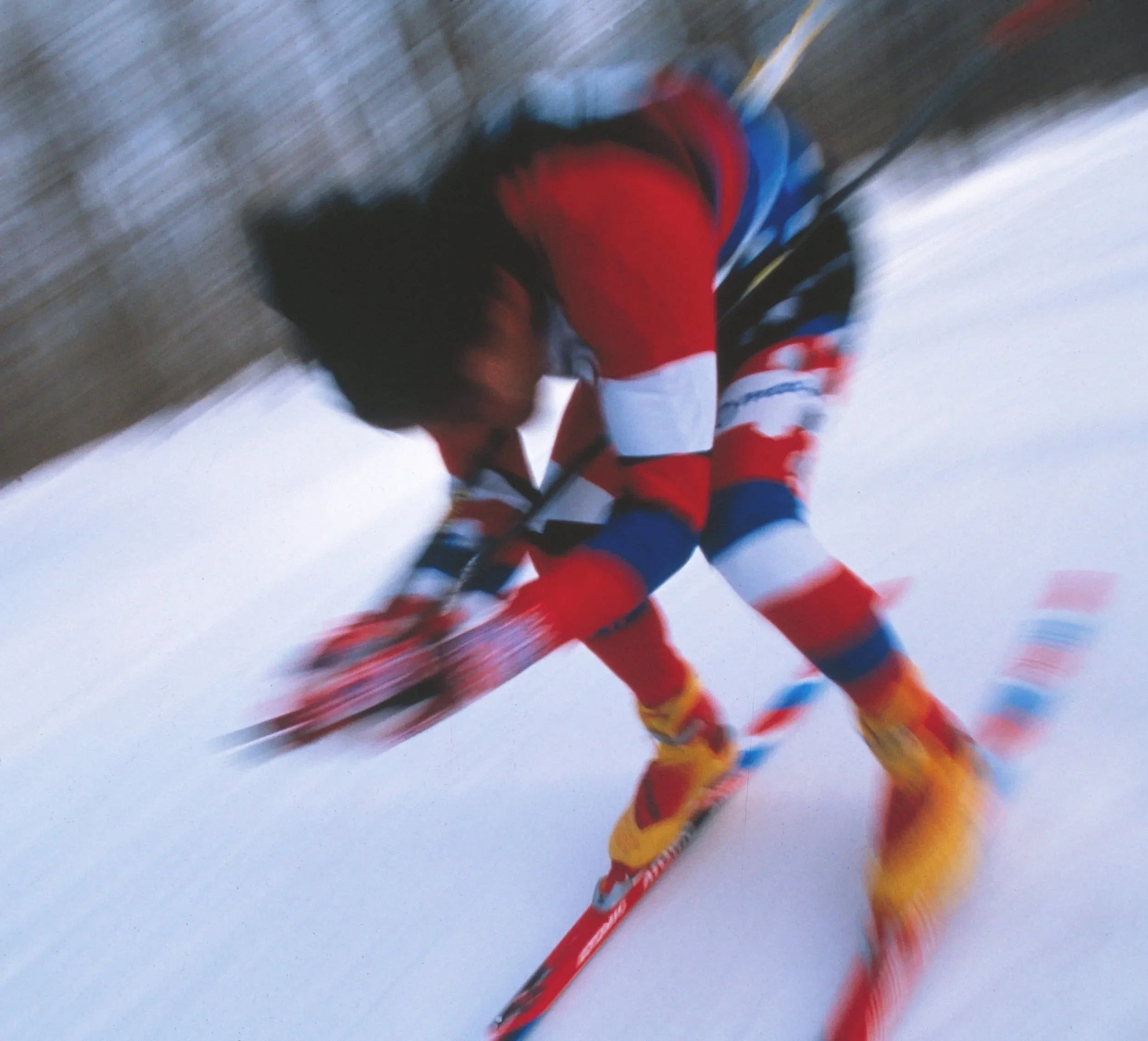
Looking back was not a good idea. At that instant, my left ski hit a rut and, in the middle of my ascendancy, I went down like a raggedy Andy doll slapped on a concrete driveway. One ski blew off, my glasses and ski cap sailed away and my shoulder felt like it had been smacked by a framing hammer. And, as I lay sprawled in my brilliant racing suit next to the trail, everyone of those hundreds passed me back.
In time, I picked myself up, gathered my gear and slowly came back up to speed. At that point I did not feel much like a Nordic god. Unless it was a middle-aged Nordic God who had lost his momentum. I joined the ranks of skiers herring-boning uphill. Though I was still fast on the downhills, the crash had taken its toll.
When I tried to fly, my bruised wing slowed me down and I slipped into a Zen-like trance, where the course rose and fell to rhythm of my V1 and the hiss of hundreds of skis slicing through the ground ice. I reached the finish of the 25K Kortelopet, the half point of the Birky, in just under two hours, gulped a cup of hot water, squirted half a gooey energy gel into my mouth and the other half on my glasses and gloves and then skated on toward Hayward.
My wax started to go at 30K. Like an Indy car engine running out of oil, my skis started to tie up. About that time, I slipped past the “Hecklers,” a loud group of snowmobilers who award style points for crashes and spontaneous bravado on a sweeping right hand downhill. I V’d the uphills, tucked the downhills, passed racers and was passed by a few. By the last 15K I had moved up to the Fourth and Fifth Waves. I kept waiting for the infamous “Bitches of Bitch Hill”—a bunch of guys masquerading as women. The buxom Bitches had achieved a certain notoriety by taunting the racers as they soldiered on to the finish. But this year they failed to make an appearance and I could see the distant roof tops of Hayward before I realized I'd passed this milestone.
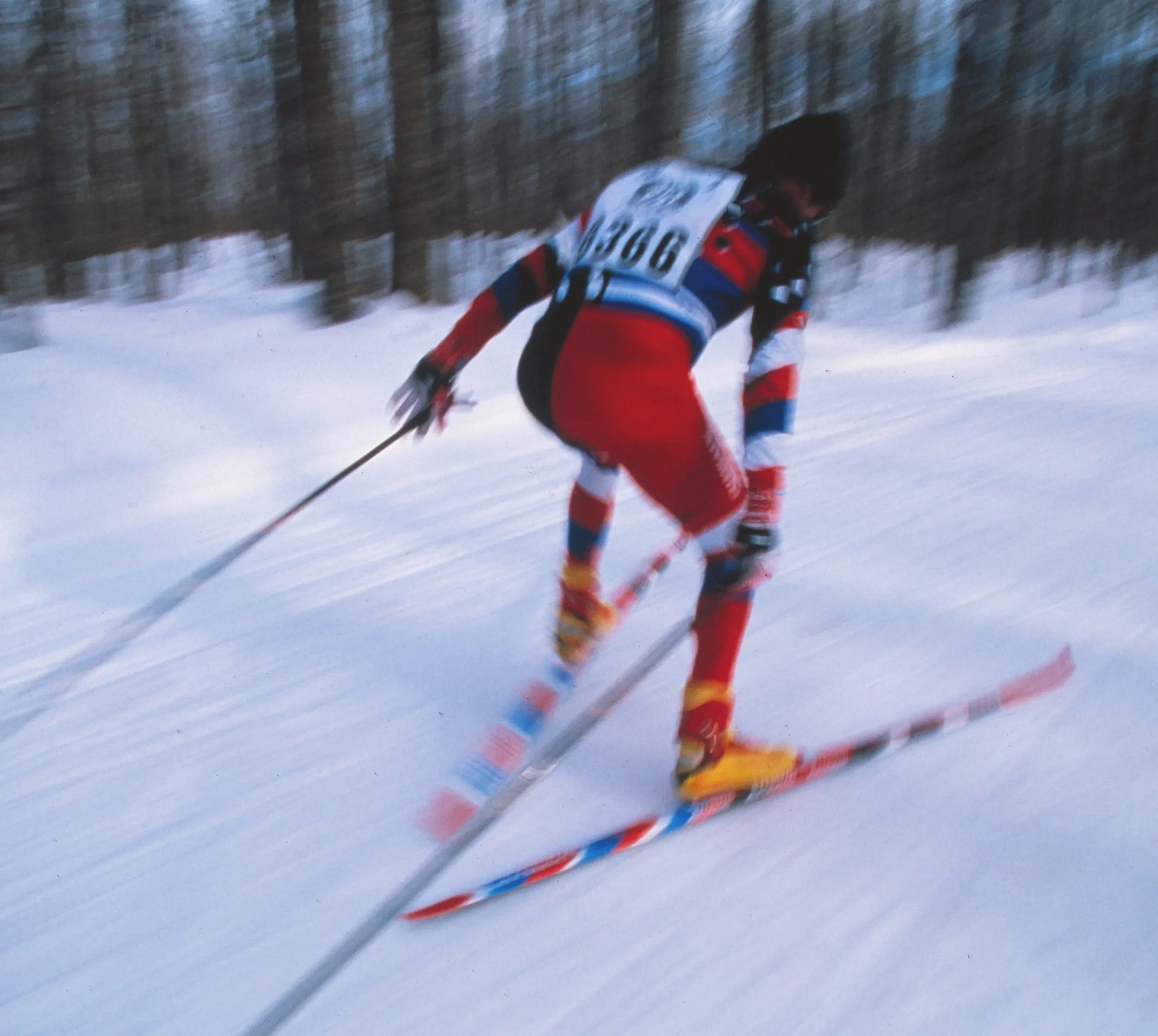
At 48K the course flattened onto a lake, the wind increased and I lowered my head and fought for the finish. In time I reached the outskirts of Hayward and turned the corner onto Main Street.
I don't remember hearing cheers as I skated hard through the finish. By the time the Sixth Wave arrived, the crowd was pretty cheered out. I accepted my first Birky medal and then found photographer Per Breiehagen, who had driven here from Minneapolis, Minn., to chronicle my race. When he asked how I felt, I admitted that other than a bum shoulder, an aching back, a sore knee and a nasty dry cough... not bad. If I hadn't had to contend with the crowd, I could have gone faster—but that's probably true of all the racers.
Mikhail Botwinov, a Russian emigre living in Austria, won the 25th Birky in a blistering 1:57:51. Audun Endestad won his age group in 2:06:15, while Jim Schultz skied fast enough to earn a start in the Elite Wave next February. Steve Chiodo had his fastest time ever. Best of all, he said my 3:50 was an awesome time for a first Birky. Looking back, I was grateful he didn't pin it to an age.
The question people always ask is, "Would you do it again?"
I have to think about this. It occurs to me that Birky racers feel a mass purpose—a tribal, primal sense of unity. If I once believed that competitive fires wane with age, the Birky changed my thinking. For as great as the event is itself, it's really the pre-race training, the anticipation and the fear of failure that defines this single morning in February. Facing my sixth decade, I wondered how, if you can’t make time stand still, that men in their 50s finished this race within 5 minutes of the Elite Wave? And when people ask if I would do it again, I think only for a moment before telling myself there is plenty of room for improvement.