
The Haute Route
It is late April and the streets of Saas Fee Switzerland are crowded with skiers. No cars are allowed in the village and two army companies appear to passing on the road to a nearby front. One has been seasoned by the Haute Route's eighty mile trek across the roof of Europe while the other is anxious to prove itself. Standard issue is a frameless pack on which is fixed a shining ice axe, rusted crampons and a bright purple rope.
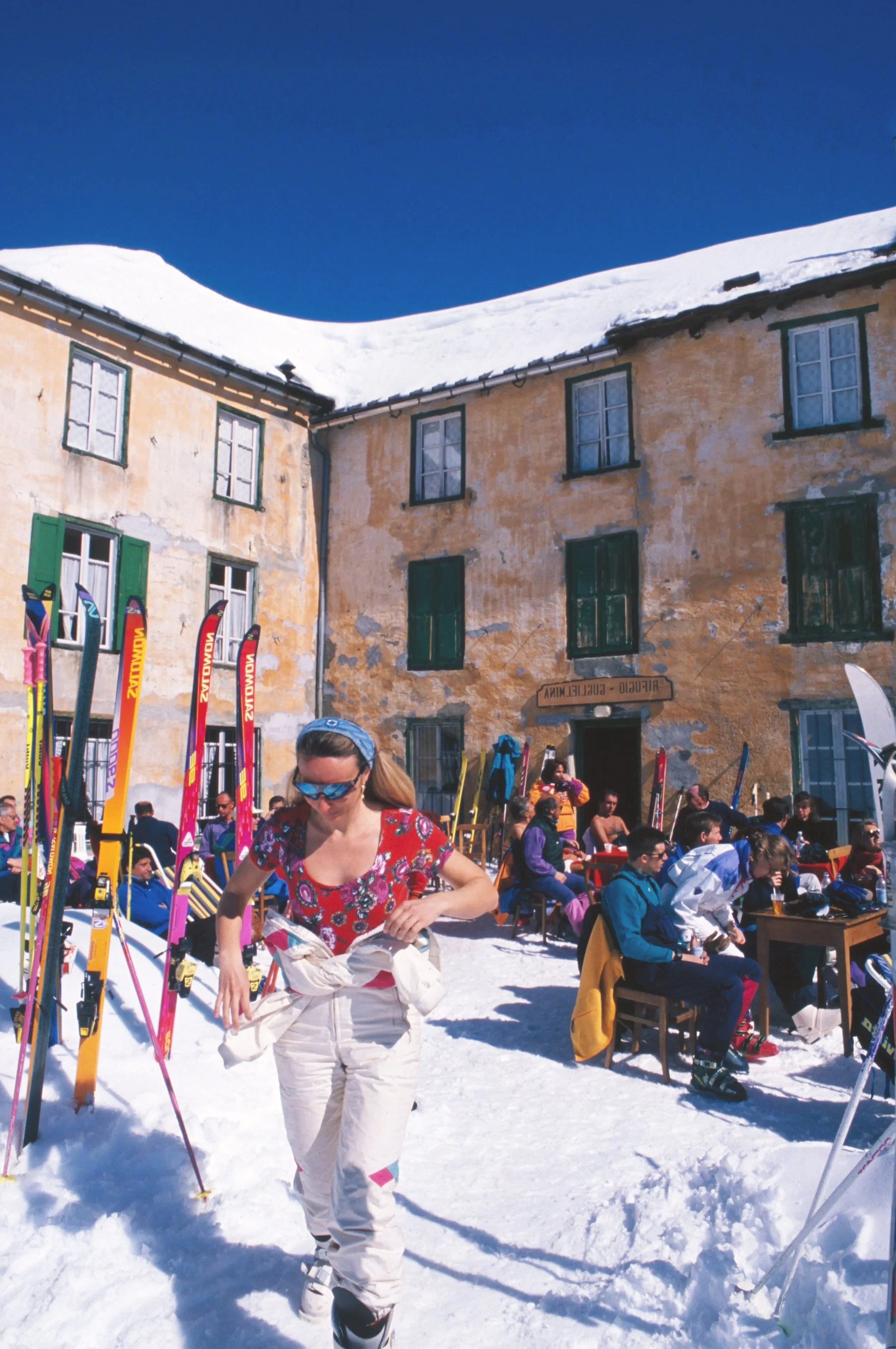
Like shouldered rifles hundred of skis flow between the bright store fronts and the tramps of ski boots beats a steady rhythm beneath the sound of German Italian and French voices. Coming off the Haute route, week old beards, dark tans and raccoon white circles around eyes shielded by high altitude glasses speak eloquently of victory. And just as eloquent, the slow deliberate step of badly blistered feet as well as a thousand yard stares from too many nights without sleep salutes the penalty.
The High Road. This classic ski trek from Saas-Fee to Chamonix France is well named. Records exist of ski mountaineering in the Bernese Oberland as early as 1850, but until January of 1903 when a party of six Chamoniaird alpinists pioneered the route from Chamonix to Zermatt, primitive equipment and early ski technique discouraged winter attempts. With the late 19th century improvement of both, what had once been the exclusive summer domain of climbers, goat herders and chamois hunters was invaded by the first guides and their clients.
In 1904, the Frenchman Hugo Mylius and three Swiss guides made the first ski ascent of Mont Blanc. In the following years the Mont-Rose, Finsteraarhorn and the Bernese Oberland were skied but it was not until April of 1910 that the final section from Zermatt to Saas Fee over the Adler Pass was pioneered, linking what is now considered the classic trek.
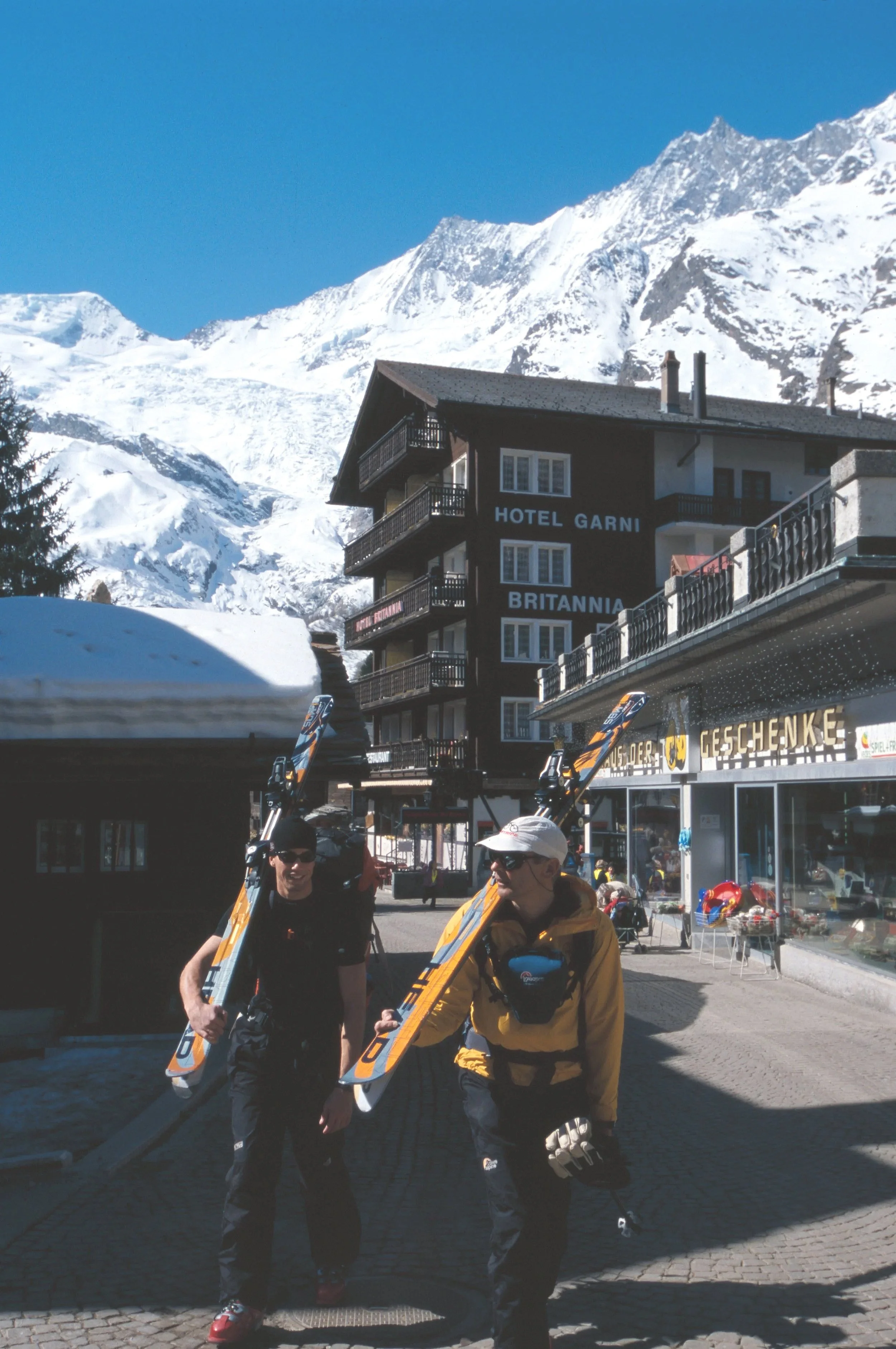
Saas Fee Beneath the Route to Zermatt
In the time since, hundreds of thousands have skied the Haute route turning the classic trek into alpine highway with accompanying problems of over crowded huts and inexperienced skiers skiing the routes numerous glaciers and extreme chutes. Due in part to the revolution in mountaineering boots, skis and clothes as well as the cost of lift passes and the beauty of the Swiss Alps, many regard the Haute Route as a pilgrimage, a chance to test oneself against rock faces, rivers of ice and rapidly moving storms.
From Saas Fee to the French border the Haute Route crosses the roof of the Canton Valais, or Valley region of Switzerland. Since 50 AD when the Roman Emperor Claudius ruled what was known as Civitas Vallensium, the Valais, has served as a fertile corridor from Italy to France. Between the Valais highest peaks and valley floor there is a 12,000 foot difference in elevation which, in large part, accounts for its startling diversity.
Tracing the Haute Route on a topo map, you will see that the huts are not only a day's hike from one and other but also within an hour ski down ot the villages of Saas-Fee, Zermatt, Arolla and Verbier. In the twenties when many of the huts were built, supply was important, but just as important was sanctuary from the huge North Atlantic storms that periodically slam into the alps. Whan a meter of snow falls in two days, travel among these exposed peaks was impossible. Then, as now the only way out was down.
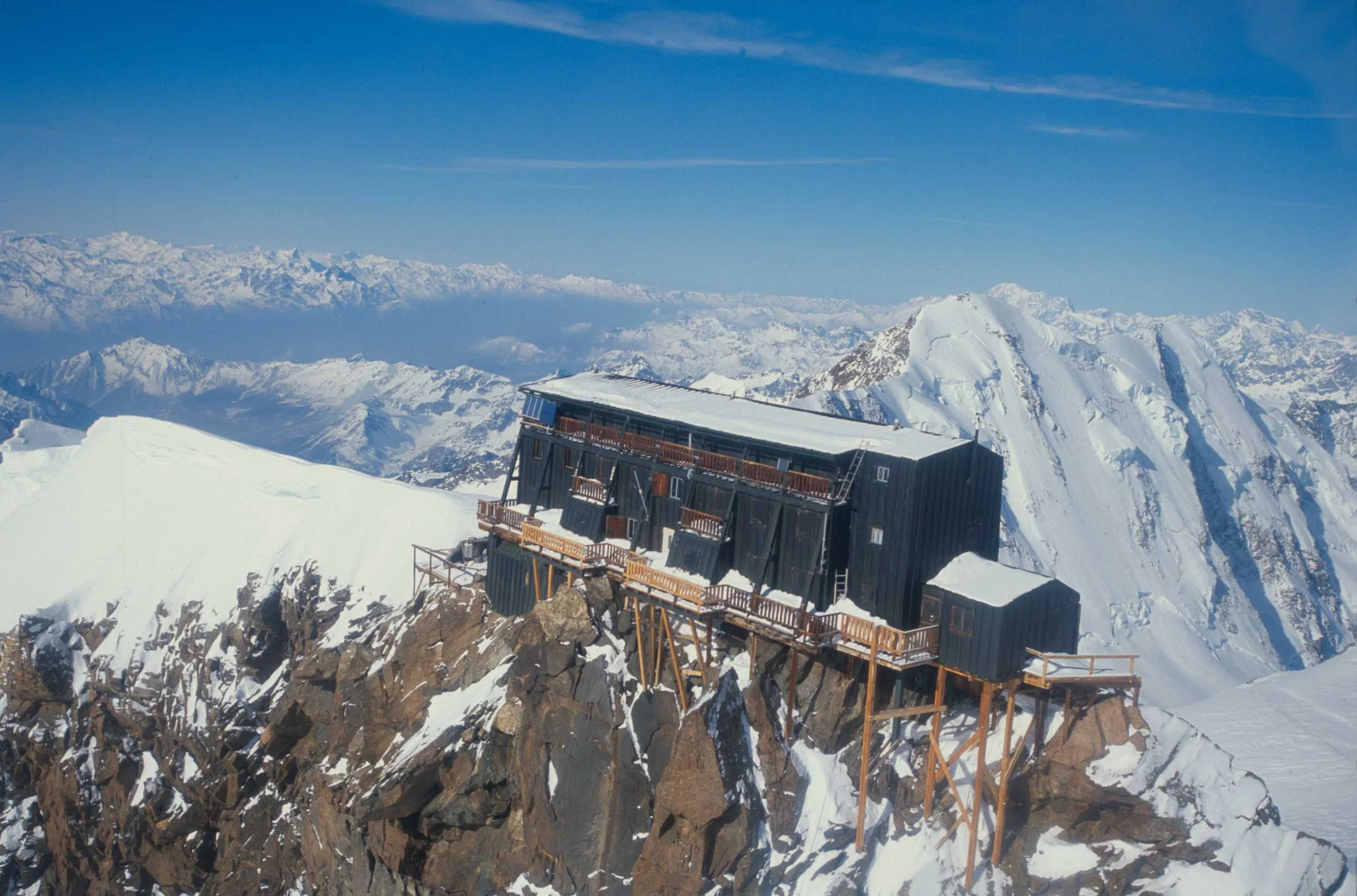
The Haute Route's easter embarkation point is the Brittaniahutte. Owned by the Swiss Alpine club, the Brittaniahutte perches on a high cliff above Saas Fee where, for the past seventy years, it has been spared by avalanches. The Brittaniahutte was built to house 120 but in the past years, that number often exceeds two hundred. To accommodate this growth, reservations must be made months in advance and even so, many are forced to sleep on the floor.
In the past every bottle of wine, every loaf of bread, every sack of rice, ever blanket, plate and pencil used during the winter was packed up by porters. Today it tankes an hour for a helicopter to accomplish what used to require months.
The interior of the Brittaniahutte (and for that matter Haute Route huts in general) is distinguished by low, beamed ceilings, wood floors polished by decades of stocking feet, narrow stairways and small windows that admit light in shallow gray pools. In the huts you learn to secure a bunk and blankets first then worry about something to eat. Even novices soon realize that life on the Haute Route is reduced to essentials: a warm place to sleep, a full stomach, boots that fit and dry socks.
To ski to Zermatt from Saas Fee you must start in the predawn darkness. At 5:00 a.m. flashlights flicker across sleeping figures and the first to rise speak in whispers. You quickly slip into layers of poly pro and pile, boots are buckled, thermoses are filled with tea, packs are shouldered and with the first faint light showing in the east, you step into your bindings and follow a dozen others down a short, steep pitch to the start of the Route.
During the first hour the squeak of plastic boots mixes with the hiss of skins and low conversations. The guide sets a slow, steady pace across the silent snow fields. About the time you begin to think the pace is too slow, you realize the guide does not stop because in his own words "It requires more energy to start again than to continue at a slower pace." The cold ebbs from the track as soon as the sun rises. Jackets are unzipped then shed and packs are ransacked for sun block to protect faces and hands against the high altitude sun.
Burdened with a pack and facing an eighty mile hike in plastic ski boots, a small blister can turn into a disabling injury. For that reason the guide reminds you to stop to doctor hot spots and pressure points.
Four miles away and 2500 feet above the Brintaniahutte, the Adler pass offers a number of decisions. Depending on snow conditions, it can be skied, or when combinations of sun and cold turn the snow to verglas, rappelled.
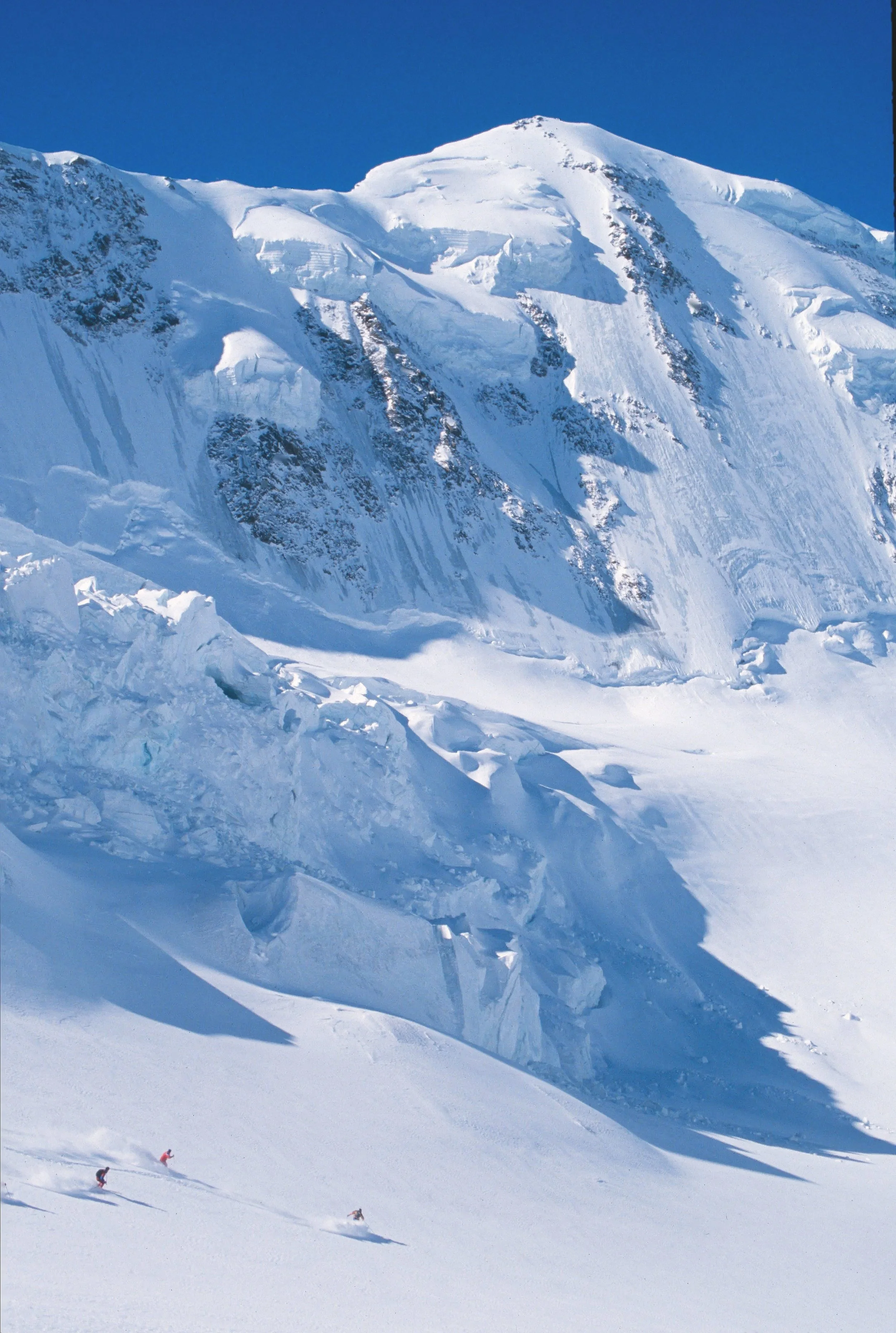
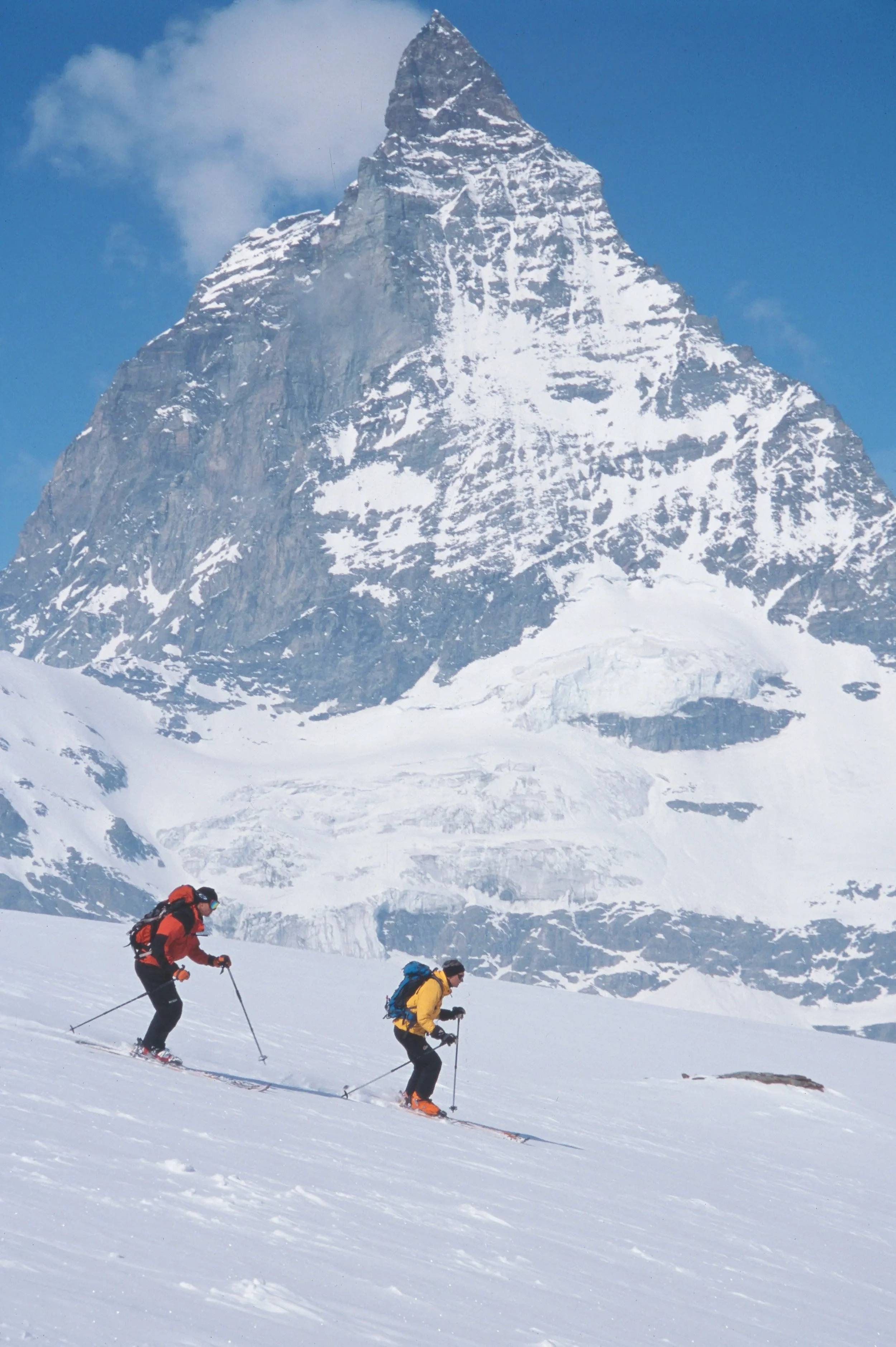
From the Adler, the majority of trekkers ski down to Zermatt, before continuing on to the Schonbielhutte. A percentage, however, traverse to the Monte Rose Hutt, from where they ski down in the shadow of the Matterhorn before continuing onto the Schonbiel.
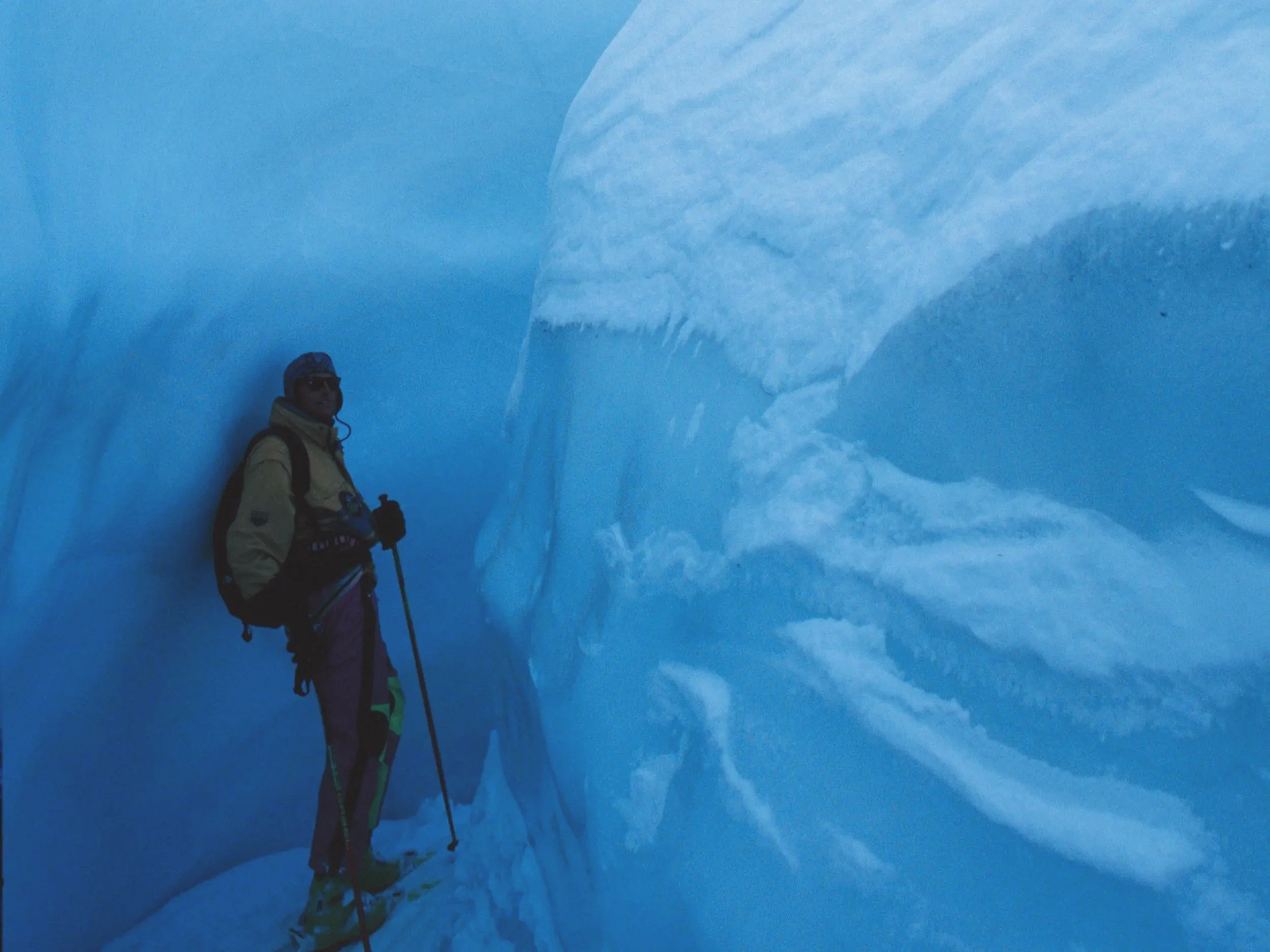
Set in the shadow of the Matterhorn's North Wall, this three story stone refuge serves as a way station for the twelve hour hike over three passses to the Cabin De Vignettes. To cross this distance, skiers start at 4:30 a.m. by side slipping down a dark, icy face that leads from the Schonbile Glacier to the 11,000 foot high Col De Valpelline. Illuminated by headlamps the track zig zags up a steep, endless face as the guide cautions the group to stay together. Dawn reveals a world of irridescent blue glacial ice, dark rock faces and whirling clouds.
One Axiom of the Haute Route is not all those who start, will finish. First time trekkers typically underestimate the difficulty of the climbs or the technical skiing and quickly descend to one of the villages. And yet it is typical of life at altitude, that no sense of failure is fixed upon those who fail to traverse the entire distance from Saas Fee to Chamonix.
Americans believe if the Haute Route has a start, it must also have a finish. This trek, however, is neither a race, nor a test of will. Europeans reduce the Haute route to its simplest terms. They treat it as a chance to escape from both their job and the city--to climb, ski, spend a few nights in the huts.. Thus starting in Zermatt, Arolla or Verbier is not a sign of weakness, but of experience and preferrence.
Once the grade flattens out on the Col de Valpelline, the pace increses but it is still late afternoon when you reach the Col de l'Eveque and start the long descent toward the Cabin De Vignettes.
The wind is howling around the rocky pinnacle when you arrive and inside the hut keeper insists the forcast is not good. A large storm is moving in from the Atlantic and throughout the night, the wind pounds at the shuttered window. At first light snow is falling at an inch an hour. Visibility is down to a few yards and with the threat of avalanche danger increasing by the hour, there is not hope of continuing and no sense in waiting. Your guice decides you must ski down to Arolla while you still can, and so pulling on your pack, you turn down the valley to the village.
As much as five days can pass before the weather clears. In that time, Aldo Lomatter returns to Saas Fee and I am lucky to find guide Jean Louis Coquoz of Verbier who leads the way back out of Arolla and over the Pas de Chevres to the Cabin De Dix.
A subculture exeson on the Haute Route. People by the guuides hut keepers and climbers, it is a hard if temporary life. Though most are in their twenties, the sun, cold and physical effort ages them. Now thirty four, Jean Louis admits that even with teaching skiing and guiding in the spring and summer, he finds it difficult to make ends meet. He tells me that the best an old guide can hope for is a hut of his own and for that reason no guide looks forward to retirement. When the rgiors of the high altitude become too much, most are reduced to selling lift tickets or loading tramps.
Human sinuses pay a penalty at altitude. Men who have never snored a night in their life, suddenly bellow like angry sea lions. First light showed the leaded horizon of incoming low pressure. To reach the 10,500 foot soutwest ride of the Rosa Blanche we traveresed around the Frozen Dix Reservoir, before turning west again and beginning to climb. We were kicking steps in a sheer face below the Rosa Banche summit when it began to wnow. With visibility down to touch, we skirted the Grand Desert, climbed the Col De Momn and decended to the the Cabin du Mont Fort which markes the outer Boundary of Verbier ski resort.
There, skiing the groomed runs down toward the Village, I asked Jean Louis how long the storm would last.
I cannot say," he replied as the snow rattled of his parka. "Perhaps two days, maybe longer."
Jean Louis's guess proved to be prophetic. Forced to wait in Verbier as the sleet slanted down onto the forested hillsides, we finally caught the train to Argentierre, France where the only open hotel is a faded, four story relic of a more prosperous past. Webs of cracks spread across its weathered face and the sleet has started to pour through broken roof tiles. This morning a rivulet reached the first floor ceiling and now the dozen skiers in the chilly breakfast room alternately study the dark stain spreading along the floral wall paper and pick at the croissants.
For Jean Louis, the six frenchmen and four germans, this is the end of the road. Everyone knows that six thousand feet above, high winds and heavy snow are loading the steep faces above the Col Du Chardonnet.
"We cannot climb in two meters of new snow.... and the avalanches are very dangerous." Jean Louis tells me. Lighting a cigarette and noting my disappointment, he continues, "You must not think of the Haute Route as a road between two cities. Think instead of the skiing, the hiking, the huts and the beauty of the mountains. Then it is not so important that you cross this final pass."
The problem is, weather change quickly on the Haute Route. A distant cloud bank may give trekkers less than an hour of warning before wind and snow reduce visibilty to ten feet. In a matter of minutes, the track disappears and trekkers are forced to seek refuge from the storms.