
Skiing Norway’s Peer Gynt Trail
Svanhild Vage at the Norwegian Tourist Board assured us that we could ski from village to village along a network of prepared trails. Burdened only by light day packs, our luggage would be driven to the next lodge.
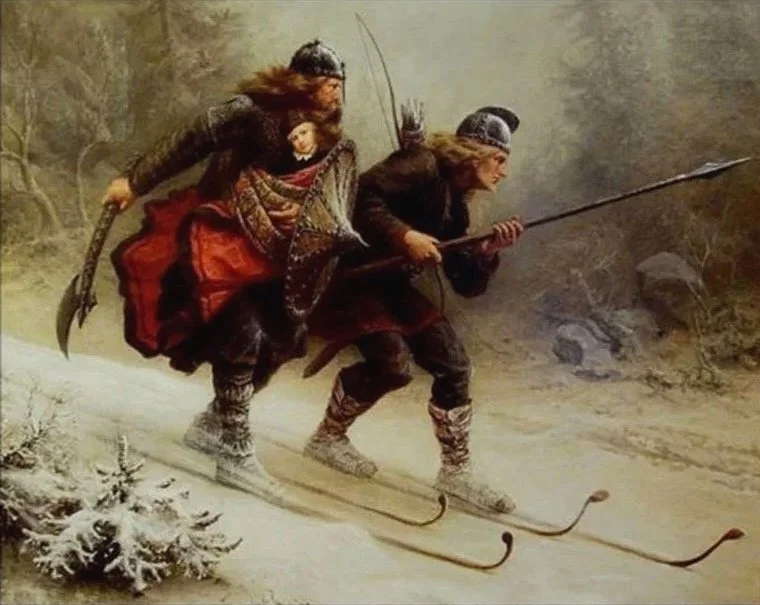
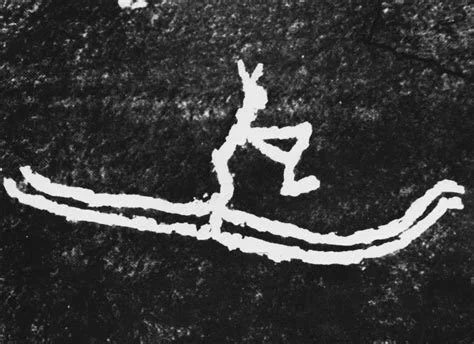
One must read Norwegian history before the country's absolute fixation with Nordic skiing starts to make sense. In the 4,000 years since the Norwegians first scratched a symbol for skis onto a rock, they've elevated ski touring to an art form—a fact illustrated by a reproduction of a painting in the Lillehammer’s Olympic Committee's promotional brochure.
Located 110 miles north of Oslo, the Oppland includes two of the highest mountain ranges in Norway––the Rondane and the Jotunheim. Though most tourists find it hard to believe, a 7,000-foot difference in elevation exists between the highest Jotunheim summit and the lowest valley––equal to anything found in Switzerland. Because the Oppland is geologically ancient, the contrast is never severe. Like our Appalachians, the Central Norwegian Plateau is part lake and river-filled valleys, part major mountain range separated by many miles of forested hills. If ever terrain was sculpted to serve sport, or if ever a sport was invented to match terrain, it was here.
Over a year had passed, since photographer Michael Daly and I discussed traveling on Nordic skis. Our idea was to emulate the freedom we'd experienced on long distance bicycle rides without being burdened by backpacks or camping gear. Great ideas demand wondrous settings, but until Norway was mentioned, our great idea was even less than wishful thinking—just a game of "what if" pushed to the psychic back burners.
It was Daly who thought of Norway.
“Why do you think they call it Nordic skiing?” Michael asked as soon as I picked up the phone. “We need to return to the source!"
The picture dramatizes how two Viking "Birkebeiner,” or birch legs (who wrapped birch bark around their legs for warmth), braved a raging winter storm to save a future Norwegian king. What caught my attention, however, was that both warriors were on ancient knob-tipped Nordic skis. In place of poles, one carried an ax and shield, the other a spear, bow and arrows. If this all seems a bit romanticized, it isn't. Norwegian history records that, to secure the Norwegian succession of kings, in 1206, two Birkebeiner carried the two-year old Håkon Håkonson across the Lillehammer Mountains. To commemorate that heroic event, the fifty-six kilometer Birkebeiner cross-country race between Lillehammer and Rena has been run since 1932.
Before we started the Peer Gynt, we spent two days in Lillehammer, the Oppland's capital, which sits on Mjøsa, the largest lake in Norway. During summer the Mjøsa is plied by the Skibladner, a 19th-century paddle steamer. In winter the lake is frozen and marked by spider webs of Nordic tracks that wander between wooded islands. If prepared tracks are to Nordic skiers what groomed runs are to Alpiners, Lillehammer has some of the best in the world. Financed by the city and maintained by city crews, local tracks form 7.5- and 15-kilometer loops through the forested hills above the small resort town, while others traverse between the towns of Lillehammer, Nordsaeter and numerous small hamlets around both. On these tracks one can train or travel, ski in circles, or ski from town to town.
Lillehammer served as the site for the 1992 Winter Olympics. Among other considerations for selection, this city of 22,000 enjoyed a mild climate, consistent snow and is just 110 miles from Oslo. City fathers believed that sponsoring the Birkebeiner gave it the necessary international prestige and experience to persuade the International Olympic Committee that Lillehammer was the best choice
During the two days we spent in Lillehammer we also discovered that the favorable exchange rate reduced the cost of a pair of dress shoes to $20, a dress shirt to $10, and an average hotel room to $16 (with full board it was $30). We found century-old shops standing in the shadows of new office buildings, a small alpine ski hill, large skating rink, clean hotels, excellent restaurants and a new museum staffed with locals who gave us a tour in English.
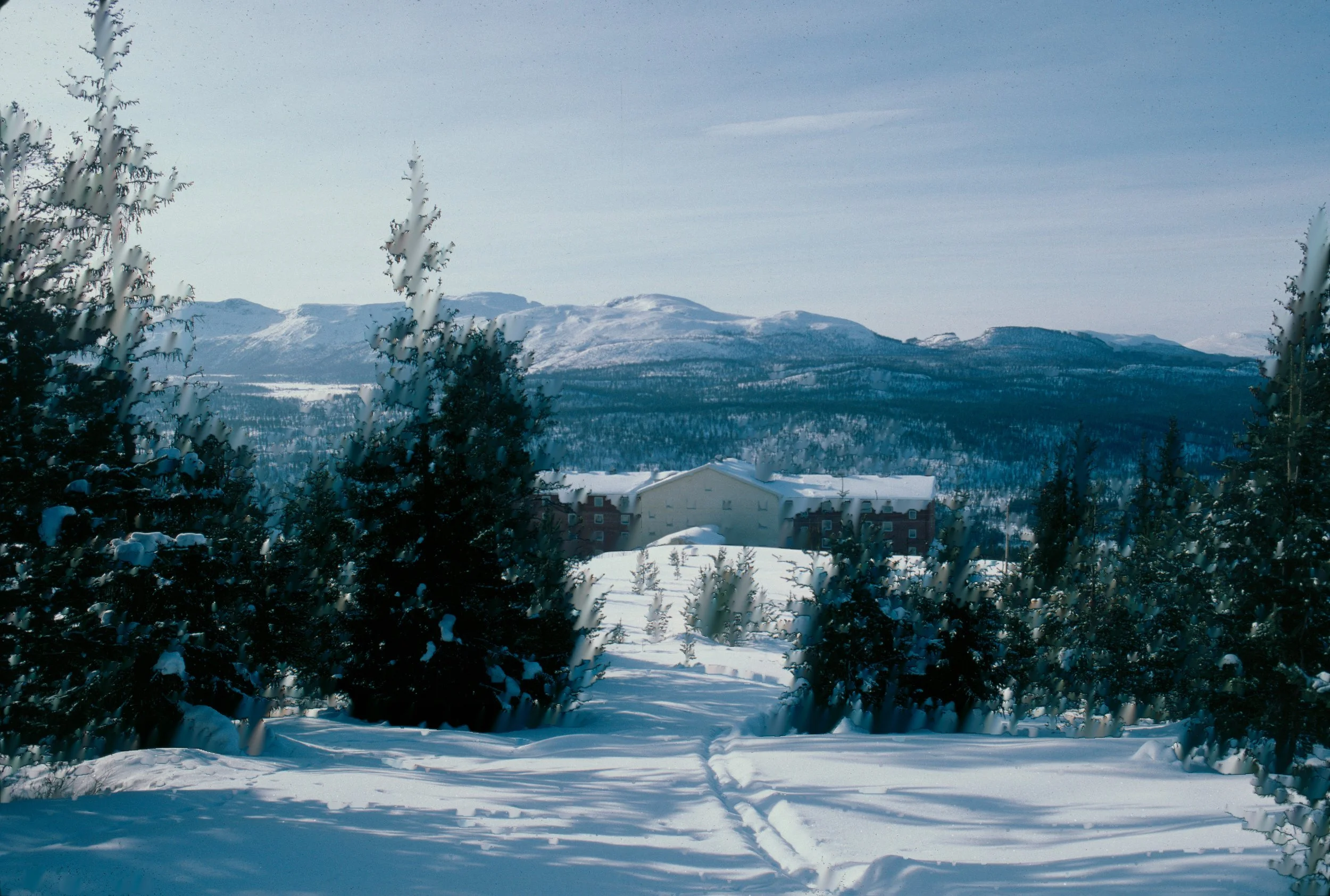
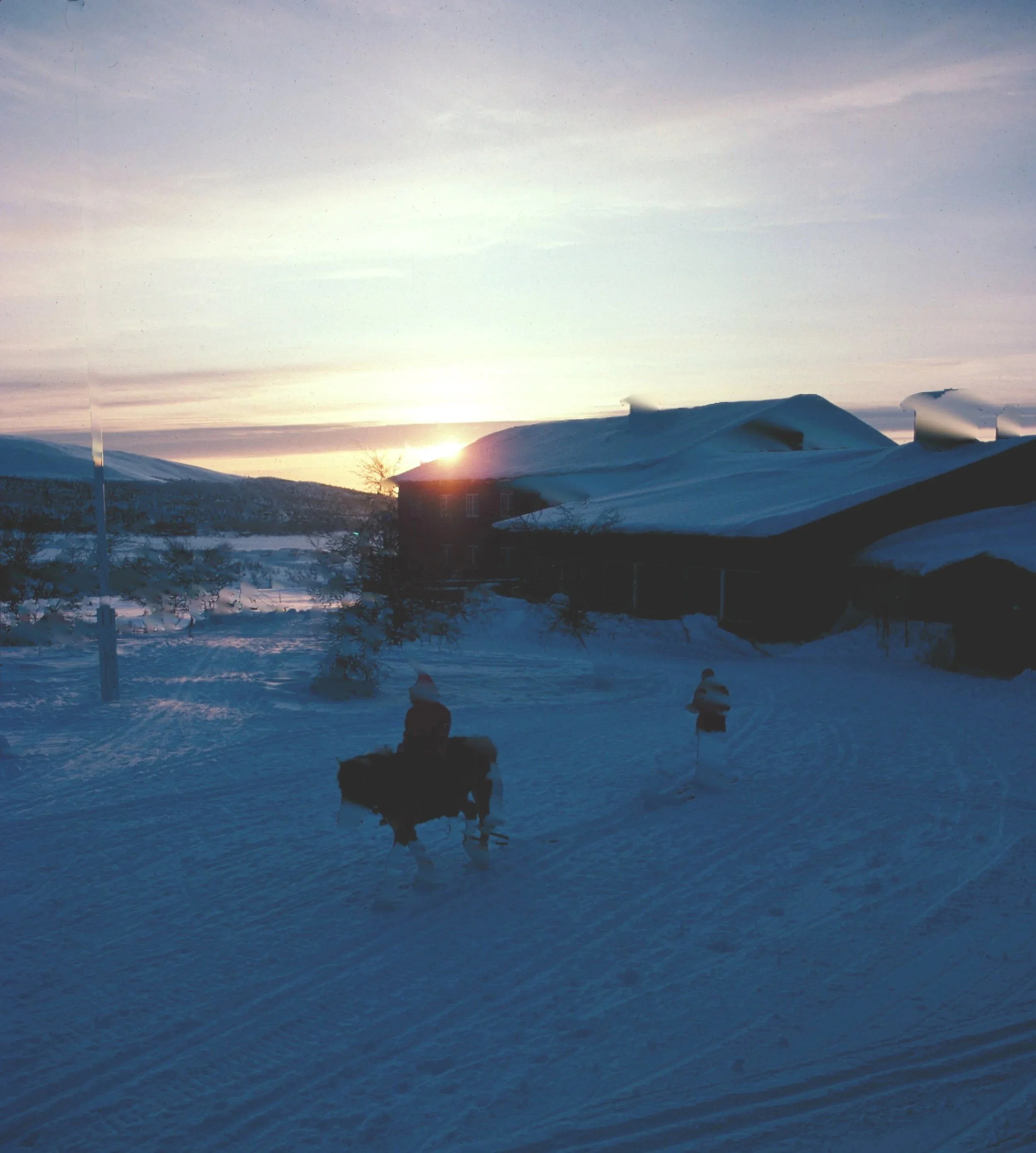
Located roughly ninety miles northwest of Lillehammer, the Dalseter Mountain Hotel in the Espedalen Valley serves as the start of the Peer Gynt Trail. The word hotel is somewhat misleading, for the Dalseter (like the other hotels along the Peer Gynt at Fefor, Gålå , and Gausdal) is a small, self-contained ski center that overlooks the frozen expanse of Breidsjoen Lake. Besides an intermediate alpine hill, each of these small resorts offers many kilometers of prepared cross-country tracks. From the hotel's doorstep, tracks depart in progressively larger and more difficult loops, and though we were anxious to start exploring as soon as we checked in, Eric Gillebo who owns the hotel with his wife, Elsa, escorted us to the dining room where lunch was being served.
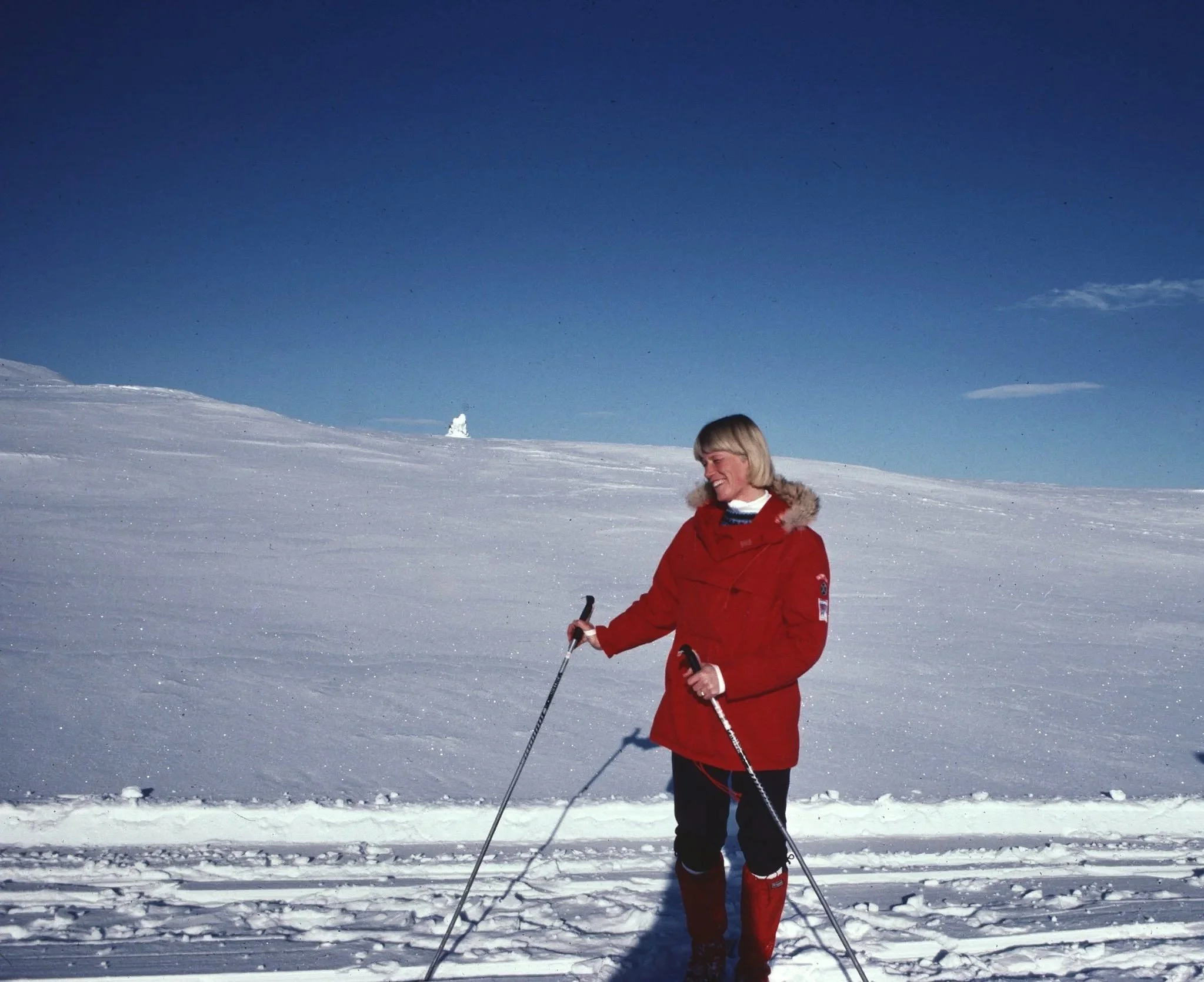
Lovely Fagerhøy Fjellskole INstructor
Norwegian is a curiously understated language. Along with its extra letters and indecipherable sounds, it is inherently modest. For example, "ski tour" translates to a fast twenty-five kilometers before "lunch." And “lunch” itself is traditionally a banquet consisting of two soups, a dozen salads, a roast, poached salmon and baked trout, casseroles, vegetables, numerous breads, cheeses, and desserts all followed by coffee. Dazed by “lunch’s” caloric overload, Michael and I could only manage a slow ten kilometers through the rolling forest above Dalseter.
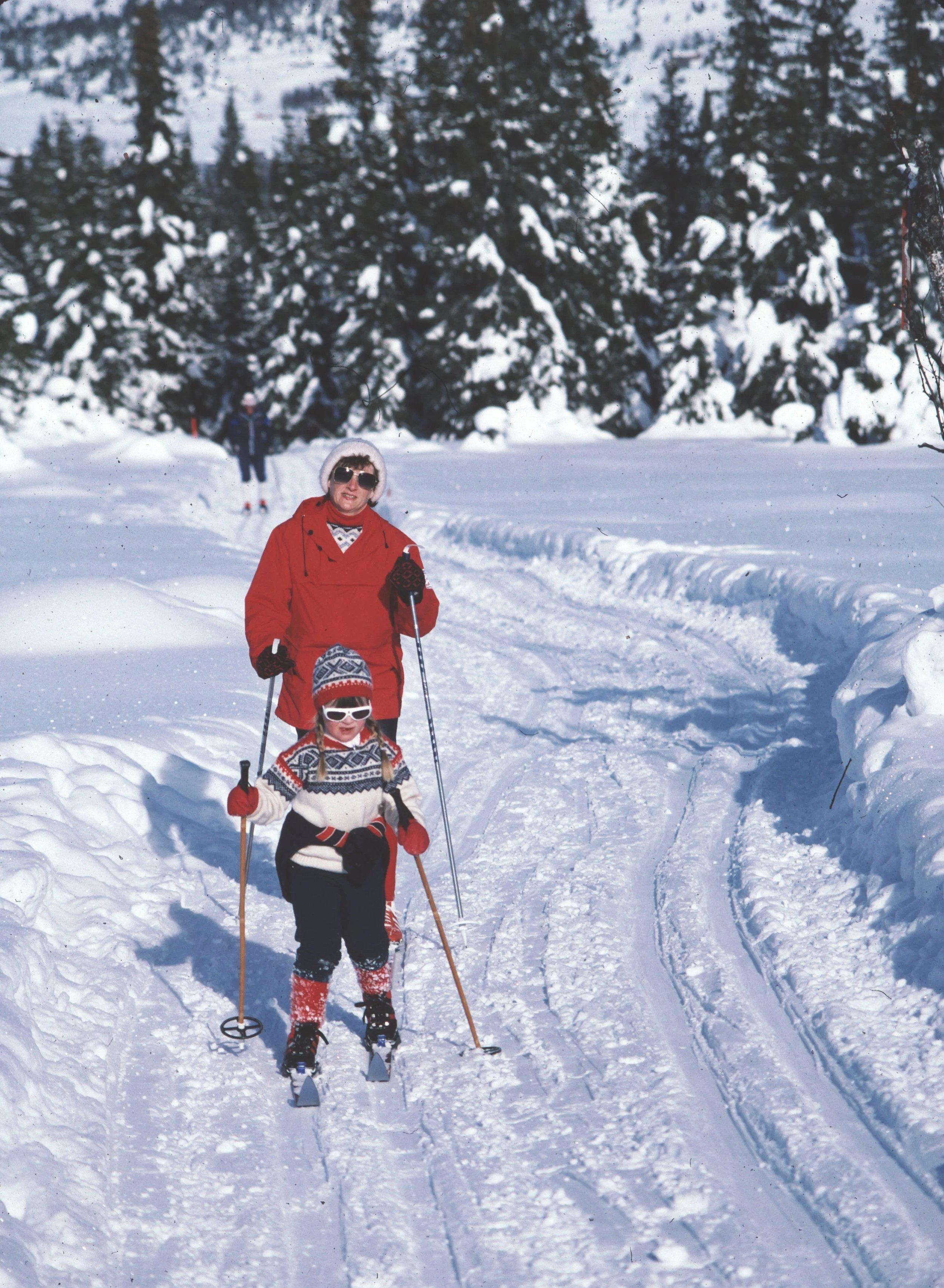
The following morning, we left our bags at the Dalseter's reception desk from where they would be forwarded to Gålå. We then stepped into our skis and, carrying only a day pack with an extra windbreaker, a thermos of tea, and a sandwich, skated toward the first gentle uphill. At 10 A.M. the air was brisk, the skies were clear, and following Eric, who insisted on accompanying us to ensure that we didn't miss a critical turn, we settled into a track that crossed a low forested saddle between Dalseter and Fefor. The Gulf Stream follows Norway's west coast, and though the thermometer can occasionally plummet, this beneficial current helps to keep temperatures in the teens and twenties. Though 1985 was reputed to be the coldest winter in a century, I was comfortable in polypropylene long underwear, a racing suit, and a Patagonia waterproof shell.
It’s no secret that Norwegians love the outdoors. Storm or sun, the long breakfast tables laden with eggs, cereals, sausages, toast, rolls cheeses, kippers, fruit, fresh cream, and cold cuts are deserted by nine A.M. Despite the immense meals, however, no one seems to gain weight. In ten days, though some must surely exist, I never saw a fat Norwegian. The secret is exercise. On weekends Norwegians are on the move—a mass migration trekking through the forests and' across the rolling snowfields. From children towed by their parents to senior citizens making slow but steady time, the tracks bloom with bright Lycra suits
By the time we returned to the hotel, the sun had set and after a sauna and swim, we joined Erik for “dinner.” “Lunch” paled in comparison to “dinner.” We quickly learned that restraint was key to keeping from gaining a quick fifteen pounds.
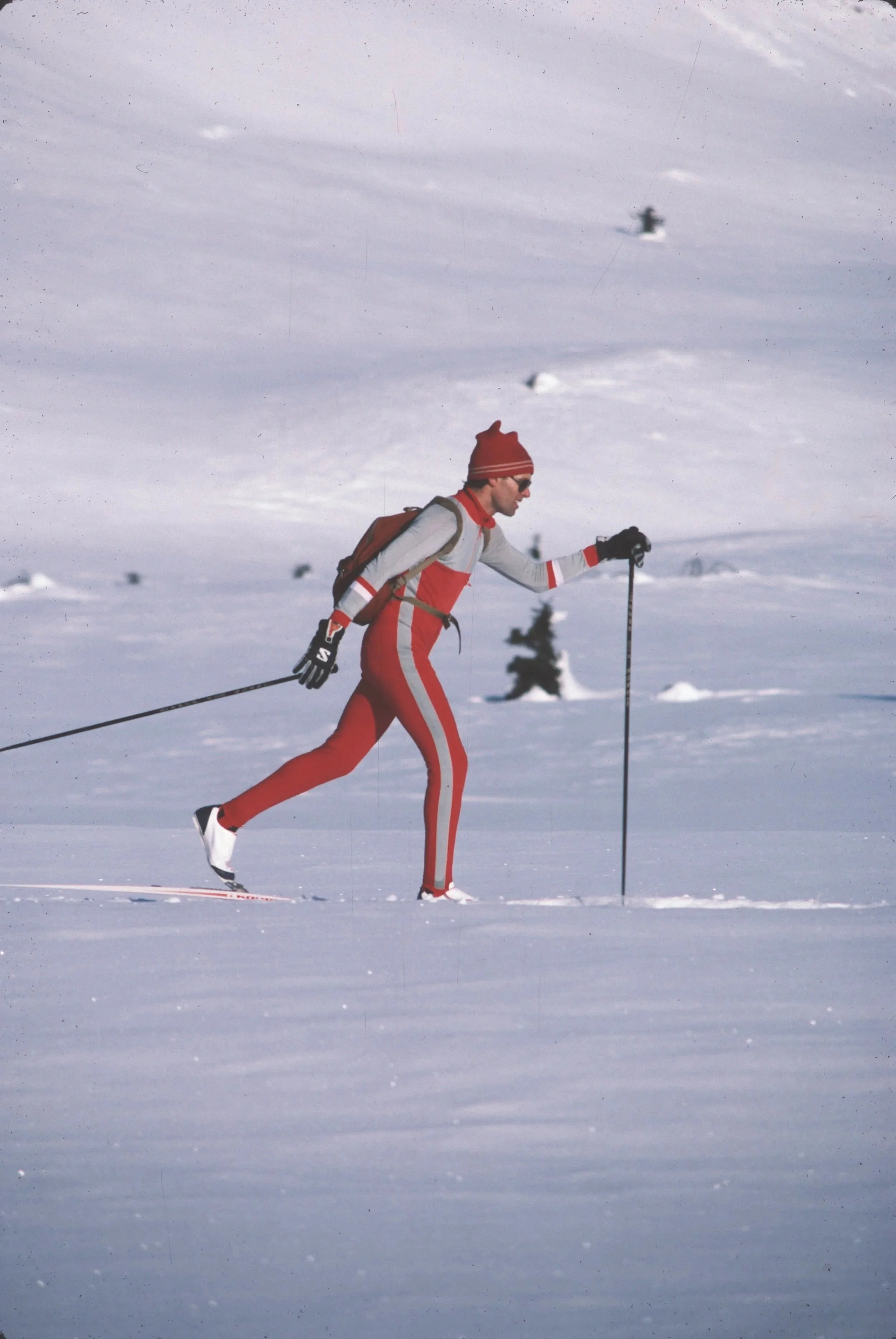
Andrew Skiing Peer Gynt Trail
Eric advised us that the best time to ski is from late February to late April. "Much depends on the snow," he said. "If we get a prolonged warm spell in April, the bottom falls out and you break through. In April, however, you have longer days and few worries about the cold."
Modern racing skis represent a high-tech miracle. Light, strong and efficient, the skis cease to exist once you settle into a rhythm. In the beginning Eric voiced reservations about using them to ski the Peer Gynt. "In tracks, of course, nothing can match these racing shoes and skis," he touched my Karhu skis with his pole. "When the sun shines and the tracks are hard, these skis are an excellent choice, but in deep snow you will struggle." Erik reminded us that the Peer Gynt is only one hundred miles from the ocean. “Storms develop quickly, “ he said. “With nothing to impede the relentless winds, snow falls sideways. Away from the forest, white-outs are common and skiers who lose the track are in serious trouble.”
One unstated beauty of the Peer Gynt Trail, however, is that the hotels allow skiers to wait out bad weather.
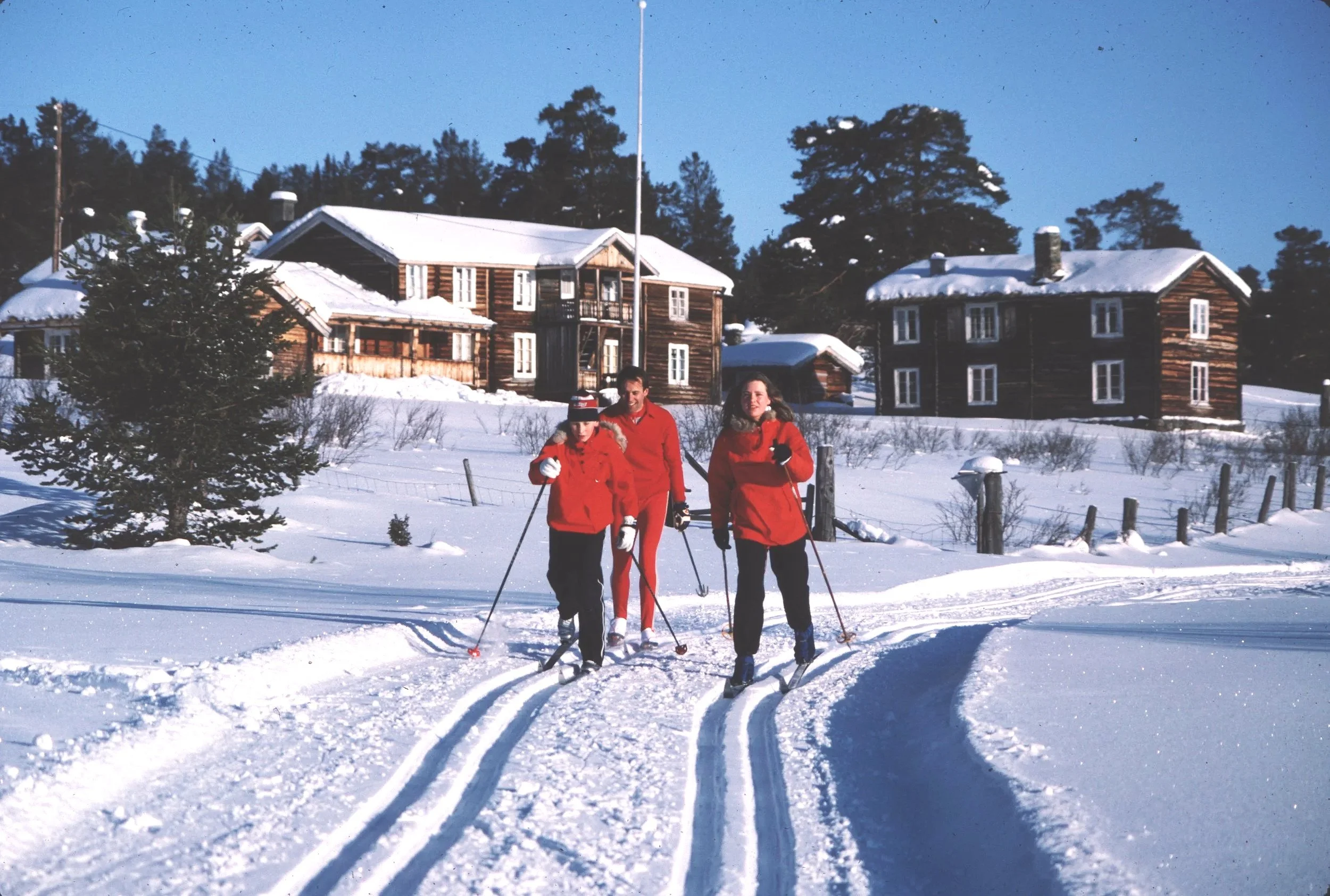
In time Erik pointed to Fefor that sat on a small, wooded rise eight kilometers below our high vantage point. Wishing us a successful journey, he then returned via a ridge route back to Dalseter. Before the day was over he would ski thirty kilometers and only count it a fair workout. From the ridge where Erik left us, Michael and I descended rolling hills and moved across. an open lake before reaching Fefor at one that afternoon. Contained within a three-hotel hamlet is a small alpine hill, a vast track system, several restaurants and bars, a pool, sauna and a weight room that appeal to families who provide the majority of bookings in the Peer Gynt hotels.
It is not uncommon to see three generations sitting at the same dinner table. Evenings tend toward conversation, chess, and route planning, but after our thirty-eight kilometers followed by a sauna, a swim and dinner, we somehow didn't need to disco.In a direct line the Gålå Høgfjellshotell is roughly eighteen kilometers from Fefor and thirty-eight from Dalseter. Perched on a wooded hillside above Lake Galan, Gålå operates as a destination resort. The last leg of the Peer Gynt, from Gålå to Gausdal alternately winds for thirty-five kilometers through thick forests open plains and rolling hills. Because it takes six hours, we stepped into the tracks at nine. That night a rapidly moving low pressure system coated the trees with a pillowy rime where only sound was the hiss of skis through the untracked now.
If the weather cooperates and a skier is in good shape the entire Peer Gynt Trail can be covered in two very long days. That pace, however, changes what should be a pleasant tour, into a Nordic marathon. The beauty of the Peer Gynt is in the chance to explore the country around the individual hotels. The ideal itinerary needs six days that alternate a day travel with a day at each resort.
It was past noon on our last day when we stopped for lunch at the Fagerhøy Fjellskole. Located halfway between Gålå and Gausdal Føyjellshotel, this remote cluster of buildings functions as a private ski school where children from eight to mid-teens learn both skiing and winter survival techniques. Though it does not accept overnight guests, the owners invited us in and for the next hour we lingered in the warmth of their sunny dining room.
Due to the distance, we needed to keep moving and soon we were back in the tracks that stretched across the rolling plateau toward the Gausdal Føyjellshotel. From Fagerhøy to Gausdal the landscape has been flattened by successive glaciers. No trees break the smooth horizons and only rolling hills lend definition the endless snow.
The tracks had been set that morning, our wax was perfect, and Michael and I abandoned ourselves to the skiing. This was as good as Nordic skiing gets. Combinations of shallow valleys, circuitous climbs, and open plateaus appeared to challenge us and when a trail sign pointed down a long slope to the distant Gausdal Høyfjellshotel, we realized that just as the Peer Gynt had a beginning, unfortunately, it also had an end.
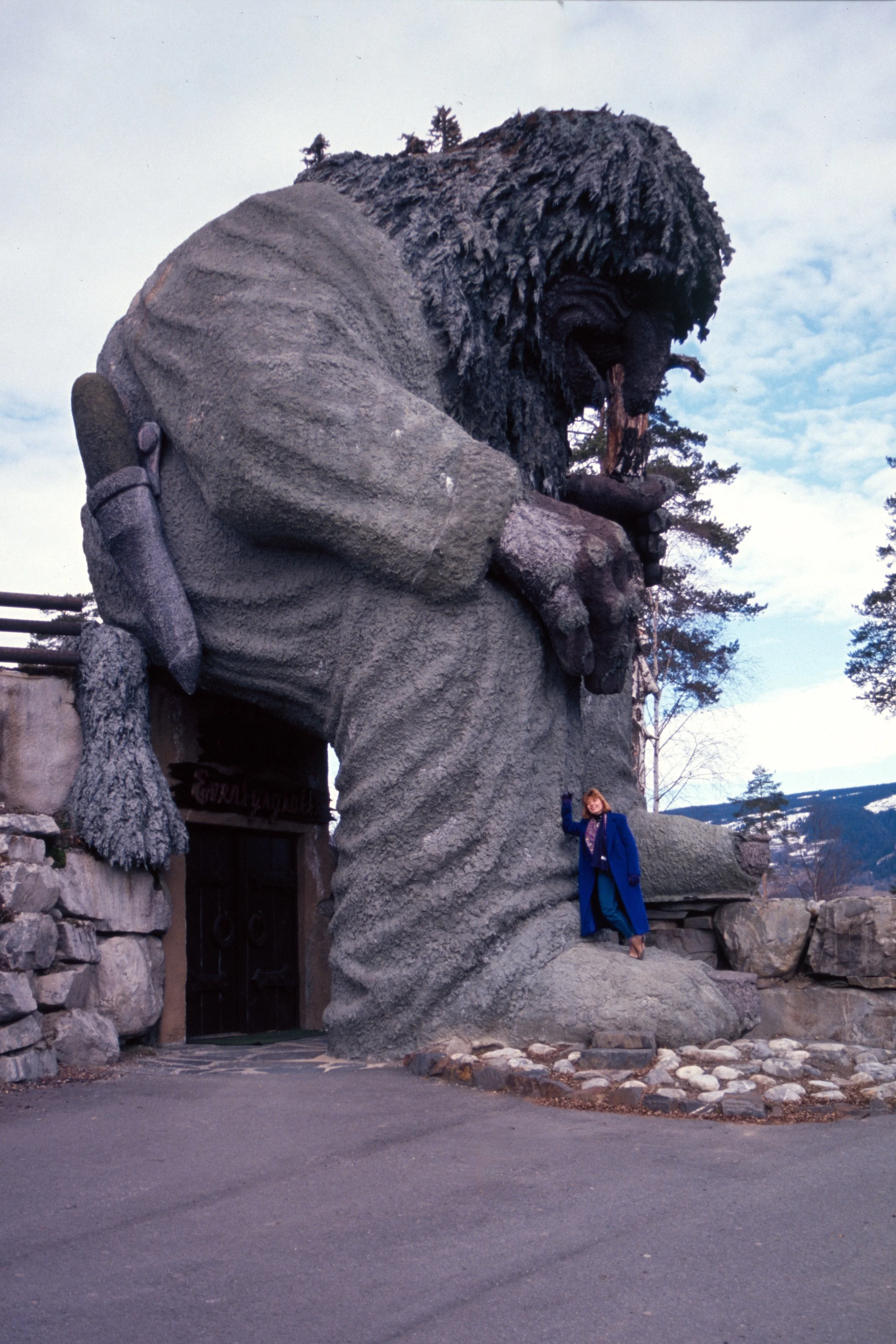
Over a candlelit dinner that night in Gausdal I remembered in the first incandescent hour we skied from Gålå into the rising sun, I caught a peripheral flash of movement among the snow-sculpted pines. And though it left tracks like a grouse, I swear it looked like a troll.