
A Midafternoon Winter’s Dream
I cannot claim that I discovered the truth about fishing Chamois Nymphs in ice-choked rivers. It was Scott Morrison who, one Sunday afternoon in early February whip finished the flesh-colored fly in his tying vice and dropped it in my hand. Studying the nymph’s grub like shape, he noted, “This fly is the right size, shape and texture,” Then, as if it were a talisman blessed by forces that control fishing luck, he added, “Huge trout won’t be able to resist it.”
To understand why sane men and women will wade into the ice choked Wood River when duck hunters scatter decoys across Silver Creek you must realize that fly fisherman are an obsessive breed. Consider the equipment they need to catch a six-inch trout. Rods, reels, waders, nets, vests, float tubes, books on streamside entomology, floats, sinker, tippets, clippers, hemostats, repellents and a new SUV to haul it all to distant and un-named streams. And that doesn’t include flies. Thousands, even ten thousand of flies. The list of fur, feather and floss imitations is long, varied, often impulsive and invariably expensive.
When I find a fly that works, one as exotic as a Moonlight Bivisible, Bead Eyed Deep Diver or Mink Haired Trout Trapper…or as pedestrian as a Royal Wulff, it eventually claims a place of honor in the upper left-hand corner of my fly box. I’ll confess that Morrison’s faith in his work of art carried some weight but until the Chamois Nymph proved itself, I stored it among the rank and file--flies that had been tested, found wanting and returned to the box without honor.
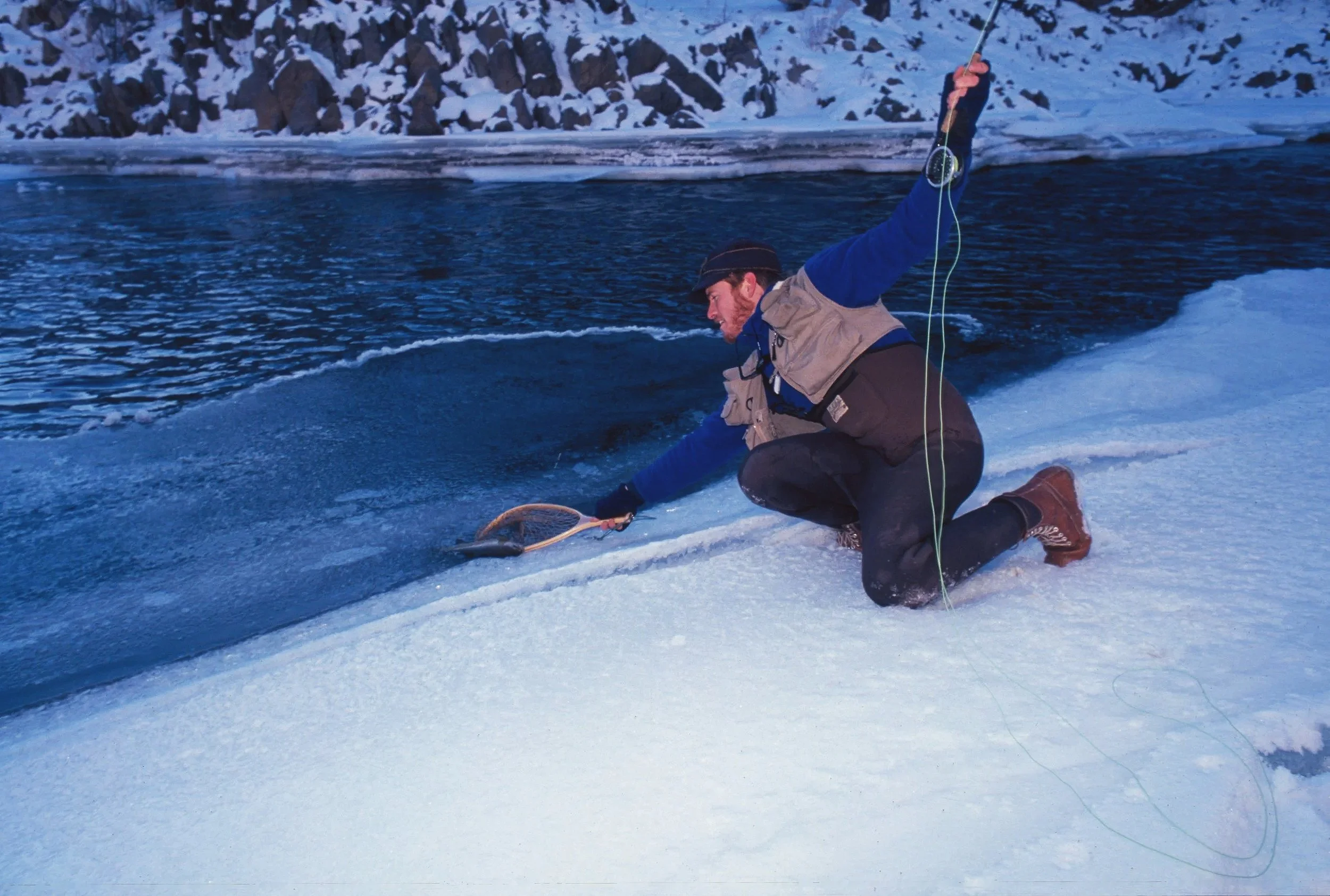
Scott Morrison with Wood River RAinbow
Until Scott and I broke trail through two feet of snow to the Wood River’s icy bank, I would have bet five hundred dollars that fly-fishing was strictly a summer sport, best practiced when Caddis clouded the Wood River, or Brown Drakes tacked across Silver Creek’s mirrored surface. Then too, it was simply not a day to be afield. The cold pushed through layers of Gore-Tex, pile and neoprene as we stumbled through dormant thickets of wild roses to the river’s bank.
Aside from the cold, there were other reasons why the Wood was deserted on that early afternoon. In a process repeated throughout the winter, the Wood had frozen then thawed, stacking blue cards of pressure ice against its steep banks.
Not surprisingly, the entry into the knee deep current was equally as dicy as the hike in. With the water temperature hanging a few degrees above freezing, I placed my feet like chess pieces, testing the slick river rocks before committing weight to my wading shoes.
While summer along the Wood River explodes with riotous tangles of leaves, bird song and pairs of mule deer fording the river, winter whispered of survival. White aspens and black cottonwoods stood in skeletal relief against the gray ceiling of a building storm. Except for a lone Ouzel dipping in open riffles and a single Mallard whistling overhead, the river was devoid of life.
morrison Hooks and Releases Winter Rainbow
“Cast that nymph to the head of the pool.” Morrison advised me. I still do not know what Morrison’s Chamois Nymph variant imitated. My best guess is a caddis pupa but, for all I know, it could be an Australian Digeree Grub. The white line and hair fine tippit floated the pale imitation into an upstream riffle where the current tumbled it back down into the pool.
The nymph should drift not drag and I mend the line by rolling the rod tip upstream. It is an unthinking process; this mending and I study the drift for any hesitation until the line sweeps out the bottom of the pool. The fly settled into the deep water where trout would be hanging on the drop off into the pool.
The clouds that have been threatening slowly lower and it starts to snow. The flakes weightlessly collide with my rod then spin into the dark current. I am surprised by how quickly the water freezes to the ferrules. Continuing to cast, I ignore the ice until it locks the floating line in place then, one by one, free the ferrules and take a step closer to the head of the pool.
As the storm intensifies, I search for midges among the spinning flakes and watch the calm water for rises. Among all outdoor sports, fishing is neither weather, nor season dependent but more based on timing and focus. Fish respond to the mating rituals of mayflies, the mechanics of Gulf of Alaska low pressure systems, the moon’s gravitational pull, the ebb and flow of deep strata springs and a dozen other factors, some knowable, most mysteries.
Wading upstream it occurs to me there is another difference between summer and winter. The lack of people. Except for the trophy houses that litter the Wood’s banks, the river is empty and pristine. In summer I have watched otters and beavers ride the current, but those animals that don’t hibernate, or live beneath the snow, have migrated out and if do I cut a set of fox prints, they are days old.
Considering the effort Morrison has gone to--tying up half a dozen Chamois Nymphs and guiding me to his secret spot, I uncharitably realize that I could be cutting fresh tracks on Baldy’s high faces. Hard core fly fisherman, however, point out that when skiing is good, fly-fishing is better. In truth it’s a tough choice. Trout are creatures of the cold, seek dark deep holes in the summer or wait at the head of still pools when ice chokes the banks. A snowstorm’s relatively warmer temperatures trigger hatches that, while they cannot compare to summer’s entomological fecundity, draw trout to the surface. To oversimplify the equation, winter is a harsh, killing season, trout must feed and when temperatures soar above freezing, will rise aggressively to insects, or anything that approximates an insect.
Standing knee deep below the River Run Bridge or above Hulen Meadow’s drop structures, Morrison knows huge trout that haunt summer’s cold blue holes, feed without fear in winterís ice free pools. Northern Ice fisherman with their augers, cans of corn, worms and heated shanties have known all this for a century.
I was starting to think that Morrison and I were wasting our time when I saw a brilliant flash of rainbow red at the head of the pool. Gently raising the rod tip, I felt the #14 hook find a purchase in the troutís jaw as, a second later, the rod bent to the rainbow’s weight.
I once believed I could judge the weight and length of a fish by how it resisted the hook. But fish are as different as the pools and rivers they inhabit and because one fish hunkers down and shakes against the barbless sting does not mean the next won't pour on the power and exit downstream.
The Chamois Nymph miraculously holds, the fish stays out from beneath the ice and a minute later a sixteen-inch hen seeks the eddy down stream of my waders. Gently removing the hook I admire her brilliant color and turn her loose.
It must be hard for Morrison not to gloat, to parody my doubts. Instead he simply says, “Real nice fish.”
There is pacing in the February afternoon. Making my way upstream I cast, then retrieve, take a step, then cast again. There are places where the ice reaches into the river's deep pools and I am forced to creep onto the bank, then glissade into the water further upstream. I cannot claim the action is red hot. But if I do not land a twenty-inch fish, the rainbows I do hook fight strongly as the light gently fades from the high ridges to the river. The storm abates, the snow stops and when we can no longer see to cast, we climb out of the Wood and posthole through the February drifts to the truck.