Fly Fishing Kamachatka’s Spring Fed Nikolka
I was casting a red fly to a Silver Salmon when Ingo Skulason, pointed to the ancient cedar coffins. Excavated by Eastern Russia’s Kamchatka River three had broken open spilling their contents into the water. Two others, however, protruded from the gravel bank where, balanced precariously between the overlying meadow’s dense thistles and the resting salmon, their square ends had been knocked off exposing the leather shoe soles of the long dead occupants.
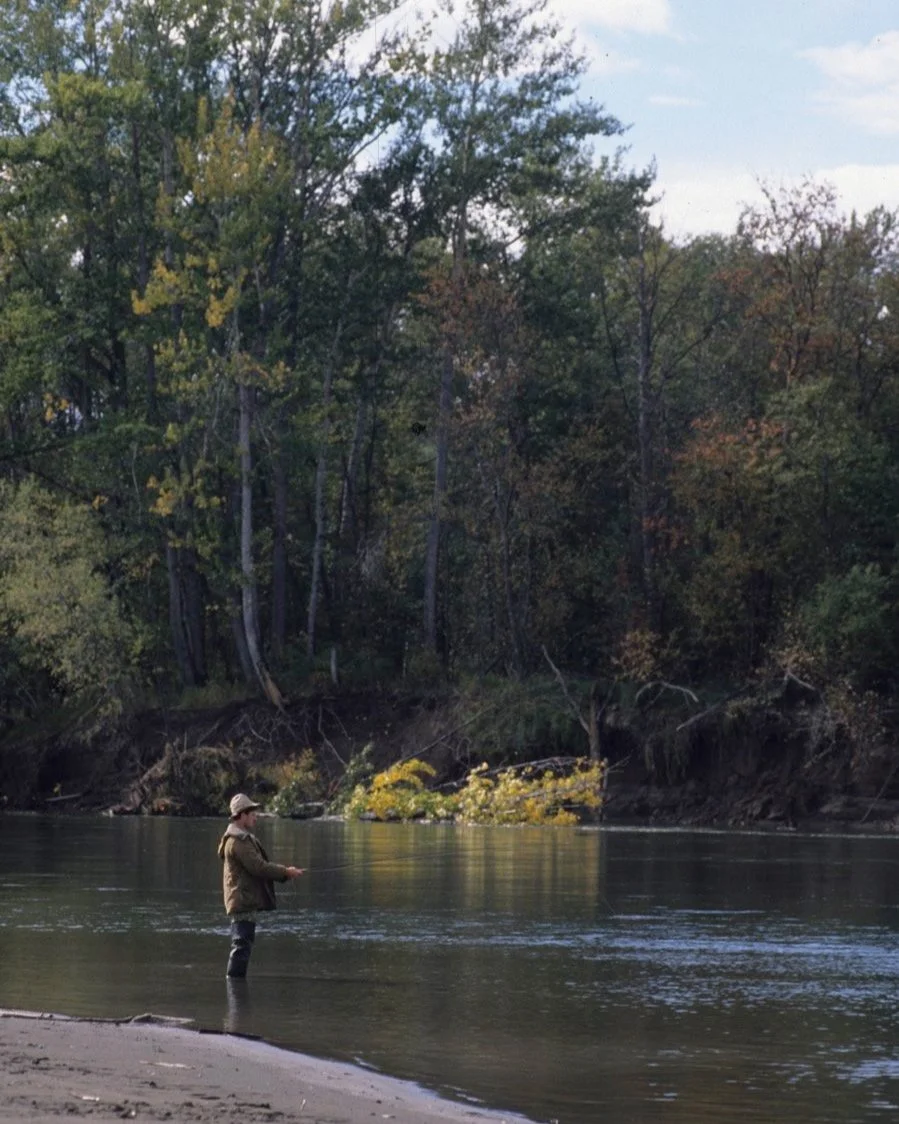
The Nilkolka River pulsed with Pinks, Coho, Chum and Sockeye Salmon all rushing upstream to the tributary gravel spawning beds
While on assignment for International periodicals I wrote and photographed hundreds of adventures.
The following are a selection of my favorites.
Studied from the helicopter, the warm morning sun has ripened corn snow across two hundred and fifty thousand acres of bowls, chutes, ridges, glaciers and cliffs.
It was early afternoon when we climbed into the Mackenzie boats below White Bird. Tying on Wee Worts and Hot Shots we were still within sight of the launch ramp when Mick’s rod suddenly arced toward the dark water.
We did not expect to catch anything that early morning in January. The guides who met us in a greasy spoon couldn’t promise we’d get a bite, much less land a fish, but they were willing to try if we’d be ok waiting for a fight that might never come.
Decades of salt air exposure had painted a patina of rust over the Model 11’s original bluing. The stock was scarred and loose, the forearm checkering was worn and the rubber recoil pad was brittle with age.
He did not know why he found it more comfortable to sleep with his hands raised to the ceiling. A doctor claimed his shoulders had been separated then separated again until they now slid in and out of their socket like worn eight balls at a Gooding pool tournament
I have watched the riders for two decades. In that time, the bikes have grown lighter, more complex. Carbon fiber frames, electric gearshifts and perfectly spaced cassettes where the chain flows seamlessly from one cog to the next, all serve to shave ounces and increase power.
A flash of yellow squirted through the grass and I am blistered by the acrid stench of burning tires. Other than profanity, there is no describing the skunk’s blindingly strong smell.
“When you hear this rattle again, turn around and walk carefully away.” I told the boys, who begged me to grab the old rattler and stuff it in the cooler.
Koa and Makaha traced their ancestry to Kaimana, Hawaii’s first Royal Rooster. The shining black Cock had finished his second molt when he was taken from the King’s farm on the Marquesa’s island of Nuka Hiva and caged aboard a seagoing canoe for the perilous voyage north.
I wonder, in the scheme of a state budget, if trout are less valuable than forests? It takes years to grow a big rainbow and a helicopter with a bucket could easily fly the breeders to nearby spring fed streams. But the Fish and Game is as stressed as the fish and need to balance the cost of helicopters against the loss of these big fish, their public relations value and the number of tourist dollars they bring to Idaho.
Earl Holding had given three interviews in fifteen years. I figured there would be little or no chance he’d sit down for a fourth. When my land line rang on a late winter day, I didn’t recognize the voice. “Wally said you’re a straight arrow.” Earl Holding greeted me. While I tried to maintain a journalistic distance, in all honesty, I was flattered.
Knees have always been a cyclist’s nemesis, the weakest link in a dependable power train. Like a pitcher’s shoulder, or a runner’s hamstrings, when knees fail…game over.
For tens of thousands of years, altitude and isolation helped protect the Snake Range’s Bristlecones. Then, in 1964, while studying the last ice age on 13,000 foot Wheeler Peak, a University of North Carolina doctoral candidate broke his boring tool in what back packers called the Prometheus Tree.
Stirling Moss, who raced Maseratis in the 1950s and ’60s, said “I only know about cars and women………..and I can’t see one thing bad about this car.”
This is not what I expected from Arizona. Not snakes in caves, or war shirts with power or snow that blows over your head.
Dave Ashby’s future beckoned from the knife edge ridge of New Zealand’s Grand Divide. To reach it, he needed to navigate through the Fox Glacier’s labyrinthian crevasses.
Arnold Schwarzenegger on skis is a force of nature. It is his expression that speaks volumes–the Terminator’s single-minded sense of purpose that refines the image of a 225 pound, six foot two, granite boulder bouncing from edge to edge.
The road to La Grave is sheltered by concrete sheds and stoplights to restrict travel when avalanches drain from distant and unseen cirques. More than the slides, however, it is La Meije’s extreme, unpatrolled terrain that discourages all but the crampon and guide pack crowd.
Line poured off the level wind reel as, thirty feet downstream, a steelhead tumbled across the surface in frantic splashes of rose and silver. Watching Dan pump and reel, it seemed a miracle that this steelhead had crossed eleven dams in its 1,000-mile migration from the Pacific.
On the Corso Italia, the passeggiata is drifting languidly past the storefronts filled with bright ski suits, gold jewelry, books, film and postcards depicting Cortina draped in heavy snow. This evening ritual provides a fitting stage to meet Cortina’s beautiful people.
Standing on a boulder in the middle of a nameless river that swirls like hot oil, I am surrounded by rising Speckles–brilliant, broad backed fish that, until this moment have never seen a dry fly.
Watching the unbroken snow rise to meet me, I realize that much of my adult life has been defined by Bald Mountain. Without the influence of expert runs that plunge from its broad ridges, I might have spent my life in the pursuit of more worldly, but far less rewarding goals.
The moon is said to affect the blood in the same way it pulls at the tides and I wonder if, while finning beneath the dark over hung bank, Browns feel the same quickening, that betrays a need to breed and feed.
Rock. The man liked the name. Defined by hard consonants with the barest nod to a minor vowel, the Jack’s name conjured a short, tough, light middleweight who could take a punch.
During the winter of 1974, Hemingway’s impact on literature and writers had yet to be fully realized. The tourists had yet to leave Cuban cigars, empty shell cases, or glasses of red wine on his grave in the Ketchum Cemetery. The Nature Conservancy had yet to purchase The Hemingway house that overlooked the swimming hole upstream from the Warm Springs Bridge but now sat empty and haunted beneath a leaking roof.
“……there was a great glacier run,” Hemingway wrote. “forever straight if our legs could hold it, our ankles locked, we running so low, leaning into the speed, dropping forever and forever in the silent hiss of the crisp powder. It was better than anything else.”
Robert is fearless…a fact that concerns me when I think about the skier who died today on the Gornergletscher. Witnesses reported he was twenty feet away, linking turns on a gentle, sunlit slope when the powder suddenly collapsed into an enormous blue cavern.
We come to the dove blinds by way of a dusty dirt road that passes small, stuccoed farmhouses where sleeping hogs litter the front yard, horses sleep on their feet in poor corrals and gauchos push cattle off the road to allow us to pass.
From a distance Suicide Point resembles an outlaw’s weathered face. Disfigured by the trail’s gray scar running across nose, cheek and jaw, in September’s 100 degree heat, its 800 vertical feet serves as the last major barrier to Gracie Bar.
Muskies are ambush fish and, as such, are both extremely territorial and cannibalistic. The biggest defend clear, quiet water filled with submerged weed beds, sunken stumps and logs. Lying in wait for hours, they’ll attack fish, frogs, snakes, mammals, ducks or, less often, feet and hands that are carelessly dangled off boats and docks.